

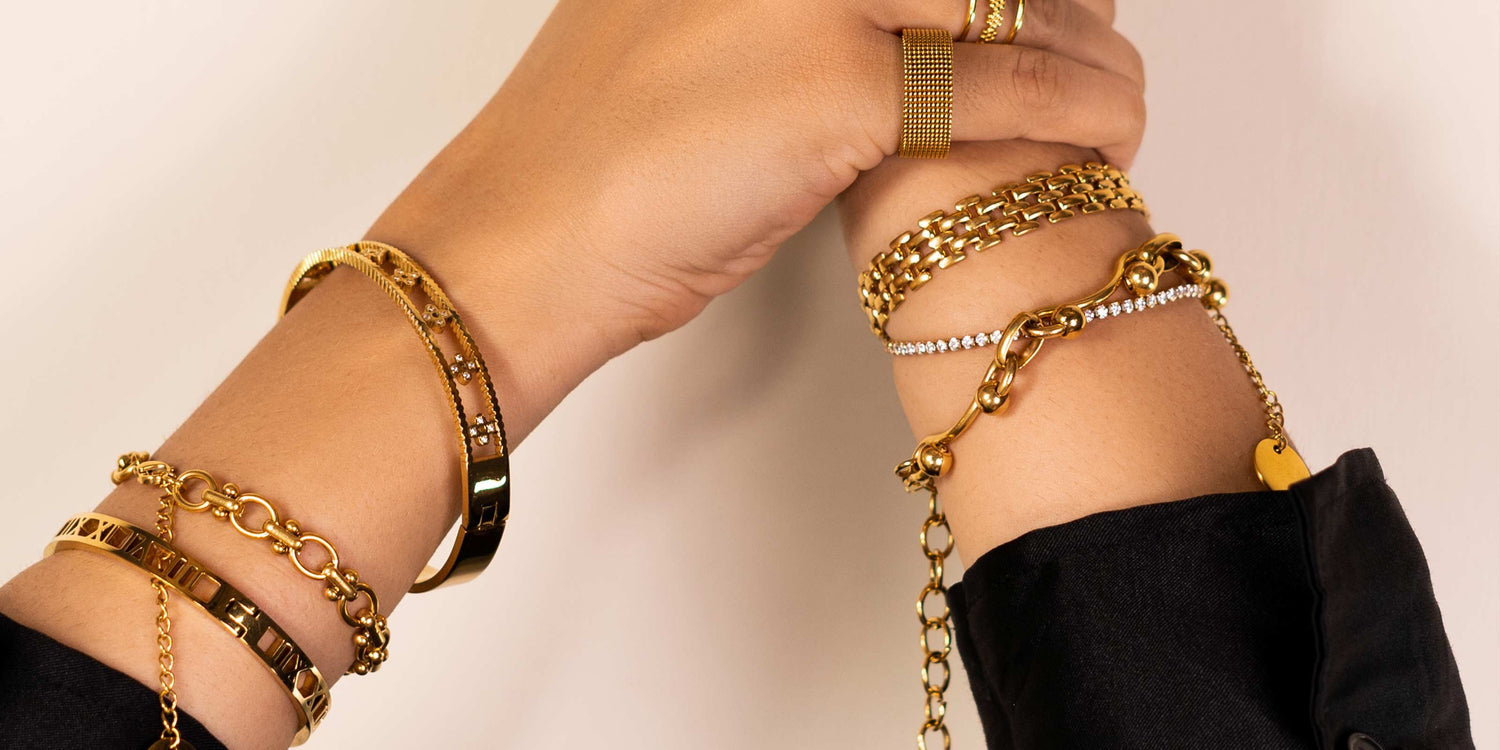
There is a specific kind of wrist that looks effortlessly put together — three pieces, each distinct, all somehow reading as one deliberate decision. And then there's the version where four bracelets went on at once and none of them are talking to each other. The difference between the two is almost never the pieces themselves.
Why wrist stacking is harder than ring stacking
Ring stacking works because each ring is small, the visual field is compact, and proportion differences between pieces are easy to read at a glance. A wrist is a longer, wider surface that moves constantly throughout the day — every bracelet on it is in motion relative to the others, and pieces that looked balanced sitting still on a desk can look chaotic once the wrist is actually in use.
The other variable is weight. Three rings on a hand add maybe 6g of combined weight and don't affect how anything feels. Three bracelets on a wrist can add 30g or more, and the combined movement, sound, and sensation of that changes how comfortable the stack actually is to wear through a full day. The pieces that work on the wrist for six hours aren't always the same as the ones that look best in a photo.
The three-piece framework
Most wrist stacks that read as intentional follow a loose hierarchy of three distinct elements — not three of the same type, and not random variety, but three pieces that each do a different visual job.
-
One structural pieceSomething with visible form — a cuff, a tennis bracelet, a bangle. This is the anchor of the stack, the piece the eye lands on first. It should be the heaviest and most visually defined piece in the grouping. A tennis bracelet or a solid cuff both work here — the key is that this piece has enough presence to be the lead rather than just another layer.
-
One chain pieceA thinner, more delicate chain bracelet that moves freely and catches light differently from the structural piece. This is what creates visual contrast without competing for attention. A chain link bracelet in a lighter gauge sits naturally alongside a heavier structural piece without either one drowning the other.
-
One accent pieceSomething small and specific — a charm bracelet, a thin plain band, a minimal ring worn at the wrist if that's your preference. This is the finishing element, and deliberately keeping it understated is what stops the stack from reading as too much.
What actually makes a stack work on a Pakistani wrist day-to-day
The visual hierarchy above is the starting point, but daily Pakistani life adds variables that don't come up in styling guides written for anyone else. A wrist that needs to do wuzu, type for hours, carry a dupatta, and survive a summer commute has different practical requirements from one that only needs to look right for a photo.
Stainless steel pieces stacked together don't cause the galvanic corrosion between dissimilar metals that happens when brass and stainless steel sit against each other under daily sweat. Mixed-base stacks look fine at first and tarnish unevenly within weeks. The bracelets buying guide covers why base metal choice is the most important decision before building any stack.
Under 30g total for a stack worn through a full day. Above that, the constant movement of multiple pieces becomes noticeable during desk work and typing. Checking individual piece weights before stacking is worth doing — most sellers state it when asked. The weight and comfort guide has the full breakdown by piece type.
When multiple clasps end up on the same spot of the inner wrist, they stack against the skin and become uncomfortable within an hour. Deliberately offsetting clasps — wearing one bracelet with its clasp at the top and another with its clasp at the side — prevents this entirely.
A stack of loose-fitting pieces that water passes through freely is much simpler to manage during wuzu than a mix of tight and loose pieces where some come off and some don't. Building a stack of consistently loose-fitting pieces is a practical decision for anyone praying regularly throughout the day.
Stacking for specific Pakistani occasions
For office and daily wear, two pieces rather than three is the more practical baseline — one structural piece and one chain, leaving the wrist mobile and quiet. A three-piece stack for an office day works if all three pieces are lightweight and none of them jangle. The daily wear bracelet guide covers which styles hold up through a full workday specifically.
For shaadi season and events, a fuller stack reads more naturally against formal Pakistani dress — three to four pieces, with the structural piece doing more visual work and the chain pieces providing the layered movement that complements embellished fabric. The key difference from daily wear is that event stacking is worn for a fixed number of hours rather than a full day, which gives more room for heavier or more decorative combinations.
For casual everyday wear — kurta, jeans, ordinary days — the most versatile approach is a two-piece stack that stays on regardless of the activity: a bangle and a chain bracelet, both in the same metal tone, both loose enough to slide freely. The bangles vs bracelets guide covers why a bangle and a chain pair better structurally than two bangles or two chains together.
Sizing a stack correctly
Each piece in a stack needs to fit on its own terms rather than being sized for a single piece worn alone. A bracelet sized at 17cm works fine as a standalone piece with the standard one-finger fit. In a stack where other pieces are also moving on the same wrist, slightly looser across the whole stack — 17.5 to 18cm — prevents the pieces from binding against each other during movement. The bracelet size guide has the measurement method for finding the right starting circumference before adjusting for stacking.
Frequently asked questions
-
Q1. How many bracelets should I stack at once?A: Two to three is the practical range for daily wear — one structural piece and one or two lighter chain pieces. Four or more works for event wear where the stack is on for a few hours rather than a full day, but becomes heavy and noisy for an all-day routine. Three is the sweet spot that reads as intentional without overwhelming the wrist.
-
Q2. Can I mix bangles and chain bracelets in the same stack?A: Yes — it's actually one of the most effective combinations. A bangle provides the structural anchor, a chain bracelet provides the flexible, light-catching contrast. The practical requirement is that both are in the same base metal to avoid uneven tarnishing under daily wear conditions in Pakistan's heat and humidity.
-
Q3. Does bracelet stacking work for office wear in Pakistan?A: Yes, with two conditions — the total weight stays low enough not to interfere with typing and desk work, and none of the pieces jangle during movement. Two lightweight pieces in the same metal tone is a clean office-appropriate stack. Three heavier pieces tends to read as too much for a professional setting.
-
Q4. Should all bracelets in a stack be the same gold tone?A: For a clean, deliberate look, yes — matching gold tones across the stack reads as intentional. Mixing warm gold with cool silver tones in a wrist stack is harder to pull off than mixing metal tones in rings, because the close proximity of multiple pieces on the same surface makes mismatched tones more visually obvious.
-
Q5. How do I stop a bracelet stack from tangling or scratching?A: Store each piece separately rather than in a pile, and offset the clasps when wearing so they don't all sit on the same inner wrist point. Metal-on-metal contact in storage causes the same scratching as metal-on-metal contact during wear. The jewelry storage guide covers the exact separation method that prevents this across all piece types.
Build the stack around one piece you already reach for
The stacks that actually get worn every day aren't built all at once. They start with one piece that already works — the chain you always put on first, the bangle that never comes off — and add around it. One structural piece, one chain piece, and restraint on the third is a complete wrist that reads as deliberate every time.
Shop bracelets to build your stack at mithraofficial.com

Leave a comment
This site is protected by hCaptcha and the hCaptcha Privacy Policy and Terms of Service apply.