

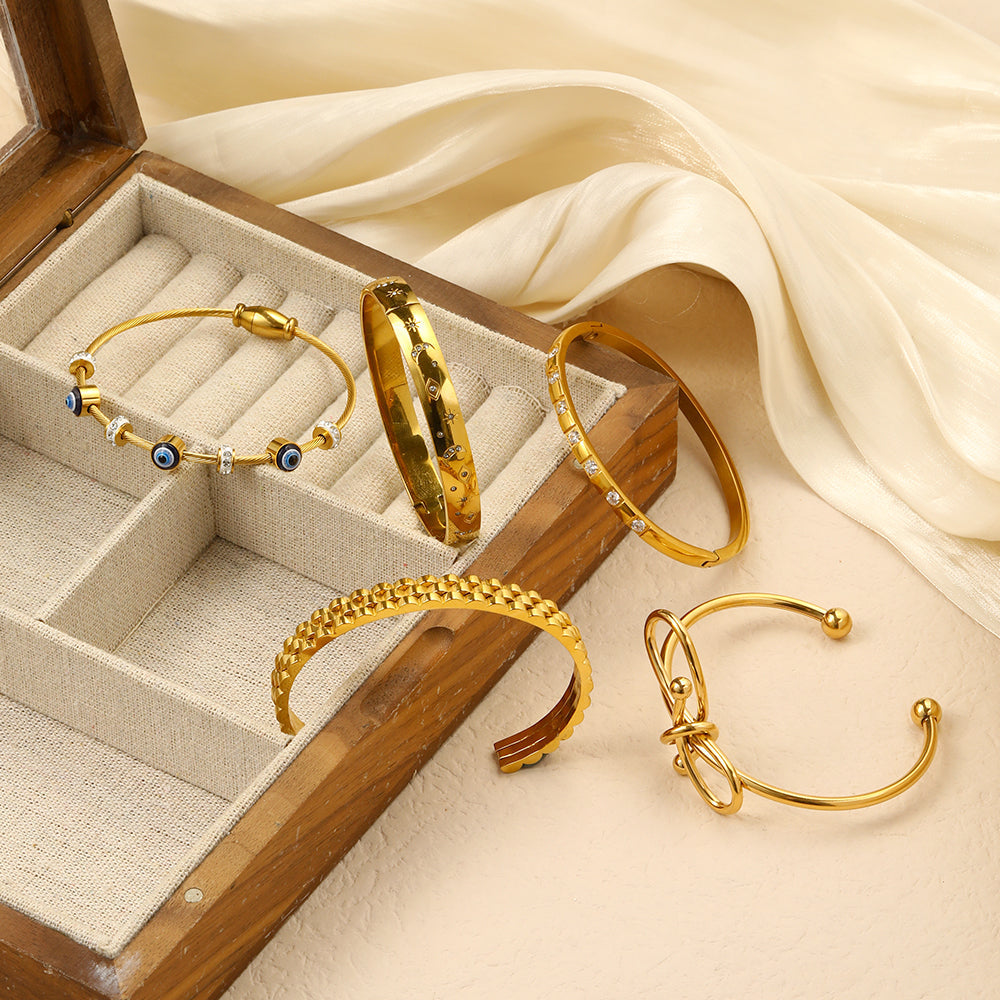
Why bracelets are the hardest test for any coating
A necklace rests against skin. Earrings move with the head. A bracelet on the dominant hand hits phones, keyboards, desk edges, bags, and clothing continuously, all day, with sweat trapped underneath it. That is why a bracelet shows the quality of its coating months before a necklace in the same material does — and why the buying decision for a bracelet needs more than "it looks nice". This guide covers the four checks that decide whether a bracelet is still on your wrist in a year, realistic lifespan by bracelet type, and which type suits which use.
The four checks before buying any bracelet
- Base metal, named. Stainless steel or 316L on the listing. Brass and zinc alloy oxidise under sweat where the coating thins — and on a bracelet that is the underside of the wrist, the sweatiest point on the body. Stainless steel does not react. If the listing says "alloy" or nothing, assume brass.
- Coating method, named. PVD stated explicitly. Standard electroplating at 0.5–2 microns wears through at the inner wrist and clasp within weeks of daily wear. PVD at 1–3 microns, vacuum-bonded, is the only plated finish that handles wrist friction for years. The full comparison is in gold plating types explained.
- Clasp quality. Bracelets fail at the clasp before they fail at the surface. A lobster or box clasp sized to the bracelet's weight; a spring-ring clasp on anything heavier than a petit chain is a weak point. If you remove the bracelet several times a day, a clasp you can work one-handed matters more than most buyers realise.
- Width and weight for your routine. Thin chains flex more and stress the coating at flex points; wide cuffs and bangles distribute contact but trap sweat. A bracelet that feels fine for ten minutes in a shop can feel heavy by the third hour at a desk.
Lifespan by bracelet type — the reference table
Bracelets sit at the high-friction end of the site-wide lifespan figures, and the type matters as much as the material. These are daily-wear figures in Pakistani heat and humidity.
| Bracelet type | Base and coating | Daily wear lifespan | Where wear shows first |
|---|---|---|---|
| Any style | Brass, electroplated | 2–8 weeks | Inner wrist and clasp, then green marks |
| Chain bracelet | Stainless steel, 18K PVD | 1–4 years (dominant hand at the low end) | Clasp and the links nearest it |
| Tennis bracelet | Stainless steel, 18K PVD | 2–4 years | Underside of the settings |
| Cuff or bangle | Stainless steel, 18K PVD | 1–3 years | Inner surface against the wrist |
| Petit / delicate chain | Stainless steel, 18K PVD | 2–4 years | Clasp |
Wear starting at the inner wrist and clasp is the normal behaviour of any coated bracelet, not a defect. Why Pakistan's climate pushes every figure toward the low end is in why gold plated jewelry fades; the realistic PVD figures for every jewelry category are in PVD jewelry explained.
Which bracelet type for which use
- Daily wear, office, university. A 2–3 mm chain bracelet or a petit chain. Light, flat against the wrist, quiet, easy on and off, and the longest-lasting type under daily friction.
- Formal without being festive. A tennis bracelet. Continuous stone setting reads polished on a bare wrist; bezel-set stones are more secure than prongs under Pakistani humidity.
- A single statement. A plain cuff, 8–10 mm. Slides on without a clasp, works in professional settings where a bangle stack would not. Wear it slightly loose in summer so sweat does not seal under it.
- Festive and traditional. Bangles in sets. Correct and expected at a mehndi or Eid; the sound makes them wrong for a quiet office.
- Layering. Keep every piece in a stack on the same base metal. Brass against stainless steel under sweat sets up galvanic corrosion on the brass piece.
Every type is explained in full — what it is, how it behaves, what to pair it with — in types of bracelets in Pakistan. The chain-shape question — Cuban, Figaro, Rolo, box — is in chain link bracelets. Whether you want a bangle or a bracelet at all is in bangles vs bracelets.
Sizing for an online order
Wrap a soft tape or a strip of paper around the wrist just below the wrist bone, add 1 to 1.5 cm for movement, and compare with the length on the listing. For a chain bracelet, check the extender range — most cover 2 to 3 cm, which removes the fit risk entirely. Bangles are different: they pass over the hand, so the measurement is knuckle width, not wrist, and there is no adjustment. For a gift where you do not have a measurement, a chain bracelet with an extender is the safe choice. The full method, including bangle sizing, is in the bracelet size guide.
Daily comfort — the test most buying guides skip
A durable bracelet can still end up in a drawer if it interrupts a Pakistani day: digs in during typing, fiddly to refasten if you take it off for wuzu, uncomfortable if you forget it before sleep. Durability and comfort are two different tests. The comfort side — clasp type, weight, fit in heat, what happens when you sleep in it — is in best bracelets for daily wear.
Care that actually extends a bracelet's life
- Wipe the inner surface after every wear. The underside collects more sweat than any other piece of jewelry. A dry microfiber wipe before it sits overnight is the single most effective habit.
- Products first, bracelet last. Perfume, sanitiser, and sunscreen on, absorbed, then the bracelet.
- Dry after water. Wudu, dishes, and hand washing are fine on stainless steel PVD; a wet bracelet left on is not. Rinse and dry after the gym; take it off for weights and anything abrasive.
- Store flat or coiled, in its own pouch. Never loose with other metal pieces.
The full routine is in the complete care guide.
What to avoid
- Any listing that does not name the base metal.
- "18K gold plated" with no coating method — that is electroplating.
- A spring-ring clasp on anything but a petit chain.
- Bangles bought online without a knuckle measurement.
- Mixing brass and stainless steel pieces in one stack.
- Very lightweight chains at a mid-range price — thin-gauge links dent and kink.
Every Mithra & Co bracelet is 18K PVD over 316L stainless steel, with both stated on the product page. Browse the bracelet collection — cash on delivery nationwide, 7-day exchange for sizing from delivery.
Frequently asked questions
Q1. Why do gold plated bracelets leave green marks on the wrist in Pakistan?
A: Copper in a brass or zinc-alloy base reacting with sweat where the coating has worn through at the inner wrist — the sweatiest, highest-friction point on the body. Stainless steel contains no copper and does not produce the mark.
Q2. How long do gold plated bracelets last with daily wear?
A: Electroplated brass: 2 to 8 weeks. 18K PVD on stainless steel: 1 to 4 years depending on type and which hand — a chain on the non-dominant wrist at the top of that range, a bangle on the dominant wrist at the bottom.
Q3. How do I measure my wrist for an online order?
A: Tape or paper strip around the wrist below the bone, add 1 to 1.5 cm. For a chain bracelet, check the extender range on the listing. For a bangle, measure across the knuckles instead — it has to pass over the hand.
Q4. Which bracelet type lasts longest?
A: Chain and petit chain bracelets, because friction is spread across flexing links rather than concentrated on one rigid surface. Cuffs and bangles wear fastest on the inner surface that sits against the wrist.
Q5. Can I wear a gold plated bracelet every day in Pakistan?
A: Yes, on 18K PVD over stainless steel. Wudu, hand washing, sweat, and desk friction are all within what it is built for. Wipe the underside after wearing and take it off for the gym and pools.


Leave a comment
This site is protected by hCaptcha and the hCaptcha Privacy Policy and Terms of Service apply.