

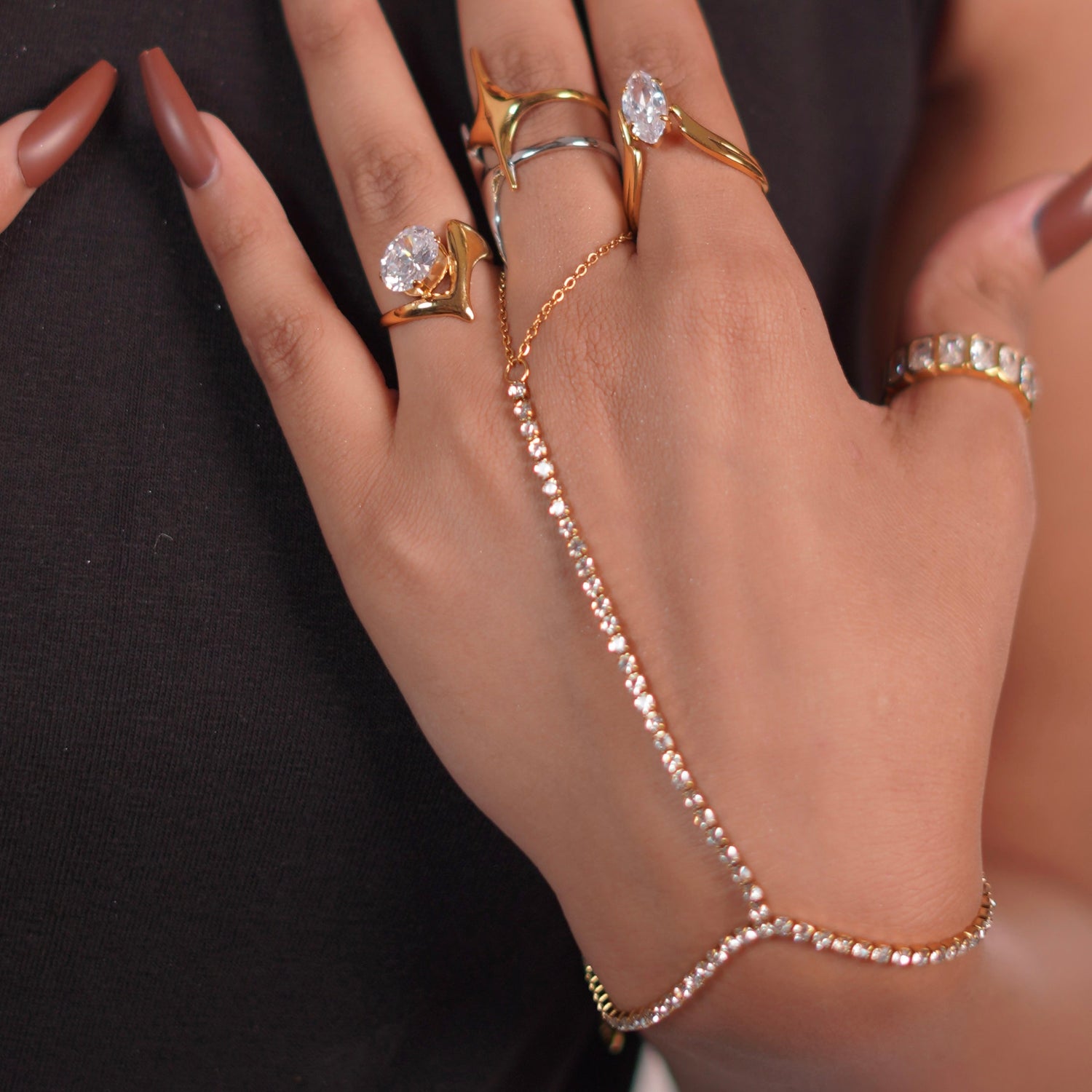
The setting matters more than the stone for daily wear
A tennis bracelet is a continuous line of identical stone settings running the full length of the wrist. The stone catches the light. The setting decides whether it stays on your wrist or starts losing stones within a few months — and the setting is the variable almost nobody checks before buying.
This is the companion to the tennis necklace guide, but a bracelet is a different wear test entirely. A necklace sits against the neck with minimal contact. A bracelet on the dominant wrist hits desks, phones, bags, and doorframes all day. That difference in friction is exactly why setting type and sizing deserve their own breakdown rather than assuming what works for the necklace works the same way here. For how a tennis bracelet compares to chains, cuffs, and bangles on friction and lifespan generally, see the gold plated bracelets buying guide.
Prong setting — the most common, the most exposed
Small metal claws hold each stone from the sides, leaving the most light through for maximum sparkle. It's also the setting most likely to catch on fabric, snag on a bag strap, or bend slightly from a knock against a hard surface — and once a prong bends, the stone it was holding is one sharp knock away from falling out.
Prong settings aren't a bad choice. They're the right choice for a bracelet you're not wearing through a full workday of typing and lifting things. For genuine daily wear in Pakistan's heat and constant hand use, prong settings need more frequent inspection than the other two options below.
Bezel setting — the one that actually survives daily wear
A continuous metal rim wraps fully around each stone instead of just gripping it at points. Stones in a bezel setting essentially cannot fall out short of the metal itself being damaged. The light through the stone is slightly reduced compared to prong, but the security trade-off is the right one for a bracelet that's going to spend eight hours a day against a desk, a steering wheel, and everything else a wrist touches.
If a tennis bracelet is meant to be worn daily rather than saved for events, bezel is the setting to look for specifically — not just any tennis bracelet, but one where the listing or photos confirm the stones are fully rimmed rather than claw-held.
Channel setting — the middle ground
Stones sit inside a metal channel with no individual claws above the surface. Cleaner and more modern-looking than prong, more secure than prong, less common than both in the budget price range. When a channel-set tennis bracelet is available at a reasonable price point, it's usually a good daily-wear option — the gap is that fewer sellers carry it because it's a more precise manufacturing process than prong.
How to size a tennis bracelet — the one finger rule
A tennis bracelet is rigid in a way a chain bracelet isn't. A chain bracelet that's slightly too big just hangs a little looser. A tennis bracelet that's slightly too big slides down onto the hand and the clasp ends up sitting wherever gravity takes it, all day, every time you move your arm.
The fit check: one finger, lying flat, should pass between the bracelet and your wrist with light resistance. Two fingers fitting easily means it's too loose. No finger fitting at all means it's too tight and will sit uncomfortably during the natural wrist flex of typing, gripping, or carrying anything.
| Wrist measurement | Tennis bracelet length to order |
|---|---|
| 13–14 cm | 14.5–15 cm |
| 14–15 cm | 15.5–16 cm |
| 15–16 cm | 16.5–17 cm |
| 16–17 cm | 17.5–18 cm |
Measure with a soft tape or a strip of paper at the widest point of the wrist bone, then add roughly 1 to 1.5 cm for the one finger fit. Most tennis bracelet clasps in this price range are fixed — a box clasp or fold-over clasp with no adjustment range — so getting the length right before ordering matters more here than it does for an adjustable chain bracelet. For the general wrist-measuring method that applies across all bracelet types, see the bracelet size guide.
Why the base metal question still applies here
A tennis bracelet has more total metal surface in contact with skin and sweat than almost any other piece, simply because of how many settings run along its length. A stainless steel base with 18K PVD coating holds its colour at every individual setting through Pakistan's heat and daily wrist contact. A brass base under the same conditions starts showing colour change first at the settings closest to the clasp, where friction and sweat concentrate most.
This is the same base metal logic covered for bracelets generally — what changes with a tennis bracelet specifically is that the stone settings are an additional point of vulnerability beyond the metal surface itself, which is why setting type and base metal both need checking together rather than either one alone.
Caring for a tennis bracelet without dulling the stones
The single habit that matters most: remove it before washing hands, showering, or doing housework. Soap and water trapped between the settings and the stones is the most common reason a CZ tennis bracelet looks hazy within weeks of purchase — not because the stone is low quality, but because a thin film of soap residue sitting in the setting dulls the sparkle the same way it would on a clean mirror.
Monthly, a brief rinse in plain lukewarm water with a soft toothbrush gently worked between the settings, followed by an immediate dry with a soft cloth, keeps the stones clear. Store it flat rather than coiled — coiling a rigid in-line piece stresses the weakest links in the chain over time, the same way it would stress a stiff wire bent repeatedly at one point.
Tennis bracelets in Pakistan — shop with COD
Every tennis bracelet at Mithra & Co is built on a stainless steel base with 18K PVD coating, available in bezel and prong settings with COD across Pakistan and free delivery on orders above Rs. 5,000. Browse the full bracelets collection or go directly to tennis style bracelets at mithraofficial.com.
Frequently asked questions
Q1. Which setting is best for a tennis bracelet worn every day in Pakistan?
A: Bezel setting, where the metal fully surrounds each stone rather than gripping it with claws. It's the most resistant to daily knocks, fabric snags, and the general wear of a bracelet on the dominant wrist. Prong settings look slightly more brilliant but need more frequent checking for loose or bent prongs if worn daily rather than occasionally.
Q2. How do I know what size tennis bracelet to order online?
A: Measure your wrist circumference at the widest point of the wrist bone with a soft tape or paper strip, then add 1 to 1.5 cm. The fit check once it arrives: one finger should pass flat between the bracelet and your wrist with light resistance. Two fingers fitting easily means it's too loose for daily wear; no finger fitting means it's too tight.
Q3. Can a tennis bracelet be resized after purchase?
A: Most tennis bracelets in this price range use a fixed box or fold-over clasp with no built-in adjustment, unlike an extender-chain bracelet. Getting the length right at the point of ordering matters more here than with most other bracelet styles, since resizing afterward usually isn't an option without professional jewelry work.
Q4. Why does my tennis bracelet look dull even though I barely wear it?
A: This is almost always soap or water residue trapped in the settings rather than the stone itself losing quality. A thin film between the stone and the metal rim dulls the sparkle the same way fingerprints dull a mirror. Removing it before hand washing and showering, and giving it a monthly soft-brush rinse, resolves this in most cases.
Q5. Is a tennis bracelet appropriate for office wear in Pakistan?
A: Yes — a single tennis bracelet on a bare wrist reads as polished rather than decorative, and the continuous sparkle is subtle enough not to be distracting in a professional setting. Worn alone or with one thin complementary chain bracelet is the most office-appropriate way to wear it. For the full comparison of how a tennis necklace performs and styles differently from the bracelet version, the tennis necklace guide covers that side of the same style.

Leave a comment
This site is protected by hCaptcha and the hCaptcha Privacy Policy and Terms of Service apply.