

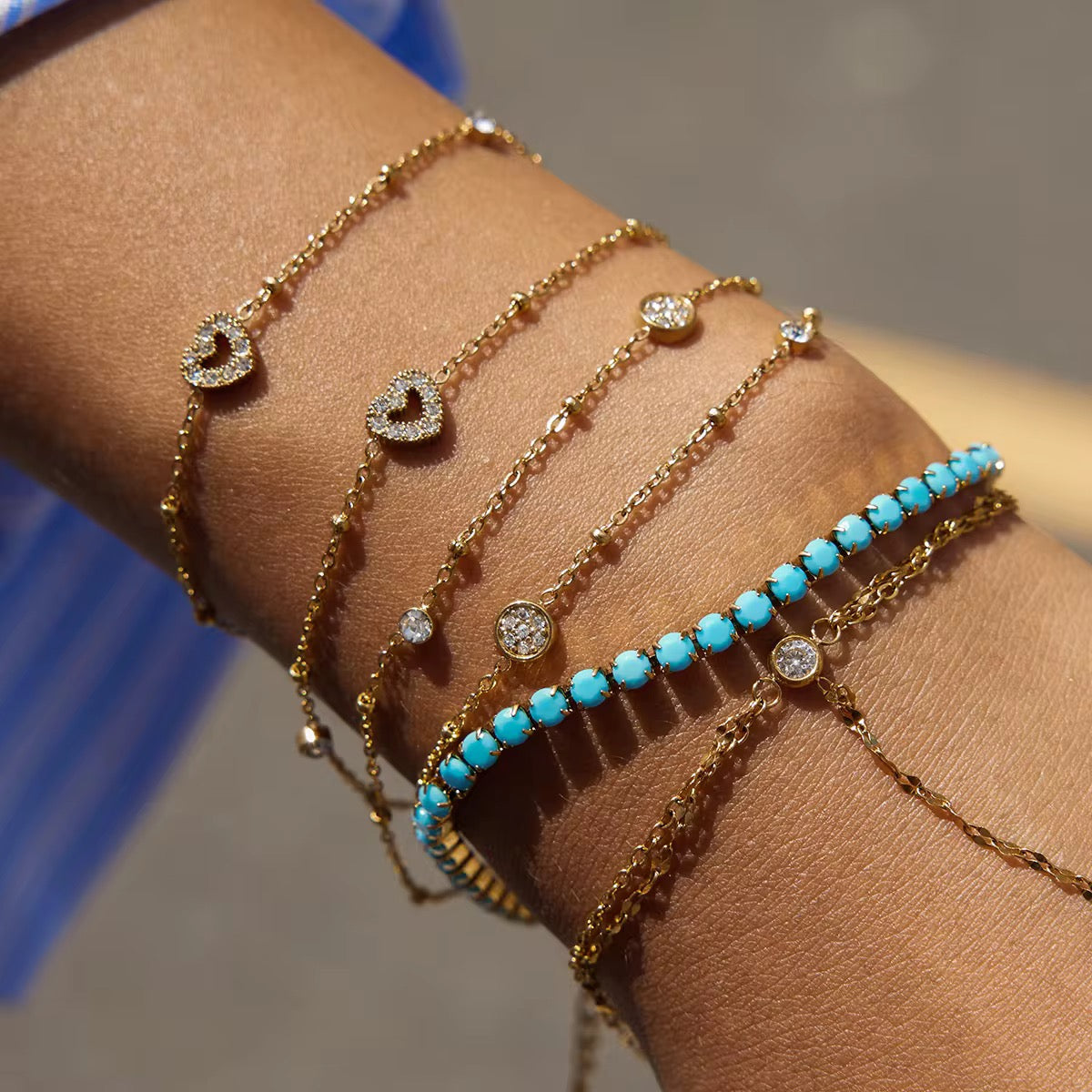
Why bracelet sizing fails more often than ring sizing
A ring that is too small will not go on. The problem is obvious before purchase. A bracelet that is too small goes on but sits tight enough to be uncomfortable after an hour. A bracelet that is too large goes on and looks fine in the mirror but slides to the wrist bone every time the hand moves. Both feel like the right size until you have worn them for a day.
Bracelet sizing has a second variable that ring sizing does not: fit style. A fitted bracelet and a chain bracelet and a bangle are all worn on the same wrist but are sized differently, hang differently, and feel different at the same circumference. Measuring the wrist correctly is the first step. Knowing which measurement to apply to which bracelet type is the second. For the difference in how these styles fit and behave, see bangles versus bracelets in Pakistan.
How to measure your wrist correctly
The measurement you need is wrist circumference — the distance around the narrowest point of your wrist, just below the wrist bone. This is not the same as the widest point of the hand, which is what you would need to slip a bangle over. Those are two different measurements and they matter for different bracelet types.
Method 1 — Paper strip (most accurate). Cut a strip of paper approximately 1cm wide and long enough to wrap around your wrist. Wrap it snugly around the narrowest point, mark where it overlaps, and measure the length with a ruler. This gives your wrist circumference in centimetres.
Method 2 — Thread or string. Same process as above but with any piece of thread. Wrap, mark the overlap point, lay flat, measure. The thread should sit snugly but not tight enough to compress the skin.
Method 3 — Existing bracelet. If you own a bracelet that fits well, measure its internal diameter across the widest point. Multiply by 3.14 to get the approximate circumference, then use the table below.
Do not measure with a rigid tape measure wrapped loosely. Do not measure at the end of a hot day when wrists are slightly swollen. Morning measurements are the most accurate baseline.
Wrist size categories and what they mean for Pakistani buyers
| Wrist circumference | Size category | Most common for |
|---|---|---|
| 13–14.5 cm | XS / Small | Fine-boned wrists, common in Pakistani women under 25 |
| 15–16.5 cm | Medium | The most common range for Pakistani women |
| 17–18 cm | Large | Broader wrists, common across all age groups |
| 18.5 cm+ | XL | Larger wrists, check adjustable options first |
Pakistani women's wrists skew toward the smaller end of the international sizing range. A bracelet labelled "standard" or "one size" on an international site is almost always sized for a 16–17cm wrist — which fits most Western buyers but can be loose on a 14cm Pakistani wrist. This is the most common source of fit disappointment when buying bracelets online in Pakistan.
Fit rules by bracelet type — the measurement is not the same for each
Chain bracelets. For a chain bracelet — any bracelet with links and a clasp — the standard fit adds 1.5 to 2cm of ease to the wrist circumference. If your wrist is 15cm, a 16.5–17cm chain bracelet sits at the right point: it moves slightly but does not slide to the wrist bone. A chain bracelet equal to your wrist circumference will feel tight after an hour. A chain bracelet 3cm above your circumference will spin constantly.
Tennis bracelets. Tennis bracelets sit closer to the wrist than standard chain bracelets. The standard ease for a tennis bracelet is 1–1.5cm above wrist circumference. A 15cm wrist wears a 16–16.5cm tennis bracelet. The closer fit is intentional — the setting needs to lie flat against the skin for the stones to catch light correctly. Too much ease and the stones face at odd angles.
Cuff bracelets. Cuffs are rigid or semi-rigid and are not measured the same way. The critical measurement for a cuff is the gap — the opening at the back. This gap needs to be wide enough to slide the cuff onto the wrist at the narrowest point but not so wide that the cuff slides off during wear. For most cuffs, a gap of 2.5–3cm works for a 14–16cm wrist. Cuffs are the most adjustable bracelet type — a slight bend inward or outward changes the fit without damaging the piece.
Bangles. Bangles have no clasp and must pass over the widest point of the hand to reach the wrist. This is a completely different measurement from wrist circumference. Measure the widest part of your hand by pressing all four fingers together and measuring the circumference at the knuckle line. The bangle's internal diameter must be at least 5–6mm larger than this measurement to slide on comfortably. Once on the wrist, a bangle sits loosely and moves freely — that is the correct fit for a bangle.
Adjustable chain bracelets. These have an extender chain at the clasp — usually 2–3cm of additional length. They work well for wrists between 14–17cm because the extender handles the range. For wrists below 14cm, even the shortest setting of an adjustable bracelet can sit too loose. For wrists above 17cm, the extender may not be long enough to close comfortably.
The ease formula — how much room a bracelet should have
| Bracelet type | Ease to add to wrist circumference | Example: 15cm wrist |
|---|---|---|
| Chain bracelet | 1.5–2 cm | Order 16.5–17 cm |
| Tennis bracelet | 1–1.5 cm | Order 16–16.5 cm |
| Cuff bracelet | Adjustable — fit by gap width | Check gap, not length |
| Bangle | Measure hand width, not wrist | Hand knuckle circumference + 5–6mm |
| Adjustable chain | Extender covers 14–17 cm range | Works if wrist is in this range |
Stacking bracelets — how sizing changes when you layer
When stacking two or more bracelets on one wrist, each piece needs slightly more ease than it would alone. The bracelets move against each other and occupy vertical space on the wrist — a stack that is sized for individual wear ends up feeling tight once all pieces are on together.
The practical rule: for a two-bracelet stack, add an extra 0.5cm of ease to each piece compared to what you would order for solo wear. For a three-piece stack, add 1cm of extra ease per piece. This keeps the stack moving freely rather than sitting compressed against the skin.
A bracelet 1cm too large will not ruin the look. A bracelet 1cm too small will not be worn. When in doubt between two sizes, the larger one is almost always the better choice for daily wear in Pakistan.
Frequently asked questions
Q1. My wrist is 14cm — will standard bracelets fit me?
A: Most bracelets sold as "standard size" in Pakistan are 17–18cm in total length, which is 3–4cm of ease on a 14cm wrist — too loose for comfortable daily wear. Look specifically for bracelets labelled XS or small, or adjustable styles where the extender chain starts at 14cm. Pakistani brands that size for local buyers tend to offer more options in this range than international brands.
Q2. How do I know if my bangle will fit without trying it on?
A: Measure the circumference of your hand at the widest point — press all four fingers together and measure around the knuckles. A bangle with an internal diameter at least 5–6mm larger than this measurement will slide on without force. Forcing a bangle over the hand compresses the knuckles and can cause the bangle to deform if it is rigid metal.
Q3. Can I resize a gold plated bracelet at home?
A: Chain bracelets with extender links can be adjusted by moving the clasp to a different link — this is not resizing, just using a different attachment point. Rigid cuff bracelets can be gently bent to a slightly tighter or looser fit. Do not attempt to resize a tennis bracelet or any bracelet with stones — the setting is calibrated to a specific internal tension and bending it damages the stone seats.
Q4. Does wrist size change during the day?
A: Yes, slightly. Wrists are marginally larger in the evening than in the morning due to fluid retention, and noticeably larger in Pakistan's summer heat when circulation increases. A bracelet that fits perfectly in the morning may feel slightly tight by evening in July. If you are between sizes, go with the larger option.
Q5. What size bracelet should I buy as a gift without knowing the person's wrist size?
A: An adjustable chain bracelet with a 2–3cm extender chain is the safest gift choice — it covers the 14–17cm range that covers the large majority of Pakistani women's wrists. Avoid fixed-length bangles as gifts unless you know the recipient's hand circumference. For more on choosing jewelry as a gift that actually gets worn, jewelry gift sizing guide Pakistan covers the common mistakes and how to avoid them.
Measure once, wear confidently
The paper strip method takes two minutes. The measurement tells you your wrist circumference, and that number — plus the ease formula above — takes the guesswork out of every bracelet purchase. A bracelet bought to the right size is one that actually gets worn.
Browse gold plated bracelets in Pakistan — available in standard and adjustable lengths, COD across Pakistan.

Leave a comment
This site is protected by hCaptcha and the hCaptcha Privacy Policy and Terms of Service apply.