

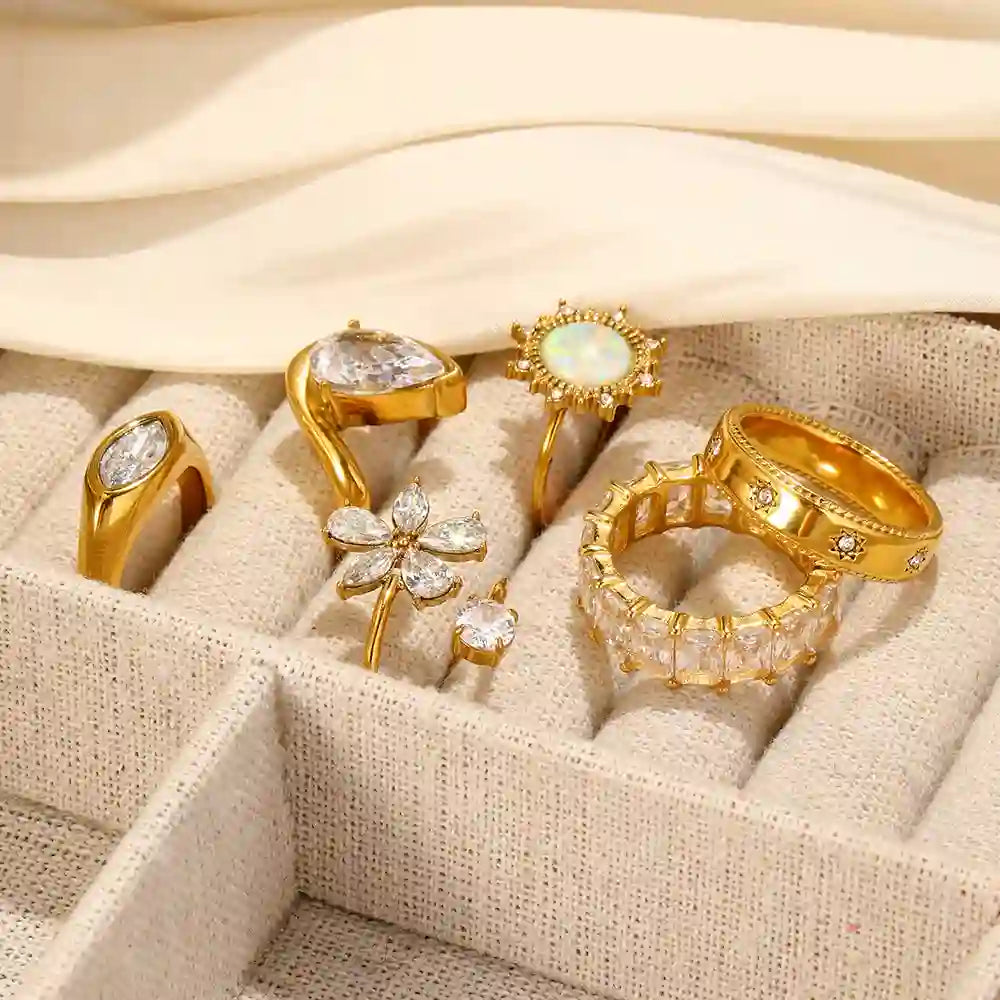
Why rings are the hardest test any jewelry material faces
A ring is in contact with hard surfaces all day — desks, phones, steering wheels, keyboards, door handles, bags. The inner band sits sealed against skin, collecting sweat, skin oil, and soap in the gap between ring and finger. The outer surface takes direct impact from everything the hand touches.
No other piece faces that much friction and that much chemistry at once, continuously. In Pakistan, add heat, humidity, frequent hand washing, wudu five times a day, and hand sanitiser. That is why the base metal and coating decision matters more for a ring than for anything else you buy. This guide covers the checks, lifespan by type, sizing, and care.
The five checks before buying any ring
- Base metal — stainless steel, stated. Brass and zinc-alloy rings leave green marks on the finger once the coating thins at the inner band, often within the first few weeks of daily wear. Stainless steel does not react with sweat or soap. For a ring you will wear daily, this is not optional.
- Coating — PVD, stated. Standard electroplating at 0.5–2 microns wears through at the inner band first. PVD at 1–3 microns, vacuum-bonded, holds far longer under the same contact. The inner band of a PVD ring still wears before the outside does; that is physics, not a defect. The comparison is in gold plating types explained.
- Band width and profile. Bands under about 2 mm flex slightly under grip, stressing the coating with every flex. Wider and flatter bands spread the pressure and hold their finish longer.
- Setting type, if there is a stone. Bezel or flush settings — the stone held in a metal collar or set level with the band — survive daily contact. Prongs on a daily ring catch on fabric and bags and loosen over months.
- A size you have actually measured, or an adjustable band. Wrong size is the most common complaint in online ring orders in Pakistan, and it is entirely avoidable — see sizing below.
Lifespan by ring type — the reference table
Rings sit at the highest-friction end of every site-wide figure. These are daily-wear numbers in Pakistani conditions.
| Ring type | Base and coating | Daily wear lifespan | What wears first |
|---|---|---|---|
| Any style | Brass, electroplated | 2–8 weeks — often the first few | Inner band, then green marks |
| Plain band, worn through every task | Stainless steel, 18K PVD | 8–18 months | Inner band |
| Plain band, worn occasionally | Stainless steel, 18K PVD | 2–3 years | Inner band |
| Stone-set ring | Stainless steel, 18K PVD | 1–2 years daily | Edges of the setting; check stones monthly |
| Adjustable ring | Stainless steel, 18K PVD | 1–2 years daily | The opening, if re-bent often |
Inner-band wear after a year of daily wear is the ring doing exactly what the table predicts. Why Pakistan's climate shortens every figure is in PVD jewelry explained.
Which ring for which use
- Daily wear. A plain gold band. No stone to catch, no setting to loosen, a flat profile that goes through wudu, typing, and a dupatta without a second thought. The most durable ring there is.
- Daily with a little more. A single stone in a bezel or flush setting. Check the setting before anything else.
- Unsure of your size. An adjustable band. Size it once on arrival and leave it — the opening is only a wear point if you keep re-bending it. Choose a solid band over a thin wire-style one.
- Stacking. Thin bands in mixed widths, every one on the same base metal; dissimilar metals rubbing under sweat corrode the weaker one.
- Occasions. Statement and sculptural rings. Even on stainless steel, raised detail meets surfaces at more points and shows wear sooner than a plain band.
Every type is explained in types of rings. Which finger and how many is in how to wear rings; building a stack is in how to stack rings.
Sizing for an online order
Measure in the evening. Fingers are largest at the end of the day, and larger still in summer. A morning measurement in January produces a ring that is tight by a July afternoon.
Measure the base of the finger where the ring will sit, with a strip of paper or non-stretch thread. Mark the overlap, lay it flat, and read the length in millimetres — that is the circumference. If the knuckle is noticeably wider than the base, measure both and choose between them, leaning toward the knuckle so the ring still goes on.
Measure the hand you will wear it on. The dominant hand usually runs half to one size larger. Between two sizes, go up. Mithra's size chart and three home methods are in the ring size guide; if a ring arrives slightly large, ring size adjusters explains what fixes it.
Care that actually extends a ring's life
- Dry hands fully after sanitiser. It is 60–80 percent alcohol applied straight onto the ring. Removing the ring every time is unrealistic; a tissue before the wet skin sits under the band is the habit that works.
- Clean the inner band. Skin oil and soap build up there more than anywhere else. A soft cloth or cotton bud after taking the ring off.
- Dry after water. Wudu and hand washing are fine for stainless steel PVD; a wet band left on is not. For the longest-lasting shine, taking the ring off before washing hands is the extra step that pays off over a year.
- Store separately. Never loose with other rings — ring-on-ring contact scratches both. A ring roll, compartments, or individual pouches.
- Off for weights and abrasive work. That is friction, not water, and it is what genuinely shortens a coating.
The full routine is in the complete care guide; what sanitiser specifically does is in does hand sanitiser damage gold plated jewelry.
What to avoid
- Any listing that does not name the base metal.
- "18K gold plated" with no coating method — that is electroplating.
- Prong settings on a ring meant for daily wear.
- Thin wire-style adjustable bands for daily use.
- A size taken in the morning, or on the wrong hand.
- Stacking a stainless steel band with a brass one.
Every Mithra & Co ring is 18K PVD over 316L stainless steel, with both stated on the product page. Browse the ring collection — cash on delivery nationwide, 7-day exchange for sizing from delivery.
Frequently asked questions
Q1. Why do gold plated rings leave green marks in Pakistan?
A: Copper in a brass base reacting with the salt in sweat once the coating has worn through at the inner band. Pakistan's heat raises sweat volume and speeds the reaction, so it shows faster here than in cooler climates. Stainless steel contains no copper and does not produce the mark.
Q2. How long do gold plated rings last with daily wear?
A: Electroplated brass: 2 to 8 weeks, usually at the short end for rings. 18K PVD on stainless steel: 8 to 18 months worn through every daily task, 2 to 3 years worn occasionally. Rings wear fastest of any category because of constant hand contact.
Q3. How do I find my ring size for an online order?
A: Measure the base of the finger in the evening with a paper strip, read the circumference in millimetres, and match it to the seller's chart. Use the hand you will wear it on. Between sizes, go up. If the knuckle is wider, measure both and choose between.
Q4. What if the ring I ordered is the wrong size?
A: At Mithra & Co, contact the team within 7 days of delivery with the ring unworn and it can be exchanged for the correct size. If it is only slightly large, a ring size adjuster is the quick fix.
Q5. Can I wear gold plated rings while washing my hands?
A: On stainless steel PVD, yes — the water itself does no harm if you dry the band afterwards. Soap residue inside the band is the slow wear source, so taking the ring off before washing is the habit that keeps the inner band looking new longest.
Q6. Are adjustable rings good for daily wear?
A: Yes, if the band is solid rather than thin wire and you size it once and leave it. Repeated bending at the opening is what wears the coating there; a ring adjusted once on arrival behaves like any other band.

Leave a comment
This site is protected by hCaptcha and the hCaptcha Privacy Policy and Terms of Service apply.