

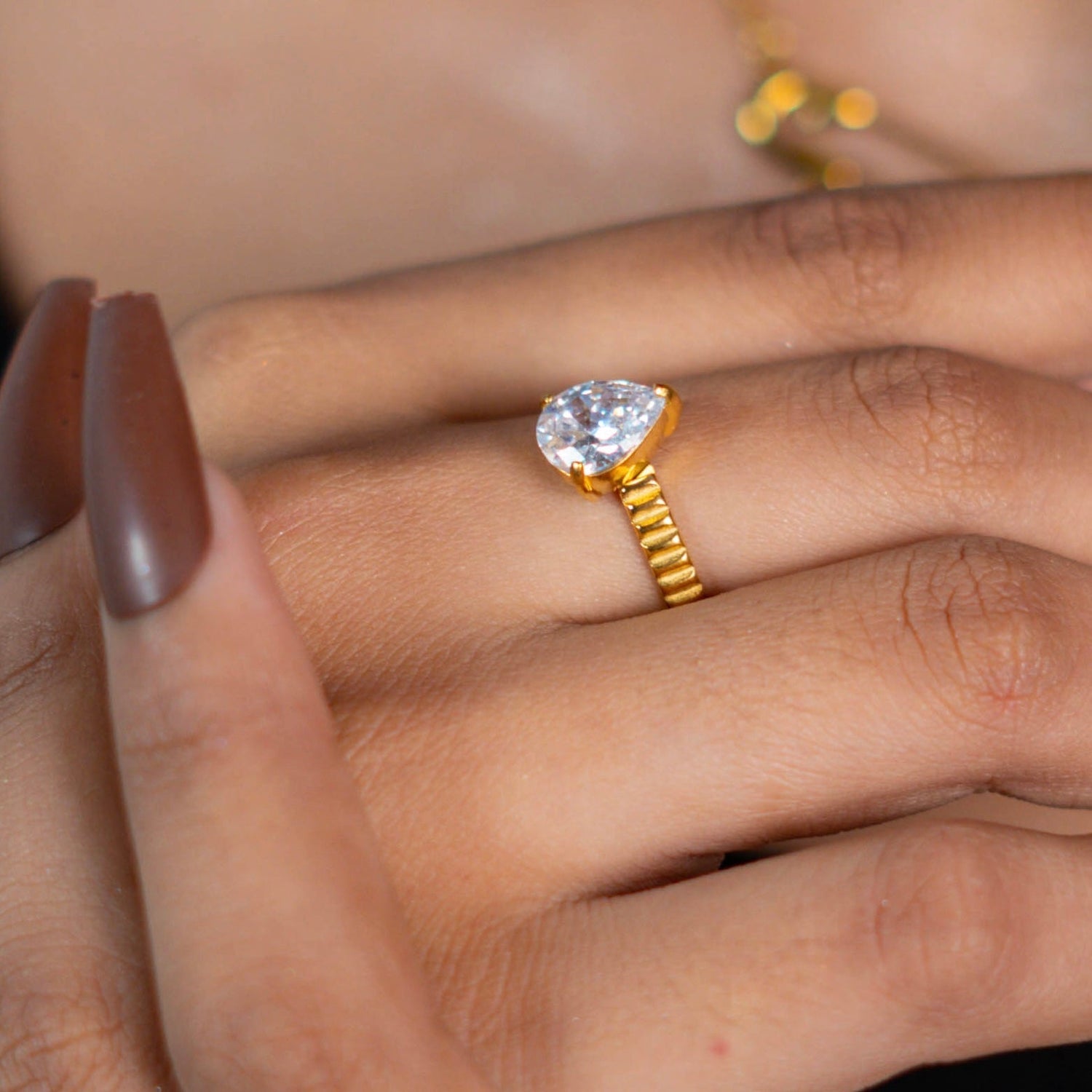
The short answer — yes, with specific limits
A ring size adjuster works for making a ring slightly smaller. It does not work for making a ring larger, does not fix a ring that is more than one full size too big, and does not solve comfort problems caused by width rather than diameter. Within those limits — a ring that fits the knuckle but spins on the finger, or a ring purchased online that arrived one size down from ideal — an adjuster is a functional, inexpensive fix that works reliably.
The reason most Pakistani buyers are uncertain about adjusters is that they arrived in the market alongside a wave of low-quality versions that collapse within a week. The quality of the adjuster is the variable that determines whether it works — not the concept itself.
What a ring size adjuster actually is — and how it functions
A ring size adjuster is a small coil or clip of thin metal — usually brass or stainless steel — that wraps around the inner base of a ring's band. It occupies space between the ring's inner surface and the finger, reducing the effective inner diameter without permanently altering the ring's shape. The ring slides over the knuckle at its original size and then sits snugly on the finger at the reduced size created by the adjuster's thickness.
The coil version wraps around the band in a spiral. The clip version snaps onto the base of the band as a single piece. Coil adjusters are more adjustable — you can add or remove coils to change the reduction amount. Clip adjusters are more stable — they do not move around the band once placed.
The adjuster does not change the ring. It occupies space inside it. This means the ring retains its original structural integrity and can be removed from the adjuster without damage — which matters if you ever want to have the ring professionally resized instead.
When a ring size adjuster is the right solution
| Situation | Adjuster works? | Why |
|---|---|---|
| Ring fits the knuckle but spins on the finger | Yes — this is the ideal use case | The adjuster fills the gap between knuckle size and finger size. Most Pakistani women have this problem on their ring finger specifically. |
| Ring arrived one size too small from COD order | No | Adjusters reduce size, they do not increase it. A ring that won't go over the knuckle cannot be fixed with an adjuster. |
| Ring arrived one size too large | Yes | Half to one full size too large is within the adjuster's effective range. More than one full size too large and the adjuster becomes too thick and uncomfortable. |
| Ring fits in winter but spins in summer | Yes — seasonal fix | Finger size changes with temperature in Pakistan — fingers swell in summer heat, narrow in winter. A thin adjuster handles the winter-to-summer size difference without permanent alteration. |
| Ring is uncomfortable because it's too wide for the finger | No | Width-related discomfort is not a size problem. The ring diameter may be correct; the band width creates pressure. An adjuster adds more material to the inner surface and typically makes width discomfort worse. |
| Ring bought without knowing exact size (common with COD) | Sometimes | If the ring arrived within one size of the correct fit, an adjuster closes the gap. If it arrived more than one size off, the adjuster range is exceeded. |
The COD sizing problem in Pakistan — why adjusters matter more here
In Pakistan, cash on delivery is the dominant e-commerce payment method, which means most ring purchases are made without trying the ring first. The buyer measures their finger at home using a paper strip or a measurement guide, places the order, and receives the ring days later — with no opportunity to exchange easily if the size is off by one step.
This creates a specific, common problem: a ring that fits in the intended spirit but not precisely in the actual measurement. An adjuster is the practical solution for this gap — not as a workaround for poor sizing, but as a buffer that handles the inevitable variance between home measurement and actual ring fit. For accurate home ring sizing before ordering, the ring size guide for Pakistan covers the most reliable methods that work without tools.
How to fit a ring size adjuster correctly
A poorly fitted adjuster is worse than no adjuster. The coil needs to sit at the base of the ring's inner band — centred on the bottom, not twisted to one side. If it sits off-centre, the ring will tilt on the finger rather than sit flat, which is uncomfortable and visually obvious.
Steps for a coil-type adjuster
Open the coil slightly so it can wrap around the ring's band. Wrap it around the inner base of the band starting from one end, coiling around two to three times depending on the size reduction needed. The coil should sit flush against the inner surface with no gap between the coil and the band. Test the fit by putting the ring on — it should slide over the knuckle without force and sit without rotating on the finger. If it still rotates, add one more coil. If it is tight on the knuckle, remove one coil.
Steps for a clip-type adjuster
Press the clip onto the base of the inner band until it snaps into place. The clip should not be visible from the outside of the ring when worn. Test the fit as above. Clip adjusters cannot be incrementally adjusted — they provide a fixed size reduction, so the ring needs to be within range before fitting one.
What ring size adjusters do not fix — the limits to know before buying
The most common post-purchase complaint about ring adjusters in Pakistan is that they "don't work" — which on inspection usually means they were applied to a problem outside their effective range.
- More than one full size too large: The adjuster becomes too thick and creates pressure rather than comfort. The ring feels tight at the base while still rotating at the top. Professional resizing is the correct solution for more than one size difference.
- Rings with stones on the inner band: If the ring has any detailing on the inner surface of the band, an adjuster cannot sit flush. It will rock over the inner detail and create an unstable fit.
- Very thin bands (under 2mm): Extremely thin band rings flex when an adjuster is fitted, which changes the ring's shape and can stress the metal at the adjuster's contact points over time.
- Knuckle-to-finger size problems of more than two sizes: Some fingers — particularly the ring finger — have a significantly larger knuckle than the finger below it. If the gap between knuckle size and finger size is more than two sizes, an adjuster makes the ring unclearable over the knuckle or creates a ring that sits extremely loose above the adjuster.
Adjuster material — what holds up and what doesn't
The material of the adjuster determines how long it holds its shape and whether it affects the inner surface of the ring. Brass adjusters are the most common and the cheapest — they work initially but deform under daily wear, losing their grip within weeks. Stainless steel adjusters are more durable and maintain their coil tension for longer. Silicone adjusters avoid the metal-on-metal contact issue entirely and are the most comfortable option for sensitive skin, though they provide less precise size reduction than a metal coil.
For rings in 18K PVD over stainless steel, a stainless steel adjuster is the compatible choice — it will not react with the ring's base metal or damage the inner surface of the band under normal use.
Frequently asked questions
Q1. Do ring size adjusters damage the ring?
A: A correctly fitted metal adjuster on a solid-band ring does not damage the ring. The adjuster sits on the inner surface without penetrating or scratching the metal under normal wear. The risk of damage comes from adjuster removal — forcing a coil off rapidly can scratch the inner band. Remove slowly, unwinding the coil rather than pulling it off. For rings with any inner surface finishing or engraving, opt for a silicone adjuster which makes no metal-on-metal contact.
Q2. How much can a ring size adjuster reduce a ring by?
A: A standard coil adjuster reduces ring size by half to one full size. Some adjusters with multiple coils can achieve up to one and a half sizes of reduction. Beyond one and a half sizes, the adjuster material becomes too thick for comfortable wear and the ring will feel tight and look misaligned on the finger. For reductions of more than one full size, professional resizing is more appropriate than an adjuster.
Q3. Where can I find adjustable rings that don't need an adjuster at all?
A: Adjustable rings — open-band designs that flex to fit a range of finger sizes — eliminate the sizing problem entirely. They are sized to fit without measurement and work across a range of finger sizes by design. Mithra's adjustable rings collection covers the full range of open-band designs in 18K PVD over stainless steel — useful specifically for COD purchases where confirming size in advance is not possible.

Leave a comment
This site is protected by hCaptcha and the hCaptcha Privacy Policy and Terms of Service apply.