

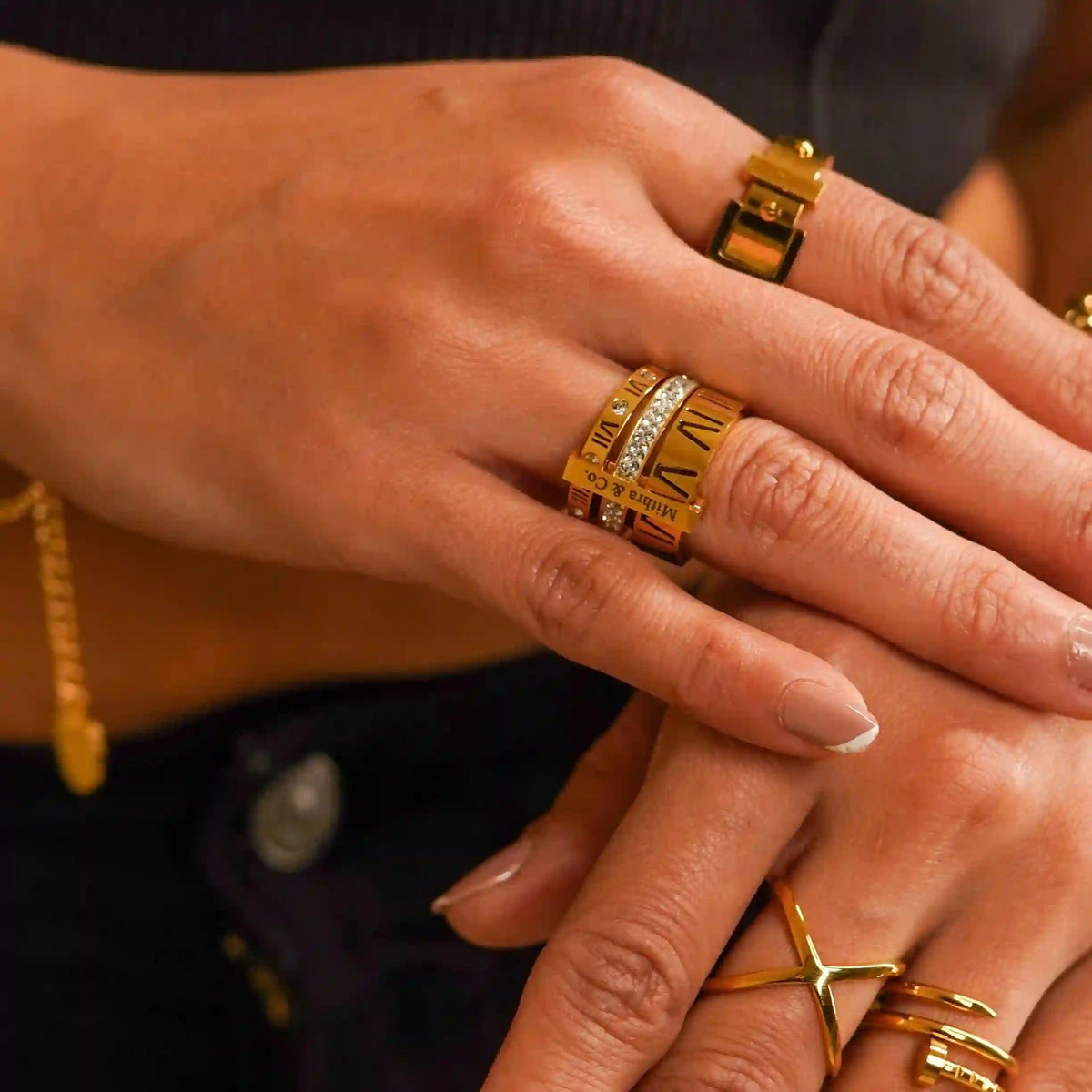
Why ring stacking looks effortless on some people and cluttered on everyone else
Ring stacking is not about wearing more rings. It is about wearing the right rings in the right places with enough intentional variation that the hand reads as styled rather than loaded. The difference between a stacked hand that works and one that does not is almost never the number of rings — it is the combination of width, profile, and finger placement. Get those three things right and the count takes care of itself.
In Pakistan, ring stacking has specific practical constraints that most international guides do not address. Wuzu five times a day. Summer heat that makes fingers swell by afternoon. Skincare routines that put lotion against metal. This guide covers all of it — the styling logic and the material logic — so the rings you stack actually stay on comfortably and hold up to Pakistani daily life.
The finger map — which finger carries what
Before counting rings, understand what each finger does structurally. Some fingers are natural anchors for stacking. Some are best left to one ring. Ignoring this is why most stacked hands look wrong.
Index finger. The highest-visibility finger. A single statement ring here — a wide band, a geometric shape, a stone setting — reads clearly because the index has the most movement and draws the eye naturally. Stacking multiple rings on the index creates visual noise at the most prominent point. One strong ring here, nothing on the adjacent middle finger if the index ring has significant width.
Middle finger. The longest finger and the natural balance point of the hand. Thin bands stack well here — two or three slim rings in different finishes or textures read as intentional. A single band ring here alongside index or ring finger stacking anchors the hand without competing. Avoid wide statement rings on the middle finger when anything is on the index — the two will clash visually.
Ring finger. Traditionally the most worn finger in Pakistan. For daily wear stacking, thin bands above and below a centre ring create a layered look without bulk. Adjustable rings work well here because finger width changes through the day with heat and hydration. A stacked ring finger with a clear centre piece and one thin flanking band on each side is the most reliable starting configuration.
Pinky finger. Underused in Pakistani ring stacking and one of the easiest additions to make. A single slim band or midi ring on the pinky extends the visual length of the hand without adding bulk to the already-active middle three fingers. If the rest of the hand is heavily stacked, leave the pinky alone. If the hand is lightly stacked at two or three rings total, a pinky ring completes it.
Thumb. Occasional, not default. A wide band on the thumb on an otherwise lightly stacked hand reads as intentional. On an already busy hand it reads as too much. Use it as a statement element, not a filler.
How many rings is the right number
There is no universal correct number. There is a correct number for what you are doing and where you are going. The practical framework is this:
| Context | Ring Count | Configuration |
|---|---|---|
| Daily office wear | 2 to 3 | One anchor, one or two thin bands — same hand or split across both |
| University / casual daily | 2 to 4 | Mix of band and adjustable — comfort and wuzu compatibility priority |
| Evening / event | 3 to 5 | Statement piece on index or ring finger, supporting bands elsewhere |
| Wedding guest — mehndi | 4 to 6 | Full hand acceptable — mix stone and plain bands across both hands |
| Daily minimalist | 1 to 2 | One ring per hand maximum — let each piece read on its own |
The rule that holds across all contexts: if you have to think about which finger to move something to when you do tasks with your hands, you are wearing one ring too many for that context. Stacking should not require management throughout the day.
Mixing ring styles — what works together and what does not
The most common stacking mistake in Pakistan is combining rings of similar width and similar profile. Three band rings of the same thickness on the same finger look repetitive, not layered. Variation in at least two of three elements — width, profile, and surface texture — is what makes a stack read as styled.
Width variation. Combine a wider band (4mm or more) with one or two slim bands (1 to 2mm). The slim bands frame the anchor piece without competing with it. Three rings of identical width on one finger look like a set that belongs together rather than a stack.
Profile variation. Flat bands, rounded bands, twisted or rope-texture bands, and stone-set rings all have different visual profiles. Mixing a flat band with a rounded band with a stone setting creates visual depth on the finger. Mixing three flat bands creates flatness without dimension.
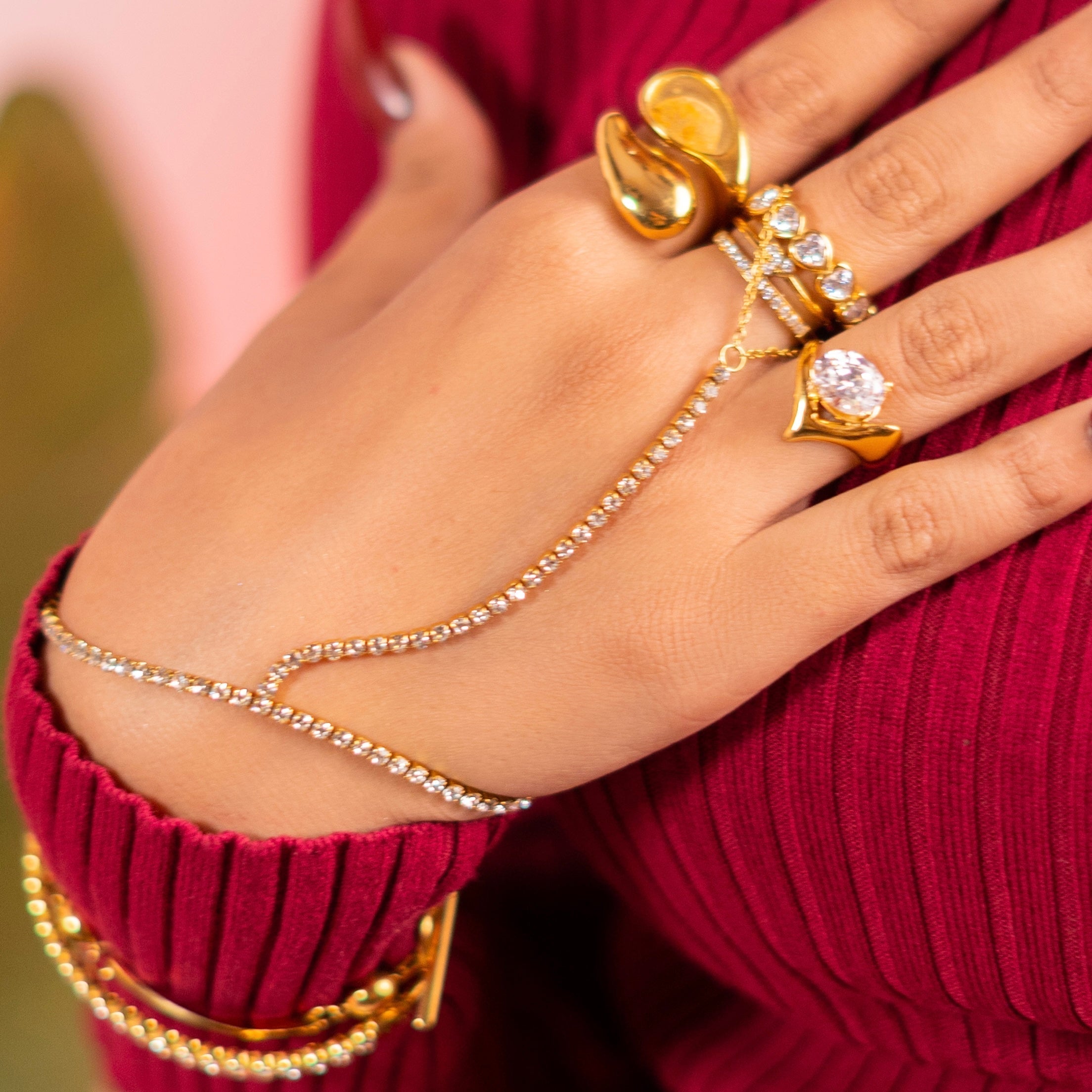
Mixing plain and stone-set. One stone-set ring in a stack of plain bands is the most reliable combination — the stone creates a focal point and the plain bands support it without competing. Two stone-set rings on the same finger tend to compete unless the stones are significantly different in size. On different fingers, multiple stone-set rings work because the hand has enough space to read each one separately.
Mixing adjustable and fixed-size rings. Adjustable rings in Pakistan are practical for daily wear because fingers change size through the day with heat and hydration. The practical approach is to use fixed-size rings at comfortable anchor positions — typically the ring and middle finger where sizing is most stable — and adjustable rings at supporting positions like the index or pinky where a slightly looser fit is acceptable. For help finding accurate sizes before buying fixed rings, the ring size guide for Pakistan covers how to measure correctly at home.
Stacking across both hands
Most Pakistani ring stacking focuses on one hand, which is the easier starting point. But distributing rings across both hands is often more balanced than loading everything onto one.
The practical split: wear your primary stack — the anchor ring and its supporting bands — on your dominant hand, and wear one or two complementary pieces on the other. A single band ring or one slim stack of two on the non-dominant hand creates visual balance without the non-dominant hand competing with the primary stack.
For occasions where a fuller look is appropriate — mehndi, events, family gatherings — a mirror approach works: similar configurations on both hands in complementary pieces rather than identical ones. The hands should look like they belong to the same aesthetic, not like two separate ring collections worn simultaneously.
What stacking does to ring wear — and why base metal matters more with multiple rings
This is the practical section that most styling guides skip entirely. When you stack rings, each ring creates friction against the adjacent rings as your fingers move. That inter-ring friction is more damaging to surface coatings than skin contact alone. If the rings are brass-base with standard electroplating, the friction between pieces accelerates coating wear at the sides of each band — exactly where rings contact each other — far faster than single-ring daily wear would.
On stacked rings, the inside band surface wears from skin contact and the side surfaces wear from ring-to-ring contact simultaneously. For brass-base pieces, this means the base metal becomes exposed at multiple points within weeks of daily stacked wear. For 316L stainless steel base rings with PVD coating, the coating is three to five times thicker and bonded at molecular level — it handles inter-ring friction significantly better. And when it does eventually change at contact points over time, the stainless steel underneath does not produce green marks or skin reactions.
This is why stacking specifically — not just daily wear — makes the base metal choice more consequential. A single brass ring worn alone may look acceptable for longer because only one face is under friction. The same ring in a stack of three deteriorates visibly faster because all surfaces are in active contact simultaneously. The gold plated rings buying guide for Pakistan covers the full material comparison for rings in detail.
Wuzu and stacked rings — the Pakistani-specific consideration
Wuzu requires water to reach the skin surface of the hands. With multiple rings stacked, water needs to reach under and between each ring to fulfil the requirement correctly. This has two implications for how you stack.
First, avoid stacking rings so tightly that water cannot pass between them during wuzu. A small visual gap between bands — even 1mm of visible skin between rings on the same finger — is enough for water to penetrate. Rings pressed flush against each other with no gap may prevent water from reaching the skin beneath, which is a practical concern for daily wuzu wearers.
Second, the water contact that wuzu creates five times daily is sustained metal-against-skin-against-water contact at the inside band surface — the highest-reaction-risk point on any ring. For brass-base rings, this is the exact condition that accelerates base metal exposure and skin reactions. Stainless steel base rings handle daily wuzu contact correctly. For the full explanation of how different base metals behave under wuzu conditions, the waterproof jewelry guide for Pakistan covers the chemistry in detail.
Stacking with Mithra's ring collections
Mithra carries four ring categories that stack naturally together: band rings as the slim supporting pieces, multilayer rings as the anchor statement pieces, adjustable rings for practical daily stacking where sizing varies through the day, and gem-stone rings for the stone-set focal point in a plain-band stack. Every piece is 18K PVD over 316L stainless steel — the base metal that handles the inter-ring friction, daily wuzu, and Pakistan's summer heat that stacking under daily wear conditions demands.
Browse the full rings collection at mithraofficial.com — COD across Pakistan including Karachi, Lahore, Islamabad, and Rawalpindi.
Frequently asked questions
Q1. How many rings can I stack without it looking overdone in Pakistan?
A: For daily wear — office, university, casual — two to four rings across one or both hands is the practical range. For occasions like mehndi or events, four to six reads as styled rather than overdone if the pieces have enough variation in width and profile. The signal that you have gone too many is when the individual rings stop reading separately and the hand reads as one undifferentiated mass of metal. Start with two or three and add one piece at a time until the hand looks complete, then stop.
Q2. Can I mix gold and silver toned rings in a stack?
A: Yes — mixed metal stacking is one of the cleaner ways to create visual interest without adding more rings. The practical guideline is to let one tone dominate and use the other as an accent. Two gold bands and one silver band read as an intentional mixed stack. Equal numbers of each tend to look undecided rather than deliberate. Keep the mixed tones on different fingers rather than alternating on the same finger for a cleaner result.
Q3. Why do my stacked rings scratch each other?
A: Ring-to-ring friction from finger movement is unavoidable in any stack. Harder surface coatings — PVD on stainless steel — scratch less readily than softer standard electroplating on brass. Storing rings separately when not wearing them prevents scratching during storage. When wearing a stack, the side-surface contact is constant and some surface change over long-term daily wear is normal regardless of material. Stainless steel base rings handle this better than brass because the material underneath the coating is more durable and does not react when surface contact eventually occurs.
Q4. Do adjustable rings work in a stack?
A: Yes, with placement awareness. Adjustable rings have an open back that means they do not sit flush against adjacent rings on the same finger the way closed bands do. This actually creates natural spacing — which is useful for wuzu compliance — but means adjustable rings pair better as the outermost piece in a finger stack rather than sandwiched between two closed bands. On a different finger from the main closed-band stack, adjustable rings work without restriction.
Q5. Where can I buy rings for stacking in Pakistan with COD?
A: Mithra carries band rings, multilayer rings, adjustable rings, and gem-stone rings — all in 18K PVD over 316L stainless steel — with cash on delivery available across Pakistan including Karachi, Lahore, Islamabad, and Rawalpindi. Browse the full rings collection here.

Leave a comment
This site is protected by hCaptcha and the hCaptcha Privacy Policy and Terms of Service apply.