Why necklaces are the easiest daily wear category — and how to still get it wrong
Of all jewelry categories, necklaces experience the least friction. They rest against skin and clothing with minimal mechanical contact compared to bracelets or rings. A well-made necklace in 18K PVD over stainless steel can last three to five years of daily Pakistani wear with basic care. That makes the necklace category the lowest-risk entry point for building a daily wear jewelry collection in Pakistan.
But the two most common necklace mistakes in Pakistan — buying a chain length that does not suit the necklines you actually wear, and buying a pendant weight that does not match the chain thickness — both result in a piece that looks wrong on and gets avoided. This guide covers both the material decision and the styling decision so the necklace you buy actually gets worn.
What to look for before buying a gold plated necklace in Pakistan
- Base metal — stainless steel for daily wear — necklaces sit against the neck and upper chest where skin is relatively dry compared to wrists and fingers, but sweat and skincare product contact still occurs throughout the day. Brass-base necklaces in Pakistan's humidity eventually show oxidation discolouration at the back of the neck where the chain contacts skin most consistently. Stainless steel base necklaces do not produce this reaction and maintain their surface integrity without skin contact issues under Pakistani daily conditions.
- Coating — PVD for lasting gold colour — necklaces show coating wear at the clasp area and pendant bail (the loop connecting pendant to chain) first. These are the highest-friction points on any necklace under daily wear. PVD at 3 to 5 microns handles this friction significantly better than standard electroplating. For the chain surface itself, both coating methods hold reasonably well since chain links experience minimal direct friction — the clasp and bail are the critical points.
- Chain thickness relative to pendant weight — a heavy pendant on a thin chain creates concentrated stress at the bail and the chain links either side of it. Under daily wear in Pakistan, this stress point wears through the coating faster than any other part of the necklace. Match chain thickness to pendant weight: pendants under 5 grams on chains of 1.5mm or below; pendants 5 to 15 grams on chains of 1.5 to 2.5mm; statement pendants above 15 grams on chains of 2.5mm or above.
- Clasp type — spring ring clasps are the most common and the weakest. Lobster claw clasps provide more secure closure and handle daily use better. Box clasps on heavier chains are most secure but less convenient for solo fastening. For daily-wear necklaces in Pakistan that go on and off every day, lobster claw clasps provide the best balance of security and ease.
Chain lengths — how to choose for Pakistani necklines and outfits
Chain length determines where the necklace sits on the body and which necklines it works with. This is the most commonly underestimated decision in online necklace purchases in Pakistan — a necklace that photographs beautifully at 18 inches may sit completely wrong on your specific neck length and most-worn necklines.
| Chain length | Where it sits | Works best with | Pakistani context |
|---|---|---|---|
| 14–16 inches (choker) | Base of neck, collarbone | Deep V, off-shoulder, open necklines | Festive and occasion wear, formal suits |
| 17–18 inches (princess) | Just below collarbone | Almost every neckline including crew and round neck | The most versatile daily wear length in Pakistan |
| 20–22 inches (matinee) | Above the bust | V-neck, boat neck, open collar shirts | Layering base chain, casual and office wear |
| 24+ inches (opera) | At or below bust | Low necklines, open jackets, western wear | Layering with shorter chains, casual styling |
For Pakistani daily wear — across the range of necklines from shalwar kameez crew necks to office shirts to casual tops — 17 to 18 inches is the most universally versatile length. It sits just below the collarbone where it is visible against almost any neckline without disappearing inside a high neck or looking too short against a low one.
Necklace styles in Pakistan — daily wear to occasions
- Plain chains — the highest-versatility daily wear piece in any Pakistani woman's collection. A 17-inch plain gold chain in 18K PVD over stainless steel works with every outfit without requiring a styling decision. This is the piece most responsible for solving the daily "what do I wear" problem permanently.
- Pendant necklaces — a chain with a single pendant adds visual interest while maintaining daily wear practicality. The pendant design communicates intent — a minimal geometric pendant for office and daily wear, a more detailed motif pendant for occasions. Check the bail (connecting loop) quality — this is the highest stress point on any pendant necklace under daily Pakistani use.
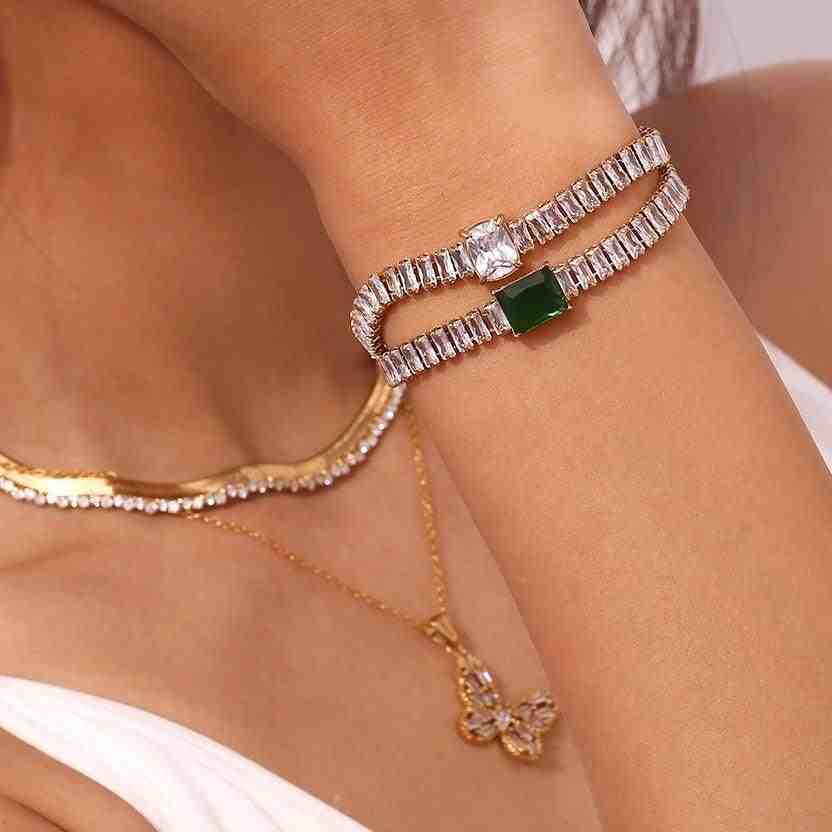
- Tennis necklaces — continuous stone setting across the full chain creates a consistent sparkle that works for both office and occasion wear in Pakistan. Already the most-searched necklace style in Pakistan's GSC data. The distributed stone setting means no single high-stress point — tennis necklaces handle daily wear well when built on the correct base material.
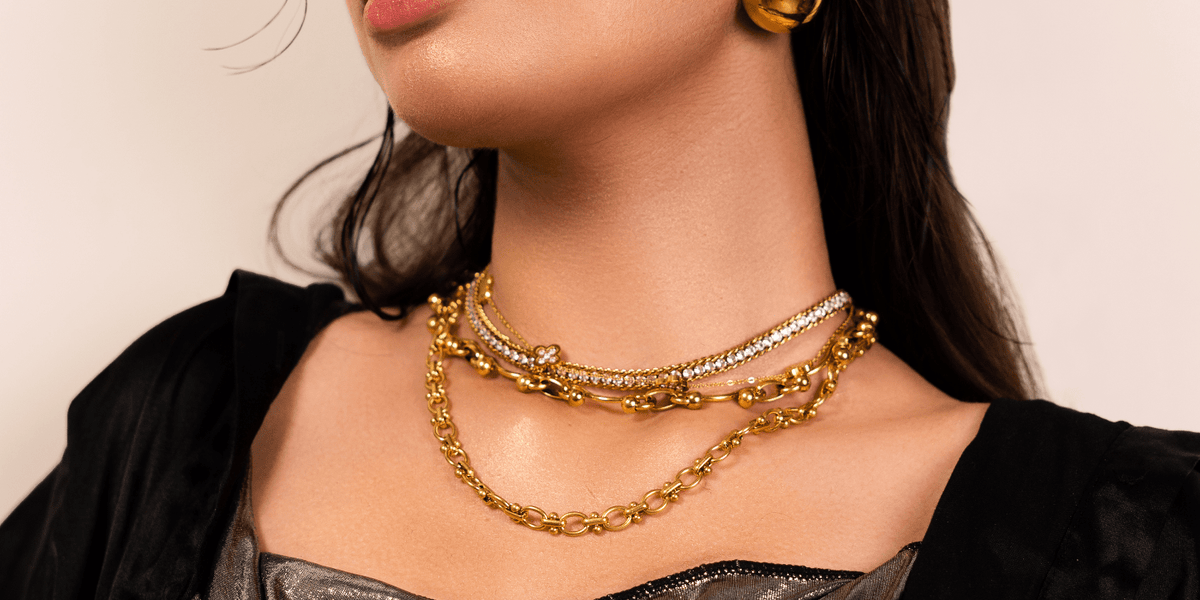
- Layered necklaces — two or three chains worn at different lengths simultaneously. The most common Pakistani Instagram and social styling look. For layering in Pakistan, all pieces in the stack should be the same base metal to prevent galvanic corrosion between dissimilar metals under neck sweat. PVD over stainless steel throughout the stack ensures no discolouration between pieces under daily Pakistani wear.
- Statement necklaces and malas — for shaadi season, Eid functions, and formal occasions. Heavy, elaborate, or culturally-referential necklace styles for occasions that call for them. For event wear in Pakistan's summer, the same material rules apply — stainless steel base and PVD coating handle the compounding heat and sweat stress of a full occasion evening better than brass-base alternatives.
How long do gold plated necklaces last in Pakistan — realistic lifespan
| Necklace type | Base and coating | Daily wear lifespan Pakistan |
|---|---|---|
| Standard fashion necklace | Brass, electroplated | 1–4 months |
| Better electroplated necklace | Brass, thicker plating | 4–10 months |
| Plain chain 18K PVD | Stainless steel, PVD | 3–5+ years |
| Pendant necklace 18K PVD | Stainless steel, PVD | 2–4 years |
| Tennis necklace 18K PVD | Stainless steel, PVD | 3–5 years |
Necklaces last significantly longer than bracelets and rings under equivalent coating quality because their friction exposure is the lowest of all jewelry categories. A PVD plain chain worn daily in Pakistan represents the best lifespan-per-rupee value in the entire jewelry category — it is the piece that earns its place most consistently in any collection built for real Pakistani daily life. The complete material comparison across all gold plating types for necklaces is in the gold plating types guide.
How to care for gold plated necklaces in Pakistan
- Apply perfume before putting the necklace on — the neck and collarbone area receives the most direct perfume application of any jewelry-wearing body area. Putting the necklace on after perfume has fully absorbed prevents alcohol compounds from sitting directly against the chain surface under neck heat.
- Check the clasp monthly — necklace clasps are the most common failure point under daily wear. A monthly check that the lobster claw mechanism closes fully and snaps securely prevents the gradual loosening that causes necklace loss. If the clasp feels loose or does not snap with a satisfying click, have it replaced before it fails during wear.
- Store hanging or flat — never coiled in a knot — necklace chains knot easily in storage, particularly thin chains. A wall-mounted hook system or a hanging jewelry organiser keeps each chain separate and tangle-free. Unknotting a fine chain puts localised stress on individual links that can weaken the chain at that point over time.
- Wipe the back of chain and clasp specifically — the back of the neck where the chain rests is the highest sweat-contact area for necklaces. A microfibre wipe specifically along the back section and clasp after wearing removes sodium chloride before it sits against the coating overnight.
Gold plated necklaces in Pakistan — shop with COD
Every necklace at Mithra & Co is made with 18K PVD coating over a stainless steel base — tarnish-free, no skin reactions, and built for daily Pakistani wear from plain daily chains through to occasion statement pieces. COD across Pakistan with free delivery on orders above Rs. 5,000.
Browse gold plated necklaces in Pakistan at mithraofficial.com — plain chains, pendants, tennis necklaces, and layering styles.
Frequently asked questions
Q1. What chain length is best for everyday wear in Pakistan?
A: 17 to 18 inches — the princess length — is the most universally versatile chain length for Pakistani daily wear. It sits just below the collarbone and works with every neckline from crew-neck kameez to V-neck office shirts to casual tops without disappearing inside a high neck or looking too short against a low one. If you are buying one everyday chain for all outfits, 17 to 18 inches is the correct starting length for most Pakistani women's neck lengths and typical wardrobe necklines.
Q2. How long does a gold plated necklace last with daily wear in Pakistan?
A: Standard electroplated brass: 1 to 4 months before visible discolouration at the clasp and back-of-neck area. 18K PVD over stainless steel: 3 to 5 years for a plain chain with basic care. Necklaces last significantly longer than bracelets or rings under equivalent coating quality because friction exposure is lower — the chain rests against skin and clothing without the continuous mechanical impact that wrist and finger jewelry experiences throughout the day.
Q3. Can I layer gold plated necklaces in Pakistan?
A: Yes — with one important material consideration. All pieces in a layered stack should be the same base metal to prevent galvanic corrosion. When dissimilar metals — stainless steel and brass, for example — sit in contact under neck sweat, an electrochemical reaction between them accelerates tarnishing on both pieces faster than either would tarnish independently. For layering in Pakistan, stainless steel throughout the stack eliminates this risk and all pieces maintain their finish under daily Pakistani wear conditions.
Q4. What is a tennis necklace and why is it so popular in Pakistan?
A: A tennis necklace is a continuous chain where each link contains a stone — typically cubic zirconia in gold plated fashion versions — creating a consistent sparkle across the full length. It became the most-searched necklace style in Pakistan because it bridges the gap between daily wear minimalism and occasion-ready presence — one piece that works for office, casual, and event contexts without looking underdressed or overdressed in any of them. In 18K PVD over stainless steel, the distributed stone setting and non-reactive base make it one of the most durable daily-wear necklace options in the category.
Q5. Where can I buy gold plated necklaces in Pakistan with COD?
A: Mithra & Co ships all necklace orders across Pakistan with cash on delivery — every piece is 18K PVD coated over stainless steel with chain length and base metal specified on each listing. Free delivery on orders above Rs. 5,000. Browse the full necklaces collection at mithraofficial.com — plain chains, pendants, tennis style, and layering sets available nationwide.


Leave a comment
This site is protected by hCaptcha and the hCaptcha Privacy Policy and Terms of Service apply.