

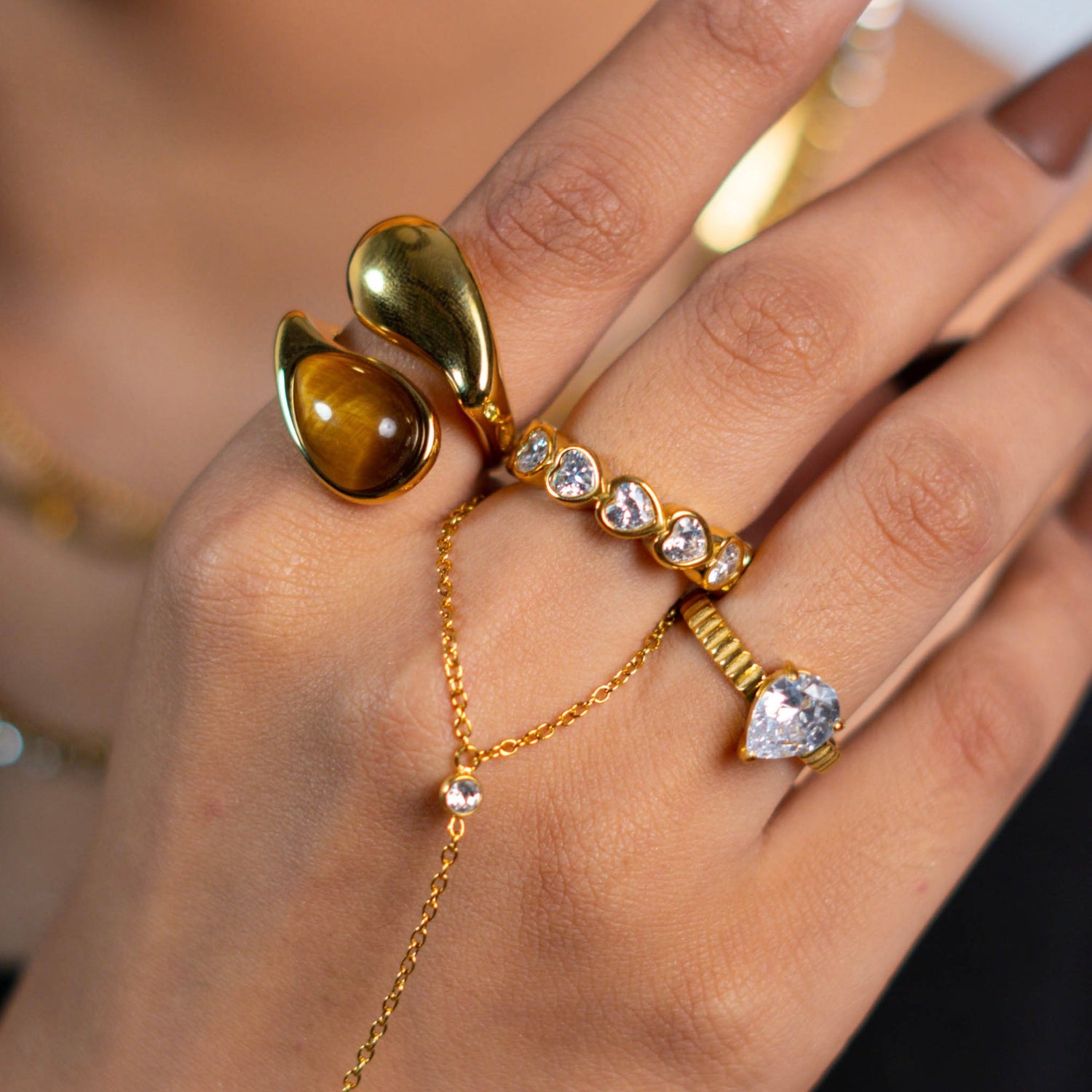
Why the ring type matters more than the design
Most people pick a ring based on how it looks in the photo. The problem is that a cocktail ring that photographs beautifully is an active hazard at a desk, and a band ring that looks understated online is the exact piece that stays on through everything and earns its place permanently. The type of ring determines how it fits into daily life — not the design on the surface.
Pakistan's heat, wuzu five times a day, and the shift between kurta and western wear all create conditions where the wrong ring type creates a problem the right one would not. This guide covers every ring type available in Pakistan, what each one is actually designed for, and where each one fails.
Band rings — the daily wear standard
A band ring is a continuous loop of uniform or near-uniform width, with no raised setting, no stone, and no significant protrusion above the finger line. It sits flat against the skin, catches on nothing, and survives every condition that a ring with a raised element cannot.
In Pakistan's context, the band ring is the one ring type that goes uninterrupted from morning to night. It passes wuzu without snagging. It does not catch on dupatta or lawn fabric. It does not scratch phone screens or press uncomfortably into adjacent fingers during typing. For daily wear in Pakistan — office, university, commute, outdoor errands in summer heat — the band ring is the reference point that every other type is measured against.
Width varies: thin bands (2–3mm) are subtle enough to stack with everything; medium bands (4–6mm) read as a deliberate single piece; wide bands (7mm+) are a statement on their own. The plain band in gold-toned PVD over stainless steel is the closest thing to a permanent ring that works in Pakistani conditions — no maintenance, no tarnish, no skin reaction from the base metal. Mithra's band rings collection covers plain and engraved options in 18K PVD over stainless steel.
Stackable and multilayer rings — the layering type
Stackable rings are thin bands — typically 1–3mm — designed to be worn in multiples on the same finger or distributed across fingers of the same hand. Individually they look minimal. Together they create a layered effect that reads as more deliberate than wearing a single statement piece.
The stackable category in Pakistan has grown because it solves a specific problem: one ring looks like an afterthought; a statement ring looks like an occasion piece. A stack of three or four thin bands sits between those two — visibly intentional but still appropriate for daily wear, professional settings, and casual contexts simultaneously. Mithra's multilayer rings collection is built specifically around pieces designed to sit together without visual noise.
The practical note: the more rings on one finger, the more friction between them. Over a full day in Pakistani summer, that friction generates heat and moisture against skin. Stainless steel base metal eliminates the green discolouration and skin reaction that brass-based stackables cause under the same conditions. For how to build a stack that looks designed rather than accumulated, the ring stacking guide covers the width and proportion rules in full.
Gemstone rings — the colour accent type
A gemstone ring centres on a coloured stone — natural, synthetic, or semi-precious — set into a metal band. The stone may be the primary visual element on a minimal band, or part of a more elaborate setting. The defining characteristic is that colour is doing most of the work.
In Pakistan, gemstone rings work on two levels. As a single accent ring worn alongside plain bands, a gemstone ring adds colour without requiring a full outfit change — the same hand can shift from neutral to intentional by adding or removing one piece. As a standalone piece for formal occasions, a well-set stone in a clean gold setting reads as polished in contexts where a sculptural statement ring would be excessive.
The material consideration: the stone itself does not react to sweat or heat — the issue is always the metal underneath and around it. A gemstone set in a brass-based ring will show tarnish at the edges of the setting, where the brass oxidises in contact with skin moisture. Stainless steel base eliminates that edge-tarnish problem. Mithra's gemstone rings collection uses PVD-plated settings over stainless steel base.
A gemstone ring worn with two plain bands on the same hand creates more visual interest than either piece does alone. The contrast between the coloured stone and the plain metal is what earns the look.
Adjustable rings — what the flexibility actually costs
An adjustable ring has an open shank that allows the diameter to expand or contract. The appeal is clear: one size fits multiple fingers and can be shared or resized without a trip to a jeweller. Mithra carries adjustable rings for this reason — not every buyer wants to commit to a fixed size before purchasing.
The practical cost of adjustable rings is worth knowing before buying one for daily wear. Every adjustment stresses the metal at the opening point. PVD coatings are designed for static wear — the molecular bond that makes them durable on a flat surface does not hold as well at a point that is repeatedly bent and re-bent. The break point in an adjustable ring is exactly where the coating is most likely to fail first, exposing the base metal underneath.
For occasional wear, gifts, and situations where the ring will be sized once and left alone, adjustable rings are a sensible choice. For daily wear in Pakistan — where heat-related finger swelling creates ongoing pressure on the metal — a sized ring in the same material will last significantly longer.
Solid gold rings — the investment type
A solid gold ring is made from actual gold alloy throughout — typically 14K or 18K — rather than a plated base metal. The gold is not a surface coating; it is the metal itself. This means the piece does not tarnish, does not fade, and does not require coating protection to maintain its colour.
In Pakistan, solid gold rings sit at a different price point from gold plated pieces — and serve a different purpose. They are investment pieces, occasion jewellery, and heirloom pieces that carry financial as well as aesthetic value. Mithra's solid gold rings collection is for buyers specifically looking for the permanence and intrinsic value of real gold rather than a plated daily-wear alternative.
The distinction matters: a solid gold ring and an 18K PVD gold plated ring look nearly identical in photographs. The difference is what sits underneath the surface. Solid gold is gold throughout. 18K PVD gold plated means an 18K gold colour coating applied over a stainless steel base through Physical Vapour Deposition. Both are legitimate choices — for different budgets, different purposes, and different levels of daily wear intensity.
Statement and cocktail rings — the occasion type
A statement ring has a raised, prominent design element — a large stone, an architectural geometric shape, an oversized sculptural form — that draws attention to the hand. It is a deliberate accent piece, not a background element.
In Pakistan, statement rings serve two distinct contexts: formal occasions (walima, dawat, event dressing) and expressive everyday styling for women who dress intentionally rather than neutrally. They do not work in every setting. A large sculptural ring in a conservative office environment reads as out of place. The same ring on a Friday casual outfit or at a mehndi function is exactly right.
The wearability constraint: any statement ring with a raised dome or large stone collects moisture underneath the setting in summer heat. Remove it periodically. This is not a reason to avoid them — it is a reason to wear them deliberately rather than as permanent daily pieces.
A statement ring worn every day stops being a statement. Its value is in the contrast it creates — which only exists if the background is something quieter.
Rings by context — comparison table
| Ring type | Daily wear PK | Office | Formal occasions | Wuzu-friendly |
|---|---|---|---|---|
| Band | Best | Best | Works as base layer | Yes |
| Multilayer / stackable | Very good | Good (2–3 max) | Good layered look | Yes |
| Gemstone | Good | Good (single piece) | Works as accent | Yes (check setting fit) |
| Adjustable | Occasional use | Occasional use | Occasional only | Yes but coating risk |
| Solid gold | Best (investment piece) | Best | Best | Yes |
| Statement / cocktail | Occasional | Context-dependent | Best here | Remove recommended |
The right base metal for all of them
The ring type determines silhouette and function. The base metal determines whether it survives Pakistani conditions. For plated rings — bands, stackables, gemstone settings, adjustable open shanks — stainless steel base outperforms brass in every Pakistani wear condition.
Brass oxidises in contact with sweat, humidity, and the alkaline soaps used for wuzu. The discolouration happens fastest under closed settings — exactly where gemstone rings and statement pieces trap moisture. Stainless steel's chromium oxide passive layer prevents oxidation at a material level. For 18K PVD over 316L stainless steel, the gold tone does not fade from sweat exposure alone, and the base does not react against skin in Pakistan's heat. For buyers who want no maintenance whatsoever and long-term value, the solid gold option removes the question entirely.
The ring that earns permanent wear
Every type in this guide serves a purpose. The statement ring has its occasion. The gemstone ring adds colour when the outfit needs it. The solid gold ring is the investment. But the ring that earns permanent wear in Pakistan — the one that goes on in the morning and you stop thinking about — is always a variation on the band or a well-chosen stackable. Slim, unraised, correctly sized, right base metal. Everything else adds to that foundation.
Browse by type at mithraofficial.com — band rings, multilayer rings, gemstone rings, adjustable rings, and solid gold rings — all with COD across Pakistan.
Frequently asked questions
Q1. Which type of ring is best for daily wear in Pakistan?
A: A plain band ring in 18K PVD over stainless steel. No raised setting to catch on fabric, no dome trapping sweat against skin, flat profile that works through wuzu without complication. Multilayer stackable rings are a close second — but the more rings on one finger, the more heat accumulates between them in Pakistani summer.
Q2. What is the difference between a solid gold ring and an 18K gold plated ring?
A: A solid gold ring is made from gold alloy throughout — the gold is the metal itself, not a surface layer. An 18K gold plated ring has a thin gold-coloured coating applied over a base metal (ideally stainless steel) through electroplating or PVD. Solid gold does not tarnish or fade under any wear conditions. A well-made PVD gold plated ring over stainless steel holds its colour through daily Pakistani wear for significantly longer than standard plating — but it is still a surface coating over a different base.
Q3. Can I wear a gemstone ring during wuzu?
A: Usually yes, if the ring sits loosely enough for water to flow underneath the stone setting. A tight-fitting closed bezel setting that presses flush against the finger creates the same water-blockage problem as any domed ring. If the ring fits with a small gap between the underside of the setting and skin, water reaches the skin and wuzu is valid. If it sits sealed against the finger, remove it.
Q4. Why do adjustable rings damage faster than fixed-size rings?
A: The flex point at the open shank concentrates mechanical stress on the coating in one spot with every adjustment. PVD coatings are designed for static wear — the molecular bond does not hold as well at a point that is repeatedly bent and re-bent. Pakistan's heat adds thermal expansion cycles on top of that stress. A fixed-size ring in the same material lasts significantly longer under identical daily wear conditions.
Q5. How do I choose between multilayer rings and a single statement ring?
A: Multilayer rings work across contexts — daily, office, and casual — because their individual pieces are quiet. A statement ring works best in one specific context because it announces itself. If your wardrobe shifts between professional and casual in the same week, multilayer rings earn more daily use. If you dress for specific occasions and want maximum impact for those moments, a statement ring is the right choice. Most women who wear rings regularly end up needing both. For how to build the stack so pieces sit together without visual competition, the ring stacking guide covers the proportion rules that make a multilayer look work.

Leave a comment
This site is protected by hCaptcha and the hCaptcha Privacy Policy and Terms of Service apply.