

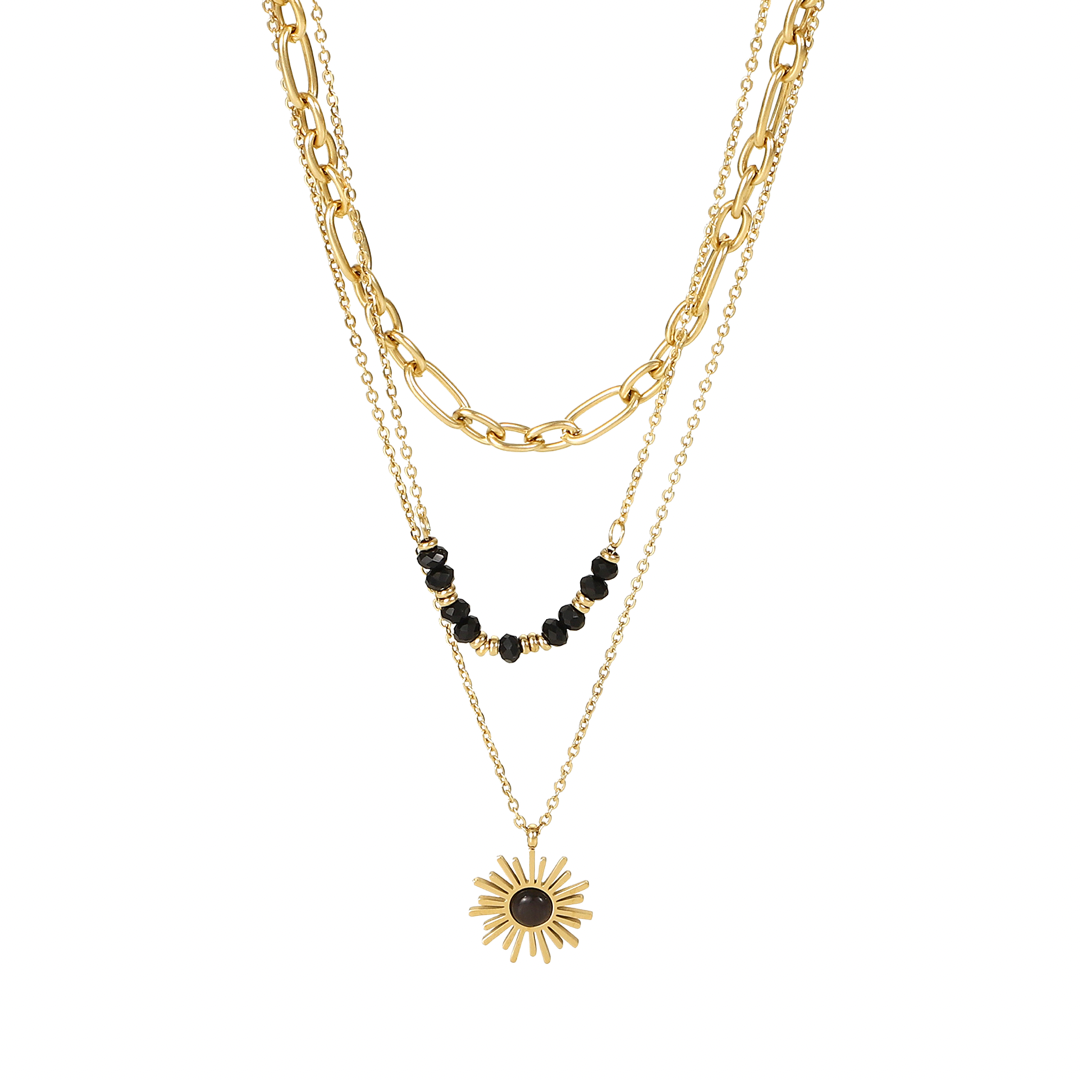
Why chain type matters before you buy
A chain necklace looks like a simple purchase until you receive it and realise it sits differently than the product photo suggested, is heavier than expected, or catches on every dupatta it touches. The chain type determines the weight, the drape, the thickness, the flexibility, and the visual density — none of which are obvious from a product image alone. Knowing what each chain type actually is before ordering resolves all of these.
Pakistan's specific outfit context also filters the chain category. A chain that works perfectly against a western neckline sits wrong against a kurta collar. A lightweight paperclip chain that is subtle on its own becomes the right foundation for a pendant over a plain kameez. This guide covers every major chain type by structure, by feel, and by how it actually behaves in Pakistani wear conditions.
Box chain — the most versatile daily wear chain
A box chain is made from square links connected end-to-end at 90-degree angles. The cross-section of each link is a box — four flat sides rather than the curved wire of a round link. The resulting chain is smooth, structured, and relatively rigid compared to round-link alternatives. It lies flat against the skin and does not rotate or twist under a pendant.
In Pakistani daily wear, the box chain is the most consistently useful chain type. The flat, smooth surface does not catch on dupatta fabric at the collar line. The structured links do not kink or tangle during storage or wear. A pendant sits centred and stable because the chain does not rotate under weight the way a rounder-link chain does.
Width range: 1mm (delicate, barely visible) to 3mm (substantial, visible as a chain rather than a line). For daily wear over Pakistani suits, 1.5–2mm is the most practical range — visible enough to read as intentional, fine enough to work under or over a dupatta without creating bulk.
Rope chain — the textured statement chain
A rope chain is made from small oval links twisted together in a spiral pattern, creating a surface that resembles twisted rope. The twisting gives the chain visual complexity — it catches light differently from different angles, and the surface texture makes it look heavier and more substantial than its weight suggests. A 2mm rope chain reads visually as a 3–4mm chain due to the light interaction with the twisted surface.
Rope chains work well in Pakistani formal and semi-formal contexts — mehndi guest wear, office event dressing, dinner occasions, and Eid outfit styling where a plain chain would be too understated but a statement pendant would be too much. The rope chain is a statement piece on its own, without requiring anything added to it.
The one practical limitation: rope chains are more prone to kinking than box or cable chains because the links are twisted rather than flat. Storing a rope chain without a clasp closure, or pulling it from a tangled jewelry box, can create permanent kinks in the spiral. Keep it clasped during storage and hang it separately if possible.
Cable chain — the round-link standard
A cable chain is the simplest and most common chain structure: uniform oval or round links connected alternately at right angles to each other. The flat-to-the-eye cross-section of alternating links creates the characteristic look of a linked chain — what most people picture when they think of a necklace chain without a specific type in mind.
Cable chains are lightweight, flexible, and drape naturally against the neckline. They suit layering because they are flat and fine enough to sit alongside other chains without competing. A 1–1.5mm cable chain is the default choice for pendant necklaces in Pakistan — the chain disappears visually and lets the pendant carry the attention.
The limitation compared to box chain: cable chains are more prone to rotation under pendant weight because the round links have more pivot freedom than flat box links. A pendant on a cable chain may flip to the back under a collar during commuting. A pendant on a box chain sits more stably.
Figaro chain — the mixed-link pattern
A Figaro chain alternates between two or three smaller round links and one elongated rectangular or oval link, creating a repeating pattern rather than a uniform structure. The pattern gives it visual rhythm — the eye follows the alternation rather than reading the chain as a solid line or a uniform texture.
In Pakistan, Figaro chains work as mid-weight chains that are more interesting than a plain cable chain but less dramatic than a rope chain. Worn alone without a pendant at 45–50cm, a 2–3mm Figaro chain sits as a standalone necklace over a plain kurta or western neckline. The pattern reads as intentional without looking like occasion jewellery.
For pendant use, the alternating link pattern means the pendant sits slightly less flat than on a box chain — the elongated links create small gaps in the chain plane where the pendant can rotate. A smaller, lighter pendant works better on a Figaro chain than a heavy, asymmetric pendant.
Paperclip chain — the flat modern chain
A paperclip chain is made from elongated rectangular links — large, flat, open ovals that resemble the shape of a paper clip. The links are wide enough to be individually visible rather than reading as a continuous line, giving the chain a graphic, modern quality. The flat surface catches light uniformly and the wide links create a chain that reads as substantial even at light weight.
The paperclip chain arrived in Pakistani jewelry mainstream through the global minimal jewelry trend and the old money aesthetic. It is one of the few chain types that works visually at short collar lengths (38–42cm) because the link size means even a short length reads as a complete piece rather than looking unfinished.
Against Pakistani suits, the paperclip chain sits best against plain fabric — the graphic link pattern has enough visual information that it competes with printed or heavily embroidered fabric rather than complementing it. Against a plain white or solid-coloured kurta, it is one of the most effective single-chain looks available.
Snake chain — the smooth solid-surface chain
A snake chain is made from tightly fitted metal plates or rings that create a smooth, solid-surface tube rather than individual visible links. The surface is continuous — running a finger along it feels like smooth metal rather than individual links. The movement is fluid and the drape follows the neckline precisely because there are no link gaps to create stiffness.
Snake chains are delicate in a specific way: the smooth plate construction means they do not kink but they can crack at the joints under sharp bending. A snake chain should never be coiled tightly during storage or bent at a hard angle. Stored hanging, it lasts. Crammed into a jewelry box, the joints where the plates connect can fracture.
In Pakistani wear, snake chains work best as pendant chains for lightweight pendants, and as standalone chains at 1–2mm at collar length. The smooth surface creates a very clean, minimal look that works against formal Pakistani fabric — the absence of link texture means the chain reads as a line of colour rather than a structural element.
Curb chain — the flat-link heavy chain
A curb chain is made from uniform twisted oval links that lie flat when the chain is worn. The links are twisted during manufacturing so that they all lay in the same plane when the chain hangs — the result is a flat, dense chain with significant visual weight and actual weight. Cuban link chains are the widest, heaviest version of the curb chain family.
In Pakistan, curb chains occupy the statement end of the daily wear spectrum. A 3–4mm curb chain at 45cm worn alone is a deliberate outfit decision. The weight and width make it visible from across a room in a way that a box chain or cable chain is not. Wide curb chains (5mm+, Cuban link style) are more aligned with high-fashion or occasion contexts than with everyday office or campus wear.
For layering, a thin curb chain (2mm) alongside a cable or box chain creates contrast — the flat texture of the curb link reads differently from the rounder profile of the cable, making the layered pair visually distinct rather than looking like duplicates of the same chain type.
Herringbone chain — the flat surface chain
A herringbone chain is made from small, flat, V-shaped links arranged in a parallel diagonal pattern — the same pattern as herringbone fabric. The surface is completely flat and smooth with no visible individual links from the front. The chain lies flat against skin like a strip of metal rather than a linked chain.
Herringbone chains are fragile compared to other chain types. The flat surface construction has no flexibility — any kinking or hard bending permanently damages the link alignment. They should be worn, removed, stored flat, and not layered with heavier chains that could press them out of alignment. In Pakistani daily wear conditions — commuting, dupatta friction, removing and replacing — herringbone chains require more care than box or cable chains to maintain their appearance.
Visually, the herringbone creates a reflective, solid-surface look that is unlike any other chain type. Worn at 38–42cm at collar length, a 5–7mm herringbone chain makes a significant statement against plain fabric with zero embellishment. It is a high-maintenance piece for the occasions where that specific look is worth the care requirement.
Chain types by context — comparison table
| Chain type | Visual weight | Pendant suitability | Layering | Daily wear PK | Dupatta-friendly |
|---|---|---|---|---|---|
| Box chain | Medium | Best — stable, no rotation | Very good | Best | Yes |
| Cable chain | Light | Very good — light pendants | Best | Very good | Yes |
| Paperclip | Medium-high | Good — small pendants | Good | Good (plain fabric) | Yes |
| Figaro | Medium | Good — lighter pendants | Good | Good | Yes |
| Snake | Medium | Good — lightweight only | Works | Good (careful storage) | Yes |
| Rope | High | Works alone without pendant | Moderate | Semi-formal | Yes (short length) |
| Curb / Cuban | High | Statement alone | Contrast layering | Statement daily | Yes (short length) |
| Herringbone | High | No pendant — chain is the piece | No | Occasional (fragile) | Careful |
Which chain for which Pakistani outfit
Lawn suits and printed fabric: Box chain or cable chain. Fine, smooth, and does not compete with the fabric pattern. A 1.5mm box chain with a small pendant disappears against printed lawn and lets the outfit carry the look.
Plain kurta or solid kameez: Paperclip chain, rope chain, or Figaro. The plain fabric gives the chain room to read as a deliberate piece. A 2mm paperclip chain at 42cm against a white or navy kurta is a complete look without needing anything else.
Western wear (shirts, tops, blouses): Any chain type works proportionally. Open necklines give chain visibility that Pakistani suit collars often reduce. The paperclip chain, curb chain, and rope chain all read well against western necklines.
Formal Pakistani wear (mehndi, walima, dawat): Rope chain, curb chain, or layered combinations. The occasion context supports heavier, more visually complex chains that would be too much for daily office wear.
The chain that earns daily wear in Pakistan
For most Pakistani daily wear conditions — office, university, commuting, wuzu — the box chain or cable chain in 18K PVD over stainless steel is the starting point. Fine enough to layer, stable enough for pendants, smooth enough not to catch on fabric, and durable enough to survive Pakistani summer conditions without maintenance.
For the complete guide to necklace length, style, and how chain type relates to pendant sizing, the pendant chain length guide covers how chain type and length interact. For the full necklace category overview including non-chain styles, the gold plated necklaces guide covers all buying decisions. Browse neck chains and all necklaces at mithraofficial.com — 18K PVD over stainless steel, COD across Pakistan.
Frequently asked questions
Q1. Which chain type is best for wearing a pendant in Pakistan?
A: Box chain is the most reliable for pendant wear. The flat square links prevent the chain from rotating under the pendant's weight, which keeps the pendant centred and facing forward. Cable chains work well for lighter pendants. Rope chains and curb chains are better worn alone without a pendant — the chain itself provides enough visual weight that a pendant added on top creates competition rather than accent.
Q2. What is the difference between a box chain and a cable chain?
A: A box chain has square, flat links connected at right angles — the cross-section of each link is a box shape. A cable chain has round or oval links connected alternately at right angles — the classic linked chain look. Box chains are stiffer and more stable under pendant weight. Cable chains are more flexible and better for layering. Both are everyday-appropriate in Pakistan.
Q3. Which chain type is most durable for daily Pakistani wear?
A: Box chain and cable chain are the most durable for daily wear. The linked structure has flex points between links that distribute stress, which means they bend without breaking. Herringbone and snake chains are the most fragile — their flat-plate construction has no flex tolerance and permanent damage from kinking can happen in a jewelry box. Rope chains are moderately durable but prone to kinking at sharp bends.
Q4. Can I wear a chain necklace during wuzu?
A: For most chain necklaces, yes. Water flows through and around the chain links, reaching the skin underneath. The exception is very tight snake or herringbone chains worn at a length where the chain sits sealed against the neck — in that case water may not reach the skin underneath the chain at the contact points. For everyday wuzu with box, cable, rope, or Figaro chains worn at standard neck lengths, removal is not required.
Q5. What chain type works best for layering multiple necklaces in Pakistan?
A: Cable chains layer best because they are the flattest and finest in profile — multiple cable chains sit alongside each other without creating bulk. Box chains layer well at different widths. For contrast layering (making the individual chains visually distinct), combine a fine cable chain with a paperclip chain and a thin curb chain — the different link structures read as three separate pieces rather than three of the same. For the full technique, the necklace guide covers layering proportions in detail.

Leave a comment
This site is protected by hCaptcha and the hCaptcha Privacy Policy and Terms of Service apply.