

Why the style of a necklace matters as much as the length
Most guides on necklaces in Pakistan cover one thing: chain length. How many inches, where it sits, which neckline it pairs with. That is one variable. The style of the necklace — whether it is a chain, a pendant, a choker, a layered set, a tennis necklace, or a collar — is a different variable entirely, and it determines far more about whether the piece works with your outfit and your daily life than the length alone does.
A 16-inch pendant necklace and a 16-inch plain chain are both 16 inches. They work completely differently on the same neckline, with the same outfit, in the same occasion context. This guide covers every necklace style available in Pakistan's gold plated market — what each one actually is, how it behaves on the body, what it pairs with, and when each one is the right choice.
Plain chain necklaces — the daily foundation
A plain chain necklace has no pendant, no focal point, no hanging element. It is a continuous loop of linked metal that sits on the neck or chest and catches light as it moves. The chain's visual character comes entirely from its link pattern — the shape and size of the individual links determine how the chain looks and feels.
In Pakistan's gold plated market, plain chains appear in five primary link styles:
| Link Style | What It Looks Like | How It Sits on the Neck | Best Outfit Context |
|---|---|---|---|
| Cable / rolo | Round or oval links of uniform size connected in a line. The simplest, most common chain pattern. | Flexible and fluid. Drapes naturally against the collarbone. The links are visible but not dominant. | Everything. The cable chain is the most versatile necklace style in existence. Plain kurta, casual western, formal wear — it has no wrong context. |
| Box chain | Square links connected at right angles forming a smooth, structured tube. Looks more solid and geometric than a cable chain. | Sits stiffly but evenly. Does not tangle. The structure is visible and deliberate. | Contemporary and western-influenced outfits. Works particularly well with plain, minimalist Pakistani dressing. The geometric structure reads as considered. |
| Figaro | Alternating pattern: typically two or three small round links followed by one longer oval link, repeating along the length. | Sits flat and close to the skin. The pattern creates visual rhythm that a plain cable chain does not. | Casual and smart-casual. Works with both plain and embellished outfits because the pattern creates its own visual interest without requiring a pendant. |
| Rope chain | Multiple metal strands twisted together to create a textured, spiralling surface. Looks thicker and more substantial than its weight suggests. | Holds its shape. The twist gives it a three-dimensional profile that reflects light from multiple angles simultaneously. | Evening and semi-formal wear. The rope chain reads as more elevated than a plain cable chain at equivalent length. Works with formal Pakistani wear without being heavy. |
| Paperclip / rectangle | Large, flat, rectangular links in an open design. A contemporary style that became widely available in Pakistan's market after 2022. | Lies flat and graphic. Very visible — the links are large enough to read as a design element rather than background texture. | Contemporary casual and editorial. Pairs with plain, minimal outfits where the chain is the statement. Less versatile than cable or box but more distinctive. |
The plain chain is the correct first necklace purchase for any Pakistani woman building a jewelry collection. It is the piece that goes on automatically every morning and requires no styling decision. The guide to building a jewelry collection in Pakistan covers why the plain chain is the correct starting point and what to add after it.
Pendant necklaces — a chain with a focal point
A pendant necklace is a chain — any of the styles above — with a separate decorative element hanging from it. The pendant is the focal point. The chain is the vehicle. The combination creates a visual hierarchy on the chest: the eye travels down the chain and arrives at the pendant.
The pendant style determines the character of the necklace entirely. The same 18-inch box chain carries a different register depending on whether the pendant is a small geometric disc, a cross, a clover motif, a teardrop stone, or a bar. The chain is neutral. The pendant is the statement.
The most common pendant necklace mistake in Pakistani everyday dressing is choosing the chain length without considering where the pendant actually lands. A 16-inch chain places the pendant at the throat on a woman of average Pakistani height. An 18-inch chain places it at the collarbone. A 20-inch chain places it on the chest. These three positions create completely different relationships with every neckline — and the neckline, not the pendant design, should determine which length you choose.
Common pendant types available in Pakistan's gold plated market and what each one signals:
- Geometric pendants — circles, triangles, bars, hexagons. The most contemporary and wearable category. Reads as intentional without being occasion-specific. Works for daily wear, office, university.
- Motif pendants — clover, star, crescent, heart, flower. The design carries meaning or aesthetic association. The clover is currently the dominant motif in Pakistan's contemporary jewelry market. Reads as playful and personal.
- Stone-set pendants — a metal setting holding a cubic zirconia, crystal, or coloured stone. Adds sparkle and formality. Better for events and semi-formal occasions than for daily wear, where stones collect perfume residue and soap faster than plain metal.
- Bar and lariat pendants — a horizontal or diagonal bar, or a Y-shaped lariat that drops two lengths simultaneously. Particularly clean with V-neck necklines where the pendant echoes the V's geometry.
For the specific interaction between pendant length and Pakistani outfit necklines, the gold plated necklaces guide maps every neckline against the correct chain length in detail.
Choker necklaces — fitted, close to the neck
A choker is any necklace that sits at the base of the neck — typically 12 to 14 inches. The defining characteristic is that it does not drop below the collarbone. It sits at the throat, creating a horizontal band of metal at the base of the neck rather than a draping element on the chest.
Chokers read differently in Pakistani dress than in Western contexts. In Pakistani styling, a choker competes with the neckline of the suit or outfit for the same visual space. An embroidered or detailed neckline — common in Pakistani formal and semi-formal wear — will clash with a choker because both are operating at the same level. A choker works best with plain, clean necklines where the throat is undecorated and the choker becomes the neckline's only element.
Plain chain chokers at 14 inches are the most wearable version for daily Pakistani life — thin enough to sit cleanly against the throat without adding visual weight to an area already framed by a collar or dupatta. Wider, decorated chokers — mesh, statement, beaded — are occasion-specific pieces that work for events where a Pakistani woman is wearing a deliberately bold look.
Layered necklaces — multiple chains worn together
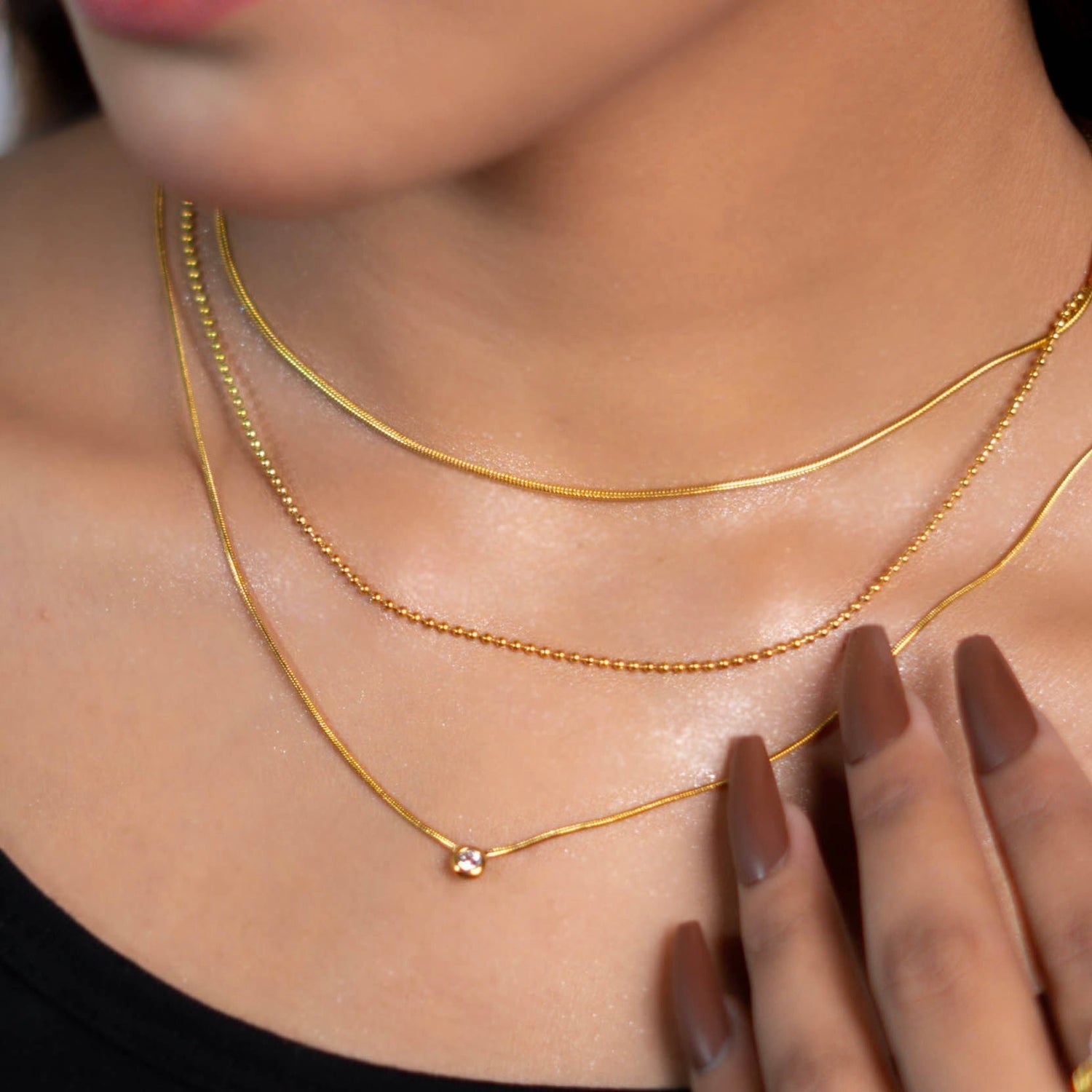
A layered necklace look is two or three chains worn simultaneously, each at a different length, so that they sit at visibly separated levels on the chest. The separation is the technique: without clear length difference between each layer, the chains tangle, overlap, and create confusion rather than a designed look.
The rule that makes layering work is minimum two-inch length difference between each chain. A 16-inch chain and an 18-inch chain create one inch of visible separation on most Pakistani women — not enough to read as deliberate. The same 16-inch chain with a 20-inch chain creates four inches of separation that reads clearly as a designed layer.
For the complete framework of which chain styles layer well together, which combinations create visual harmony versus noise, and how to handle a dupatta with a layered look: the layered necklace sets guide for Pakistan covers the full technique.
Tennis necklaces — a continuous line of stones
A tennis necklace is a single-row necklace where individually set stones — cubic zirconia in Pakistan's gold plated market — are spaced continuously along the full length of the necklace, from clasp to clasp. The result is a necklace that produces an unbroken line of sparkle around the entire neck.
The tennis necklace differs from a pendant stone necklace in one specific way: there is no plain chain and a pendant. The stones are the necklace. Every element of it reflects light. This makes it a statement piece by definition — it cannot be worn minimally. It is always the focal point of whatever it is worn with.
In Pakistan, tennis necklaces work best at formal events, wedding functions, and evening occasions where the surrounding outfit has enough visual weight to absorb the necklace's presence. On a casual lawn kurta, a tennis necklace looks like event jewelry worn on a Tuesday — the register mismatch is obvious. On a plain formal shalwar kameez for a dinner or walima, it is exactly right.
The related style — the tennis bracelet — follows the same logic applied to the wrist. The tennis necklace guide for Pakistan covers sizing, clasp types, and occasion mapping in detail.
Collar necklaces — wide, structured, sits on the collarbone
A collar necklace is wider and more structured than a choker. Where a choker is a narrow band at the base of the throat, a collar sits lower — at the collarbone level — and has enough width or structural presence to read as architectural rather than delicate. Collar necklaces can be a solid curved metal piece, a wide mesh design, or a heavily set piece with stones or motifs filling the band.
Collar necklaces are the least versatile necklace style in Pakistani daily wear because they require a specific neckline to work. An off-shoulder neckline, a wide boat neck, or a simple round neck on a plain garment gives a collar necklace the visual space it needs. Any neckline with detail, embroidery, or structure at the collar level will compete with a collar necklace. The two fight and neither wins.
For Pakistani women who wear primarily kurtas and shalwar kameez, a collar necklace is an occasion-specific purchase. It is the right choice for one or two specific looks — a plain ethnic outfit at a formal event where the collar is the statement — and the wrong choice for most daily contexts.
Lariat and Y-necklaces — open-ended, adjustable drop
A lariat necklace has no clasp. Instead, one end of the chain passes through a loop or pendant element and both ends hang freely, creating an adjustable, open-ended drape. A Y-necklace is a close relative — it has a defined chain that splits into a Y shape at the chest, with a pendant hanging from the lowest point of the Y.
Both styles share a property that makes them particularly suited to V-neck outfits: they echo the geometry of the V-neckline by directing the eye downward along the same diagonal lines. A lariat or Y-necklace on a V-neck outfit creates a visual completion of the V's geometry that no other necklace style achieves as naturally.
In Pakistani dress, the V-neck appears in both contemporary western cuts and in some kurta styles. The lariat or Y-necklace on a plain V-neck kurta in a solid colour is one of the cleanest contemporary Pakistani styling combinations available — the outfit provides a simple ground, the necklace does all the decorative work, and nothing else is needed.
How necklace style interacts with Pakistani outfit occasions
| Occasion | Best Necklace Style | Why | Avoid |
|---|---|---|---|
| Daily casual / lawn suit | Plain cable or box chain, 16–18" | The outfit is light. The chain adds gold presence without visual competition. | Tennis necklace (too formal), collar (too structured) |
| Office / professional | Plain chain or simple pendant, 16–18" | Professional environments require minimal distraction. One clean piece. | Layered stacks, stone-set statement pendants |
| University | Plain chain, pendant, or a 2-layer stack | More styling freedom than office. Layering reads as fashion-forward without being overdressed. | Very heavy stone-set pieces that read as event jewelry on a student |
| Mehndi function | Layered chains, colourful pendant | Festive, colourful occasion. The necklace can have more presence and playfulness. | Formal tennis necklace (wrong register for mehndi's festive energy) |
| Baraat / Walima | Tennis necklace, stone pendant, or elegant plain chain | Formal Pakistani event. The necklace should have enough presence to read at formal register. | Very casual plain chains that understate the occasion |
| Office dinner / evening | Rope chain, Y-necklace, or a layered look on a plain outfit | Semi-formal. More than daily wear, less than a wedding function. | Collar necklaces (unless the outfit is specifically designed to carry one) |
The material question — what stays gold through Pakistani daily wear
Every necklace style in Pakistan's market exists in two material realities: pieces built on a stainless steel base with PVD coating, and pieces built on brass or zinc alloy with standard electroplating. The style looks identical in both versions. The lifespan and skin behaviour are completely different.
Necklaces contact the back of the neck — one of the highest-sweat areas on the body — for the full duration of wear. The clasp and the chain section at the back of the neck receive the most sustained chemical exposure from sweat, perfume spray applied near the neck, and in Pakistan's summer, the accumulated heat that never fully dissipates between April and September.
On a brass base, the back-of-neck contact point shows the first visible degradation — darkening, colour change, or skin discolouration on the neck — within weeks of daily wear in Pakistani summer conditions. On a stainless steel PVD base, the same contact point handles this exposure without the base metal corroding. The coating at high-contact points experiences surface wear over months, not acute chemical breakdown over weeks.
The choice of necklace style matters. The choice of base metal determines whether that style still looks like itself six months from now.
Frequently asked questions
Q1. What necklace style is most popular in Pakistan right now?
A: Plain cable chains at 16–18 inches and pendant necklaces with geometric or clover motifs are the dominant styles in Pakistan's contemporary gold plated market in 2026. The layered look — two chains worn simultaneously at different lengths — is the styling approach with the most growth. Tennis necklaces are established in the formal and event segment. The choker has declined from its 2019–2021 peak but remains present in statement-wear contexts.
Q2. Which necklace style works with a kurta shalwar?
A: A plain cable or box chain at 16–18 inches is the most reliable choice with any kurta shalwar. For embroidered necklines — the most common challenge in Pakistani dress — either a very short chain (14") that sits above the embroidery, or skip the necklace entirely and wear earrings only. For plain kurtas with a V-neck or round neckline, a pendant necklace or a two-layer stack works well because the plain fabric gives the necklace visual room.
Q3. What is the difference between a choker and a collar necklace?
A: A choker is narrow — typically a thin chain or simple band — and sits at the very base of the throat, around 12–14 inches. A collar is wider, more structured, and sits at or just below the collarbone. A choker is delicate and primarily decorative. A collar is architectural and makes a statement by its structure and width. In practical terms: a choker can be worn with a wide range of outfits, a collar requires a specific neckline to work.
Q4. How many necklaces can you wear together in Pakistan?
A: Two or three, with a minimum of two inches of length difference between each layer. Two is the daily-wear standard. Three is for fashion contexts and festive occasions. Beyond three, the look tips from layered to cluttered. The other constraint: pendant necklaces should be limited to one per stack — multiple pendants at different lengths tangle and visually compete.
Q5. Which necklace style should I buy first if I'm starting a collection in Pakistan?
A: A plain cable or box chain at 16–18 inches in 18K PVD over stainless steel. It works with more outfits, more occasions, and more other jewelry than any other necklace style. Everything else — the pendant, the layering chain, the tennis necklace for events — gets added to this foundation. A plain chain worn daily for two years becomes part of your identity in a way no occasion piece does. Start there. Browse necklaces at mithraofficial.com — COD across Pakistan.

Leave a comment
This site is protected by hCaptcha and the hCaptcha Privacy Policy and Terms of Service apply.