

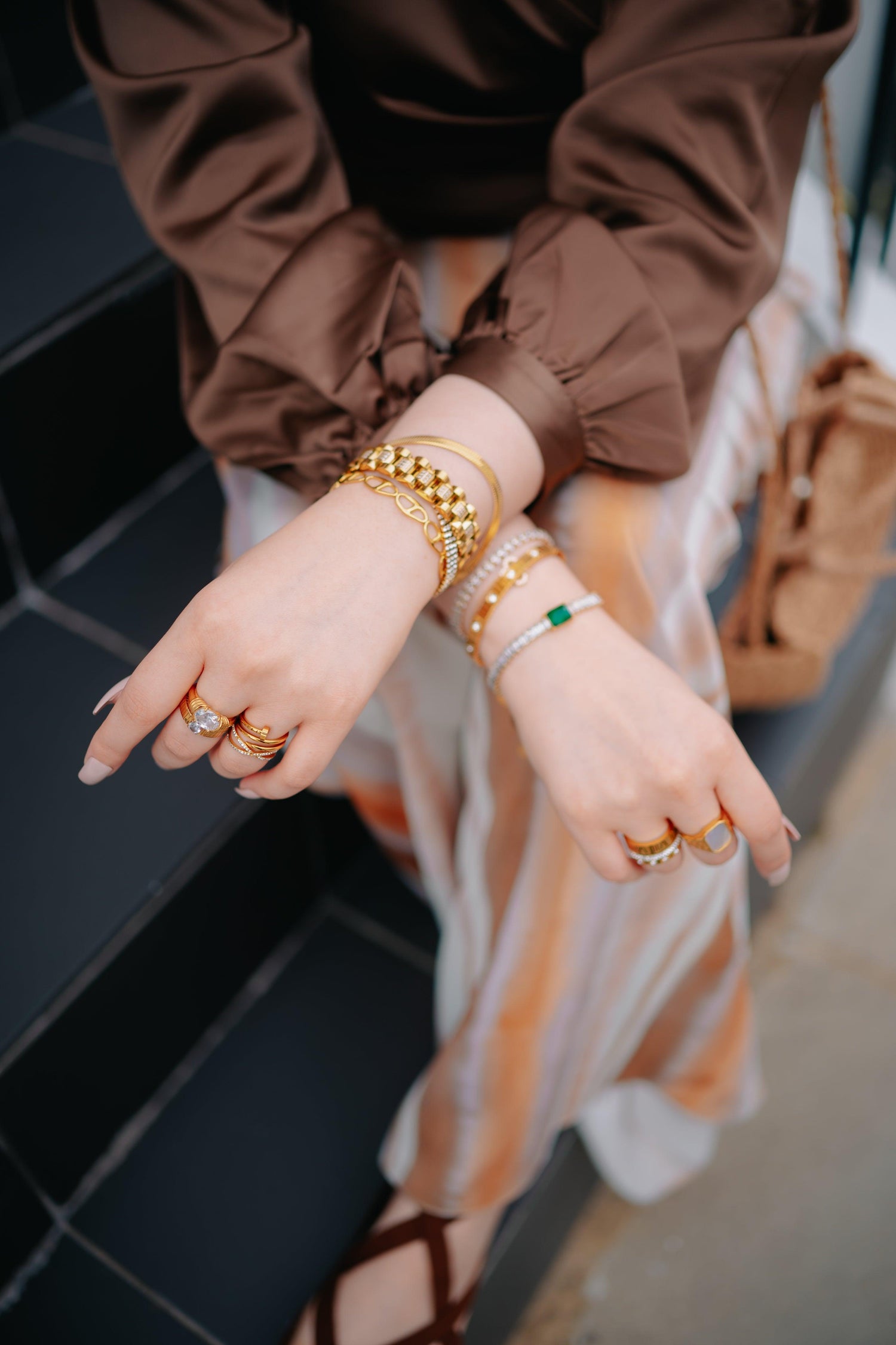
Why bracelet type matters before you buy
The bracelet category in Pakistan is wide enough that "bracelet" as a search term covers pieces with almost nothing in common — a thin chain bracelet and a rigid bangle are both bracelets, but they behave differently against every Pakistani outfit context, survive Pakistani conditions differently, and serve entirely different purposes on the wrist. Knowing what each type actually is before ordering resolves the gap between what you expected and what arrives.
Chain bracelets — the daily wear standard
A chain bracelet is made from linked metal segments — the same link structures as necklace chains (box, cable, figaro, curb) applied to a bracelet format with a clasp closure. The chain sits against the wrist with natural flex and movement. It is the lightest bracelet type by weight for a given visual size, and the clasp closure means it can be removed and put on quickly.
In Pakistani daily wear, chain bracelets are the most practical bracelet type across the widest range of contexts. The chain lies flat against the wrist without bulk. It does not create the rigid pressure of a bangle during extended wear in summer heat. The clasp removes it cleanly for wuzu. A 2–3mm gold-toned chain bracelet in 18K PVD over stainless steel is the closest bracelet equivalent to the plain band ring — it works in every context without demanding attention. Mithra's chain bracelets collection covers the main chain link styles in PVD-plated stainless steel.
Cuff bracelets — the open-ended rigid type
A cuff bracelet is a rigid, open-ended band that slides over the wrist rather than fastening with a clasp. The opening allows it to be put on and removed without a clasp mechanism — you slide it over the narrowest part of the wrist and position it on the arm. The rigidity comes from the material: cuffs are typically made from a single piece of metal or a thick gauge band rather than linked segments.
Cuffs in Pakistan occupy a specific position between casual and formal. A slim 8–10mm plain gold cuff worn alone reads as minimal and intentional — it works in office and professional settings where a bangle stack would be too much. A wider, textured or embossed cuff reads as a statement piece suited to occasions.
The Pakistani summer consideration: a rigid cuff sitting directly on the wrist creates a sealed contact area against skin during heat. Moisture accumulates under a tight-fitting cuff faster than under a chain bracelet with natural gaps. For extended wear in heat, a cuff that sits slightly loose — with natural air circulation — is more comfortable than one fitted precisely to the wrist.
Bangles — the traditional rigid type
A bangle is a rigid, closed-circle bracelet with no opening or clasp — it passes over the hand rather than opening to fit around the wrist. The closed structure means it cannot be adjusted and must be sized to fit over the widest point of the hand (the knuckles together). Bangles are worn in sets — the characteristic sound of multiple bangles moving against each other is part of their cultural function in Pakistan.
Bangles sit differently from cuffs and chains because they move freely on the wrist rather than sitting in a fixed position. The movement is both a feature and, in some professional contexts, a constraint — in a quiet office environment, the sound of multiple gold bangles is a distraction that a single cuff or chain bracelet is not.
For the practical distinction between bangles and bracelets in Pakistani context — including when each type is culturally appropriate — the bangles vs bracelets guide covers the full comparison. Mithra carries bangles and cuffs in the bangles and cuffs collection.
Tennis bracelets — the stone-set line bracelet
A tennis bracelet is a flexible, symmetrical line of individually set stones — typically cubic zirconia in gold-plated settings — that runs continuously around the wrist. The name comes from a 1987 incident where tennis player Chris Evert's diamond bracelet broke during a match; the style became the category name. The defining characteristic is the continuous line of matched stones with no plain metal sections between them.
In Pakistan, tennis bracelets function as the most formal bracelet type that can still be worn for daily use. A single tennis bracelet on a bare wrist reads as polished rather than decorative — the continuous sparkle is present but not loud. For formal occasions — walima, dawat, office events — a tennis bracelet adds enough visual presence to complete a formal outfit without requiring additional pieces.
The Pakistan-specific consideration is stone setting security. Tennis bracelets in Pakistan's heat and humidity should be checked periodically for loose settings — moisture accumulation under prong settings over time can weaken the prong-to-metal adhesion on lower-quality pieces. Bezel-set tennis bracelets (where the stone sits inside a continuous metal collar rather than under prongs) are more secure for daily Pakistani wear conditions. Mithra's tennis style bracelets cover both prong and bezel setting options.
Charm bracelets — the personalised accumulation type
A charm bracelet is a chain bracelet with small pendant charms attached at intervals along the chain. The charms — small three-dimensional objects in metal or enamel — hang from the chain links and move independently. The bracelet grows over time as charms are added, making it inherently personal rather than a finished design.
In Pakistani daily wear, charm bracelets sit at the casual and personal end of the bracelet spectrum. The charms create sound when they move against each other — a constraint in professional settings, a feature in casual and social ones. The weight of accumulated charms also increases significantly as the bracelet fills, making fit and weight relevant buying considerations.
For daily office wear in Pakistan, a charm bracelet with three or fewer charms — lightweight, minimal movement — behaves closer to a chain bracelet. A fully loaded charm bracelet with 10+ charms is firmly in casual or occasion territory.
Hand chain bracelets — the ring-to-wrist connector type
A hand chain bracelet connects a wrist bracelet to a ring on the finger via a chain that runs across the back of the hand. The piece creates a linked silhouette from finger to wrist that no other bracelet type provides. It is a single piece worn as a combination bracelet and ring.
In Pakistan, hand chains have grown in popularity through social media and wedding guest styling — they photograph distinctively and create visual interest on the hand that no conventional bracelet achieves. For formal photography contexts, engagement shoots, and event dressing, they are highly effective. For daily wear — typing, cooking, handling bags and doors — the chain across the back of the hand creates practical interference that makes them event-specific rather than daily pieces. Mithra carries hand chains in the chain bracelets collection.
Petit and delicate bracelets — the minimal layering type
Petit bracelets are fine, lightweight chain or bead bracelets — typically under 2mm in width — designed specifically for layering in multiples rather than wearing as single statements. They are the wrist equivalent of stackable rings: individual pieces that are quiet alone and collectively create a considered look.
For Pakistan's daily wear context, petit bracelets are the easiest bracelet type to maintain across all conditions. The fine chain or bead construction is light enough not to create heat accumulation against the wrist. They do not make sound when moved. They layer without bulk. And because they are fine, they transition between kurta, lawn suit, and western wear contexts without looking out of place in any of them.
Bracelet types by context — comparison table
| Bracelet type | Daily wear PK | Office | Formal occasions | Wuzu removal | Layering |
|---|---|---|---|---|---|
| Chain bracelet | Best | Best | Works well | Easy — clasp | Best |
| Petit / delicate | Best | Best | Layered base | Easy — clasp | Best |
| Cuff | Very good | Very good | Good (statement) | Easy — slides off | Moderate |
| Tennis bracelet | Good | Very good | Best | Easy — clasp | With fine chain |
| Bangle | Good | Context-dependent | Best in sets | Slides over hand | In sets |
| Charm bracelet | Casual only | Minimal charms only | Casual occasions | Easy — clasp | Limited |
| Hand chain | No | No | Event / photo | Remove entirely | No |
Which bracelet type for which Pakistani outfit
Lawn suits and daily kurta: Chain bracelet or petit bracelet. Fine, smooth, does not catch on fabric. A single 2mm chain bracelet is enough against a printed lawn suit — anything heavier competes with the fabric.
Plain kurta or western wear: Chain bracelet, cuff, or tennis bracelet. The plain fabric gives the bracelet room to read as a deliberate piece. A plain gold cuff against a white shirt or a solid-coloured kurta makes a clean statement without needing anything else.
Formal Pakistani wear (mehndi, walima, dawat): Bangle sets, tennis bracelet, or statement cuff. The occasion context supports pieces with more visual weight and sound. A set of thin gold bangles at a mehndi is exactly right; the same set in a quiet office meeting is not.
Frequently asked questions
Q1. What is the difference between a cuff and a bangle?
A: A cuff is open-ended — it has a gap and slides onto the wrist from the side, which means one size fits a range of wrist widths without needing an exact measurement. A bangle is a closed circle with no gap, so it has to pass over the knuckles to reach the wrist, which means it needs to match your hand width exactly or it either won't go on or will slide off. If you're unsure of the recipient's sizing, a cuff is the safer buy of the two rigid types.
Q2. Which bracelet type should I buy first if I'm starting from nothing?
A: A single chain bracelet in a neutral gold tone, 2–3mm width, in 18K PVD over stainless steel. It works across daily wear, office, and most Pakistani outfit contexts without looking out of place, removes easily for wuzu, and gives you a baseline to build around before adding anything more specific — a tennis bracelet for formal occasions, a cuff for a minimal statement, or bangles for festive wear.
Q3. What bracelet type works best for stacking multiple pieces on one wrist?
A: Chain bracelets and petit delicate bracelets layer without bulk — their flat profile allows multiple pieces to sit alongside each other cleanly. Tennis bracelets layer well with fine chain bracelets but not with other tennis bracelets. Cuffs do not layer with each other — wear one cuff with chain bracelets on the same wrist rather than multiple cuffs. Bangles layer only with other bangles, in sets of 2–6 depending on wrist size.
Q4. How does a hand chain differ from a regular bracelet in daily use?
A: A hand chain connects to a ring and runs across the back of the hand, which means it interferes with typing, cooking, and handling bags in a way a standard wrist-only bracelet doesn't. It's built for photography and event dressing — engagement shoots, wedding guest styling — rather than daily wear, which is the opposite of the chain bracelet or petit bracelet default covered above.
Q5. Is a bangle the same thing as a bracelet?
A: Not structurally — a bangle is a closed, rigid circle with no clasp, while the broader "bracelet" category includes anything with a clasp or opening, like chain bracelets, cuffs, and tennis bracelets. The full breakdown of the sizing, stacking, and occasion differences between the two — including which is the safer choice for gifting — is covered in the bangles vs bracelets guide.
The bracelet that earns daily wear in Pakistan
For most Pakistani daily conditions — office, university, commuting, wuzu five times a day — a chain bracelet or fine petit bracelet in 18K PVD over stainless steel is the starting point. Light, clasp-close removal for wuzu, no accumulation of heat against the wrist, no sound in professional settings. Everything else in this guide is an addition to that foundation for the contexts where more is appropriate. For how that chain-bracelet default actually holds up against wuzu, sleep, desk hours, and summer sweat over a real day — not just what it's made of — the daily wear comfort guide covers the routine side in full.
For the full wrist layering guide — how to stack multiple bracelet types without creating bulk — the bracelet stacking guide covers the combination rules. Browse all bracelet types at mithraofficial.com: full bracelets collection — COD across Pakistan.

Leave a comment
This site is protected by hCaptcha and the hCaptcha Privacy Policy and Terms of Service apply.