

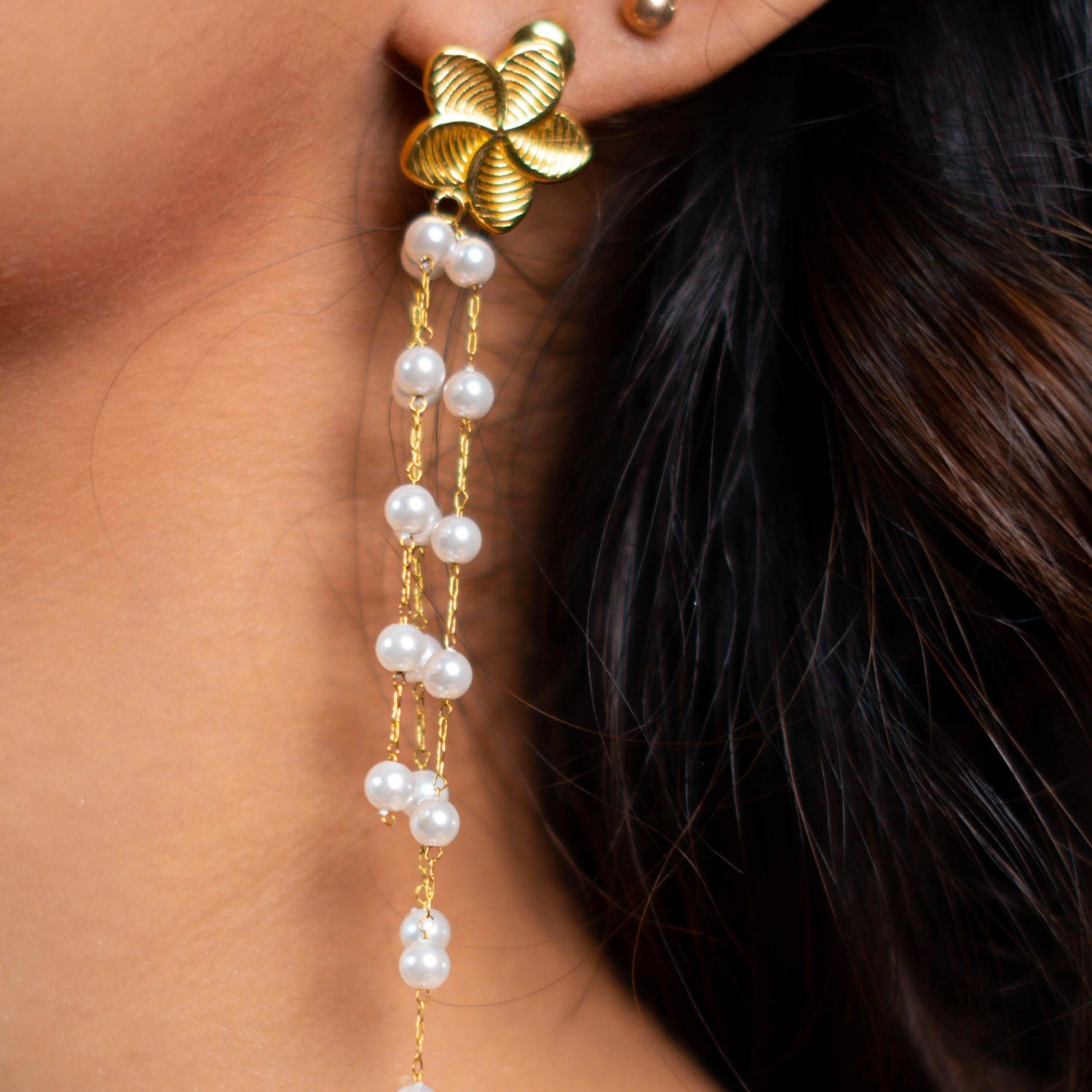
What a drop earring actually is — and what it is not
A drop earring hangs below the earlobe. That is the only technical requirement. Within that definition sits everything from a 1cm linear bar to a 10cm chandelier that reaches the shoulder — and treating them as one category is where most buying decisions go wrong. The weight, the swing, the back type, and the length all determine whether a drop earring works for how you actually live, or whether it ends up unworn in a box after the first time it caught on your dupatta and pulled.
Pakistan's specific conditions — heat, dupatta and lawn fabric, wuzu, commuting, office environments — each filter the drop earring category differently. This guide maps every type by what it is, what it does well, and what it does not.
Linear drop earrings — the most wearable type
A linear drop earring is a straight or near-straight line — a bar, a chain, a thin geometric shape — that hangs directly below the ear fitting without significant swing. It moves with the head rather than against it. The silhouette is clean and the weight is distributed along a narrow, predictable path rather than concentrated at a wide base.
In Pakistani daily wear conditions, linear drops are the one drop earring type that can function on a regular weekday. The narrow profile does not catch on collar-line fabrics. It does not swing into the face during commute. It does not pull at the ear under its own momentum during extended wear. A 3–5cm gold-toned linear bar or a fine chain drop with a small pendant at the base covers most of the visual work of a longer, heavier earring at a fraction of the wearability cost.
The linear drop is also the cleanest earring type for Pakistani office settings where statement jewellery is not appropriate. A thin 4cm gold bar earring reads as polished rather than decorative — it is visible and intentional without announcing itself across a room.
Chandelier earrings — the formal statement type
A chandelier earring has a branching, tiered structure — multiple tiers of stones, chains, or metalwork that fan out below the ear fitting. The silhouette widens as it descends, the opposite of the linear drop. Weight is distributed across a wide base. Movement is dramatic. The earring is designed to be noticed from across a room.
In Pakistan, chandelier earrings have one primary context: formal occasions. Mehndi functions, walimas, weddings as a guest, dawat dressing, Eid outfit styling. These are the settings where the scale of a chandelier earring is in proportion to the visual intention of the rest of the outfit.
Outside formal occasions, chandeliers create practical problems in Pakistani daily contexts. The branching structure catches on dupatta fabric at the shoulder. The weight at the outer edges creates an uneven pull on the earlobe over extended wear. The swing during commuting — auto, car, or standing transport — is significant. These are not reasons to avoid them. They are reasons to wear them with intention rather than all day every day.
The chandelier earring's job is to be the most visible thing in the room. That is exactly right for a walima. It is exactly wrong for a Tuesday at the office.
Huggie drops — the daily wear crossover type
A huggie earring is a small hoop that fits closely around the earlobe — the name refers to how it hugs the ear rather than hanging away from it. A huggie drop is a huggie with a small pendant or chain hanging from the base of the hoop, adding movement and length without the swing or weight of a full drop earring.
This is the most Pakistan-compatible version of a drop earring for daily use. The huggie portion sits flush against the lobe. The drop portion — typically 1–2cm of chain or a small pendant — adds visual interest below the ear without the catching risk of a longer, wider earring. The total weight is low. The footprint is small. It survives wuzu, commuting, and office settings without creating problems.
For women who want to wear drop earrings regularly rather than only for occasions, huggies with small drops are the practical starting point. They give the visual effect of a dangling earring without the wearability cost of anything longer or heavier.
Baroque and sculptural drops — the occasion accent type
Baroque drop earrings have irregular, organic shapes — asymmetric stones, twisted metalwork, freeform geometric structures. Sculptural drops have deliberate architectural forms: geometric prisms, architectural shapes, oversized abstract elements. Both categories prioritise visual distinctiveness over symmetry or conventional proportionality.
In Pakistan, these sit between the chandelier (maximum formal) and the linear drop (daily wear) on the occasion spectrum. They work well for dinner parties, cultural events, art and fashion spaces, and casual-to-evening dressing where the outfit is intentional but the context is not a full wedding function. A large irregular pearl drop. A twisted gold sculptural form. A geometric prism in gold-toned PVD. These read as considered without reading as overdressed for the wrong setting.
The weight caveat applies here: any sculptural earring with significant volume also carries significant weight. Extended wear in Pakistan's summer heat with heavy earrings creates sweat accumulation against the lobe and behind the ear. Large sculptural pieces are better as 3–4 hour occasion earrings than as all-day pieces.
Shoulder dusters — the maximum length type
Shoulder duster earrings reach the shoulder — typically 8–12cm from the ear fitting. At this length, the earring becomes a significant styling element that affects how everything else sits: collar necklines, dupatta placement, hair positioning, and even which bag to carry (a shoulder bag strap will knock into a shoulder duster continuously).
In Pakistan, shoulder dusters are a bridal and high-occasion category. They appear at weddings, film industry events, fashion contexts, and formal shoots. For everyday wear — even elaborate everyday wear — the practical constraints become significant. The length catches on everything at the shoulder line. The swing during movement is wide. They are not designed for sitting at a desk, commuting, or doing wuzu.
If you are buying a shoulder duster for a specific occasion, buy it for that occasion specifically. Do not buy it expecting it to transition into regular rotation. It will not.
Back types and why they matter for Pakistani wear
The earring back determines how the earring sits against the ear, how much movement it has, and how secure it is over a full day of Pakistani wear. Drop earrings use several different back types and the difference between them matters in practice.
Fish hook (French wire): An open curved wire that passes through the ear and hangs freely with no closure. Maximum swing and movement. Zero security — the earring can work itself out of the ear during active movement, commuting, or if the earring is heavy and creates a forward-tipping angle. Not recommended as an all-day earring in Pakistan without a small rubber back stopper added to the wire.
Lever back: A hinged closure that locks behind the ear. The earring hangs from a hinged loop rather than an open wire. Significantly more secure than a fish hook. The most reliable back type for drop earrings in Pakistani conditions — it will not work itself out during commuting, and heavy earrings do not tip forward and fall as easily.
Push back (butterfly): A small butterfly-shaped fitting that pushes onto a post. More common on stud and small drop earrings than on longer pieces. Suitable for lighter drops. For heavy or long earrings, lever backs are more secure.
Screw back: Screws onto the post. Maximum security, used for high-value earrings. Slower to put on and remove — relevant for wuzu if the earring needs to come off multiple times a day.
Weight and lobe health — the Pakistani summer consideration
Earring weight matters for two reasons in Pakistan: comfort over extended daily wear, and lobe health over time. Heavy earrings — anything over 5–6 grams per ear — put continuous downward stress on the lobe. Over months of regular wear, this can stretch the piercing hole. In Pakistan's summer heat, where the ear sweats at the piercing site, heavy earrings also sit against moist skin all day, which increases the risk of irritation if the earring post or back is not hypoallergenic.
Stainless steel posts and lever backs resolve the irritation issue. The material does not react with sweat or skin. For lobe health over time: rotate heavy statement drops with lighter pieces, and avoid wearing the heaviest earrings for more than 4–5 hours at a stretch.
| Drop earring type | Typical weight | Daily wear PK | Office | Formal occasions | Wuzu |
|---|---|---|---|---|---|
| Huggie drop | 1–3g | Best | Best | Works | Yes |
| Linear drop (small) | 2–5g | Very good | Very good | Works | Yes |
| Linear drop (long) | 4–8g | Good | Depends on length | Works well | Remove if long |
| Baroque / sculptural | 5–12g | Occasional | Context-dependent | Good | Remove recommended |
| Chandelier | 8–20g | No | No | Best here | Remove |
| Shoulder duster | 10–25g | No | No | High occasion only | Remove |
Which drop earrings work with which Pakistani outfits
Lawn suits (daily wear, summer): Linear drops and huggie drops. The clean silhouette does not compete with printed or embroidered fabric. Anything wider than the collar width is fighting the outfit rather than adding to it.
Plain kurta or shalwar kameez (casual, informal): Linear drops, baroque drops at moderate length, gemstone drops. A single accent earring against a plain outfit creates more visual interest than a chandelier against a heavily embroidered one.
Western wear (jeans, trousers, shirt): Any length works proportionally. Western necklines and collar structures are designed to carry earring visibility in a way that Pakistani suit fabrics are not. Longer drops work better here than in traditional wear.
Formal Pakistani wear (mehndi, baraat, walima guest): Chandeliers, baroque drops, statement drops. The occasion dressing context supports the scale of larger earrings — and the fully formal outfit benefits from the visual work that a chandelier or statement drop provides.
The drop earring that works before you think about it
For Pakistani daily wear, the answer is almost always a small linear or huggie drop in 18K PVD over stainless steel — light enough to wear all day, secure enough to survive commuting, and hypoallergenic at the post and back. For occasions, the chandelier or baroque statement drop is the piece that earns its wear. Both serve a purpose. The question is whether the piece matches the context it is being worn in.
Browse dangle earrings and statement earrings at mithraofficial.com — 18K PVD over stainless steel, nickel-free posts, COD across Pakistan.
Frequently asked questions
Q1. What is the difference between a drop earring and a dangle earring?
A: The terms are used interchangeably in Pakistan and internationally. Both refer to earrings that hang below the earlobe. Some jewellers use "drop" for shorter, more static pieces and "dangle" for longer pieces with more movement — but there is no standardised distinction. Both categories sit under the same collection type and the same buying logic applies to both.
Q2. Are drop earrings appropriate for office wear in Pakistan?
A: Small linear drops and huggie drops are office-appropriate in most Pakistani professional settings. A 3–4cm gold linear drop reads as polished rather than decorative and is no more visually dominant than a stud. Baroque drops and chandeliers are not office-appropriate unless the workplace dress culture specifically supports statement jewellery — most corporate and institutional settings in Pakistan do not.
Q3. Which drop earring back is most secure for daily Pakistani wear?
A: Lever back. The hinged closure locks behind the ear and prevents the earring from working itself out during commuting, active movement, or when the earring is heavier and tends to tip forward. Fish hook backs are common on drop earrings but rely only on gravity and the curvature of the wire to stay in place — they are less reliable for all-day wear in Pakistan without a rubber back stopper added to the wire.
Q4. How do I wear drop earrings with a dupatta without them catching?
A: Length and width are the factors. Drop earrings that end above the shoulder line and are narrower than the collar width rarely catch on dupatta. The problem occurs with chandelier earrings that fan out wider than the neck/shoulder line, and with shoulder dusters that hang at the exact height of dupatta drape. For wearing a dupatta with drop earrings: pin the dupatta before putting the earrings on, and choose a drop no wider than your earlobe at its widest point if the dupatta will be draped close to the neck.
Q5. What types of earrings does Mithra carry for everyday drop earring wear?
A: Mithra's dangle earrings collection covers linear drops, huggie drops, and moderate-length dangle pieces suited to daily and semi-formal wear. For larger statement drops for occasion wear, the statement earrings collection covers chandelier and sculptural styles. All posts and lever backs are 316L stainless steel — nickel-free and hypoallergenic for sensitive ears. For the full earring overview covering every type including studs, hoops, and ear cuffs, the earring types guide maps the complete category.

Leave a comment
This site is protected by hCaptcha and the hCaptcha Privacy Policy and Terms of Service apply.