

Who this guide is for
If you are buying jewelry for the first time, starting over, or looking at a drawer full of pieces you never wear, this is the starting point. It covers which pieces to buy first, in what order, what each one has to survive in a Pakistani day, and how the same collection stretches from office to Eid.
The material side — base metals, PVD, lifespan tables — is in the gold plated jewelry buyer's guide. This page is about choosing and sequencing.
Why most collections do not work
Most jewelry collections in Pakistan are not built; they accumulate. A gift, an impulse buy, a set bought for one function that never worked outside it. The result is a full drawer and nothing to wear on a Tuesday.
The problem is rarely the pieces. It is the order they arrived in. A statement necklace bought before a plain chain has nothing to sit against. Occasion pieces bought before daily ones cover the rare days and leave the ordinary ones empty — and most days are ordinary.
Start with how you actually wear jewelry
The useful question is not "what do I need for this event" but "what will I reach for on a Tuesday morning when I am already late". Answered honestly, it tells you what to buy first.
That piece has to clear a specific Pakistani day: eight to ten hours of wear, heat and sweat from April to October, wudu, a dupatta, a commute, sunscreen. Pieces built for a three-hour event fail that day within weeks.
The four foundation pieces
One excellent piece in each category covers every context — office, university, family, most occasions. Each does something the others cannot: earrings frame the face, a chain frames the neckline, a ring finishes the hand, a bracelet adds movement.
1. A plain chain necklace
No pendant, no stone. 16–18 inches, sitting just below the collarbone, where it works with a round-neck kurta, an office shirt, and a dupatta alike. It is the piece worn most, so it is where material matters most. Under about 5'2", 16 inches gives the same placement. Which link and length is in types of chain necklaces.
2. Small studs or huggies
A 6–8 mm stud or a 10–16 mm huggie. Small enough for any office, light enough for a twelve-hour day, nothing for a dupatta to catch. The post sits inside the piercing all day, so it must be stainless steel. More in stud sizes and backs.
3. One slim ring
A plain band on the right hand — no marital meaning there, so it carries none. If you do not know your size, an adjustable band: size it once on arrival and leave it. A few weeks of wear tells you which finger and width you actually like before you buy fixed sizes. Sizing is in the ring size guide.
4. A single chain bracelet
A 2–3 mm chain with an extender, on the non-dominant wrist, where it takes less desk and bag friction. It is the one bracelet type that reads polished in an office and still stacks for an event. This is the most optional of the four; some people never want one. Fit is in the bracelet size guide.
The first piece is not your favourite. It is your default — and the default is what gets worn three hundred days a year.
Buy the lowest-friction pieces first
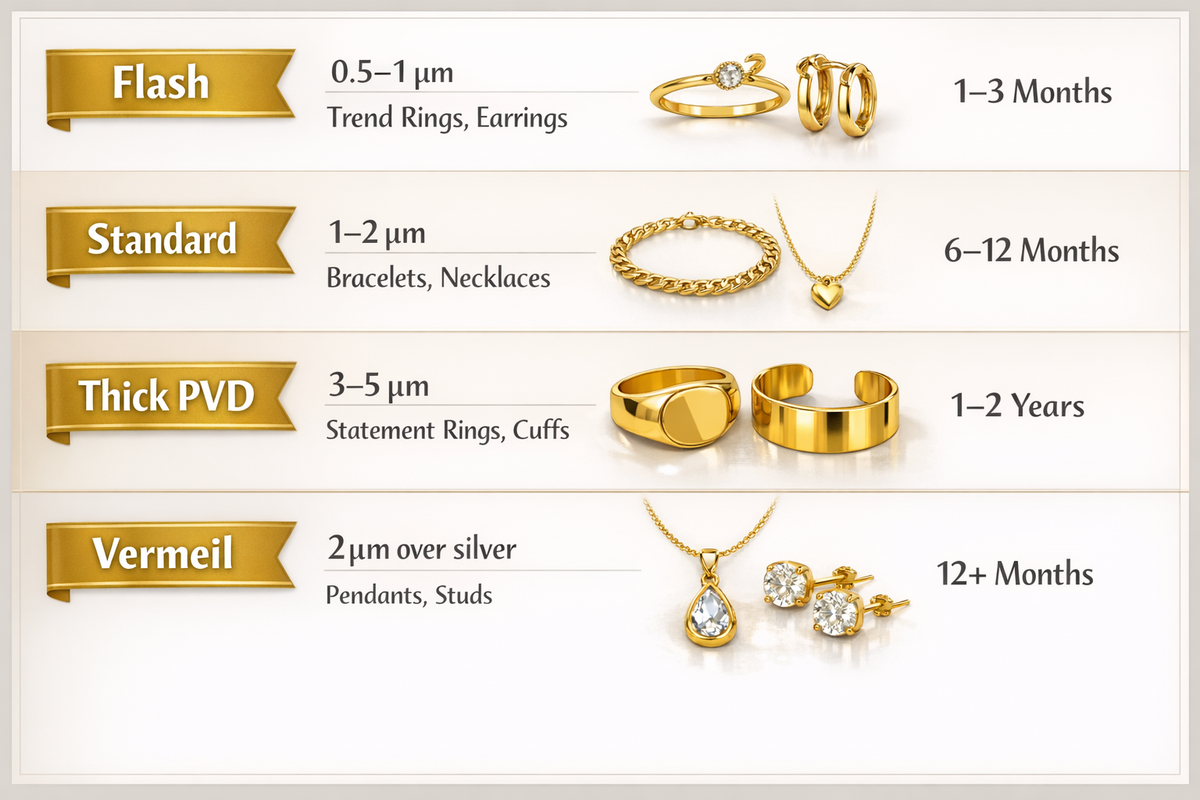
The same 18K PVD coating lasts different lengths of time on different pieces, because friction wears coatings. A necklace rests on fabric and skin; a ring meets every surface the hand touches.
| Piece | Friction | 18K PVD on stainless steel, daily wear |
|---|---|---|
| Necklace | Lowest | 3–5+ years |
| Studs and hoops | Low | 3–5+ years |
| Bracelet | High | 1–4 years, dominant hand at the low end |
| Ring, worn through every task | Highest | 8–18 months |
So if you want your first impression of a material to last, start with the chain or the studs. A ring is a fine first purchase too — just know that inner-band wear after a year of daily use is the ring behaving as expected, not a defect.
The order to build in
Stage one — the daily foundation. The chain, the studs, the ring. Wear them every day for two to four weeks until they go on without thought. A piece bought but not yet worn has not joined the collection.
Stage two — the occasion layer. A pendant necklace, worn alone or layered over the plain chain at least 4 inches longer. Then one statement earring for evenings and functions, calibrated against the pendant: if one is bold, the other stays quiet.
Stage three — the personal pieces. No fixed order. A bracelet, a second ring once you know your size, a motif pendant, a tennis piece for walimas. By now the gaps are obvious; before the foundation exists, they are impossible to read — which is why buying stage-three pieces first fills drawers.
For most people the complete collection is eight to twelve pieces. Beyond that it is usually accumulation.
Daily, office, and events — what changes
| Context | What to wear | What to avoid |
|---|---|---|
| Daily — errands, university, home | The foundation, unchanged | Anything that needs a styling decision |
| Office | Chain or small pendant, studs or huggies, one slim ring, one bracelet | Stacks, clinking bangles, swinging drops |
| Events — shaadi, Eid, dinners | The foundation plus one statement: a bold earring, a layered neck, or a tennis piece | A statement necklace and statement earrings at once |
The foundation stays on for events; the occasion piece goes on top of it. The deeper guides: office jewelry, wedding guest jewelry, and formal events.
If you already own jewelry — the twenty-minute audit
Before buying anything, empty the drawer and sort it three ways. Pieces you reach for without thinking: note what they share — tone, scale, style — because that is what to add more of. Pieces worn for specific situations: keep them, but do not build around them.
Pieces that have not moved in months: they are information, not failures. Most were bought for an occasion, chosen by someone else, or never had a foundation to sit against. Why that happens is in why you buy jewelry and never wear it.
The two checks before any purchase
Whatever the piece, two facts should be on the listing: the base metal, named (stainless steel or 316L, not "alloy"), and the coating method, named (PVD, not just "gold plated"). A foundation that fades in three months is not a foundation; it is a replacement cycle. Why those two facts decide everything is in why stainless steel is the right base metal.
Buying online for the first time? The listing checks are in what to check before buying online, and seller trust is in is it safe to buy jewelry online.
Sets or individual pieces?
Individual pieces, in the order above. A matched necklace-earring-bracelet set works as a unit and rarely with anything else, so it behaves like one occasion piece split three ways. Three separate pieces each work alone, together, and with whatever you add later.
Every Mithra & Co piece is 18K PVD over 316L stainless steel, with both stated on the product page. Browse the collection — cash on delivery nationwide, 7-day exchange for sizing and defects from delivery.
Frequently asked questions
Q1. What jewelry should a beginner buy first in Pakistan?
A: A plain 16–18 inch chain, small studs or huggies, and one slim ring — adjustable if you are unsure of your size. All three work in every daily context and need no styling decision. Add a chain bracelet as a fourth if you want one.
Q2. What is the minimum jewelry every woman should own?
A: Four pieces, one per category: a plain chain, a stud, a slim band, and a single chain bracelet. That is the capsule — the smallest set that covers the widest range of days. Everything after it is an addition for specific occasions.
Q3. How many pieces should I buy at once?
A: Three. Wear them daily for two to four weeks before adding anything. That period shows you what you actually reach for, which makes every later purchase more accurate.
Q4. Should I start with a necklace or a ring?
A: For the longest-lasting first impression, a necklace or studs — the lowest-friction pieces. A ring is fine if it is what you will wear most; expect the inner band to show wear first, which is normal for the highest-friction category.
Q5. Is a jewelry set better value than individual pieces?
A: Rarely. A set works as one look; individual pieces each work on their own and with each other. Build individually, and a set's worth of looks comes from combining what you already wear.
Q6. How do I know my collection is complete?
A: When you stop reaching into the drawer for something that is not there. For most people that is eight to twelve pieces across daily, office, and occasion. More than that is usually pieces filling space rather than doing work.

Leave a comment
This site is protected by hCaptcha and the hCaptcha Privacy Policy and Terms of Service apply.