Why Stainless Steel with 18K Gold Plating Is the Best Choice for Daily Wear in Pakistan

Why Stainless Steel with 18K Gold Plating Is the Best Choice for Daily Wear in Pakistan

The material decision that determines everything else

Most jewelry buying decisions in Pakistan are made on design and price. The decision that actually determines how a piece performs — whether it holds its colour, whether it causes skin reactions, whether it looks the same in six months as it does on arrival — is the material combination underneath the surface.

Stainless steel with 18K PVD gold plating consistently outperforms every alternative in the fashion jewelry category for daily wear in Pakistan's specific conditions. This is not a marketing claim. It is the outcome of two measurable material properties: stainless steel's non-reactivity under skin chemistry, and PVD coating's molecular-level bonding that resists the friction, moisture, and chemical exposure that Pakistani daily wear conditions produce continuously.

This guide explains exactly why — so the decision is based on material understanding rather than product description language.

What makes stainless steel the correct base metal for Pakistan

The base metal is what sits underneath the gold surface. It determines skin reactivity, corrosion resistance, structural strength, and how long any coating applied on top of it remains intact.

Stainless steel is an iron alloy containing chromium — typically 10 to 11 percent — which forms a passive chromium oxide layer on the surface that prevents further oxidation. This passivation layer is self-repairing: if scratched or abraded, it reforms in the presence of oxygen. The result is a base metal that does not corrode under sweat, moisture, humidity, or normal skin chemistry under any Pakistani wear condition.

The practical implications for daily wear in Pakistan:

  • No green marks — the copper salts that cause green discolouration on wrists, fingers, and necks come from brass and copper bases oxidising under sweat. Stainless steel does not produce this reaction. A stainless steel ring worn daily in Karachi's humidity will not leave a green mark on the finger regardless of how long or how actively it is worn.
  • No skin reactions — brass and copper-base jewelry causes contact dermatitis — itching, redness, and irritation — once the surface coating wears through and the reactive base contacts skin. Stainless steel is biologically inert at the concentration levels present in fashion jewelry. The same grade is used in surgical instruments and implantable medical devices because it produces no adverse skin response.
  • Structural strength without brittleness — stainless steel has higher tensile strength than brass and copper alloys, meaning clasps, links, and settings maintain their structural integrity under the daily mechanical stress of active Pakistani wear more reliably than softer base metals.
  • Stability under Pakistan's climate — Karachi's ambient humidity sits between 70 and 90 percent for extended periods. Lahore and Islamabad summer temperatures regularly exceed 40°C. Under these conditions, reactive metals oxidise faster than international wear estimates predict. Stainless steel remains chemically stable under these exact conditions where brass and copper accelerate toward failure.

What makes 18K PVD coating the correct surface treatment

PVD stands for physical vapour deposition. The process vaporises gold inside a vacuum chamber and deposits it onto the stainless steel surface at a molecular level — the gold bonds into the surface rather than sitting on top of it. The result is a coating that is structurally different from standard electroplating in ways that directly affect real-world performance.

  • Coating thickness — PVD produces a layer of 3 to 5 microns. Standard electroplating produces 0.5 to 2 microns. PVD coating is three to five times thicker than the industry standard for fashion jewelry plating.
  • Adhesion strength — molecular-level bonding means the coating integrates with the surface rather than adhering mechanically. Under friction — the primary wear mechanism for daily-wear jewelry — PVD resists surface abrasion significantly longer than electroplated equivalents because the bond itself is structurally stronger.
  • Lower porosity — PVD coating has fewer microscopic gaps than electroplated surfaces. Lower porosity means atmospheric moisture, sweat compounds, and chemical agents penetrate the surface more slowly. In Pakistan's humid conditions, this difference in penetration rate is the primary reason PVD pieces maintain their appearance where electroplated pieces on equivalent bases do not.
  • 18K gold specification — 18K refers to the gold purity used in the coating — 75% pure gold. Higher karat produces a richer, more accurate gold colour and marginally better tarnish resistance at the surface layer compared to lower karat plating used in cheaper alternatives.

Stainless steel + 18K PVD vs the alternatives — direct comparison

Feature Stainless steel + 18K PVD Brass + electroplating Solid 18K gold Gold vermeil
Daily wear durability 1–3+ years 2–8 weeks Lifetime 6–18 months
Skin reaction risk None High once coating wears None Low to moderate
Green marks on skin No Yes — within weeks No Possible at wear points
Pakistan humidity resistance High Low Very high Low to moderate
Structural strength High Moderate Low (soft metal) Moderate
Hypoallergenic Yes No Yes Generally yes
Price point Moderate Low Very high Moderate to high
Value for daily wear Pakistan Best Poor Excessive for daily use Moderate

The comparison above addresses the most common question Pakistani buyers have when evaluating jewelry options: why spend more on PVD over stainless steel when brass-base alternatives look identical at the point of purchase. The answer is lifespan under Pakistani conditions. The complete breakdown of every gold plating type — including gold-filled and flash plating — with realistic Pakistani lifespan data covers this comparison in full detail.

Why solid gold is not the right choice for daily wear in Pakistan

This is a point most jewelry guides avoid making directly. Solid 18K gold is chemically stable and lasts a lifetime — but it is structurally softer than stainless steel. Pure gold is a soft metal; the alloys added at 18K improve hardness but solid gold still scratches more easily than stainless steel under daily mechanical contact. A solid gold ring worn daily in Pakistan — against phone screens, keyboards, bags, and other surfaces — will show surface scratching and wear more visibly than a PVD-coated stainless steel ring under the same conditions.

Solid gold is the correct choice for investment pieces, heirloom jewelry, and pieces bought once and kept for decades. For the daily rotation — the chain you wear every day, the ring you never take off, the bracelet that goes on in the morning and comes off at night — stainless steel with 18K PVD delivers comparable appearance with better resistance to the mechanical wear that daily use in Pakistan actually produces.

Which pieces benefit most from stainless steel + PVD in Pakistan

The material advantage is consistent across all jewelry categories but is most significant in the categories that face the highest daily wear demands:

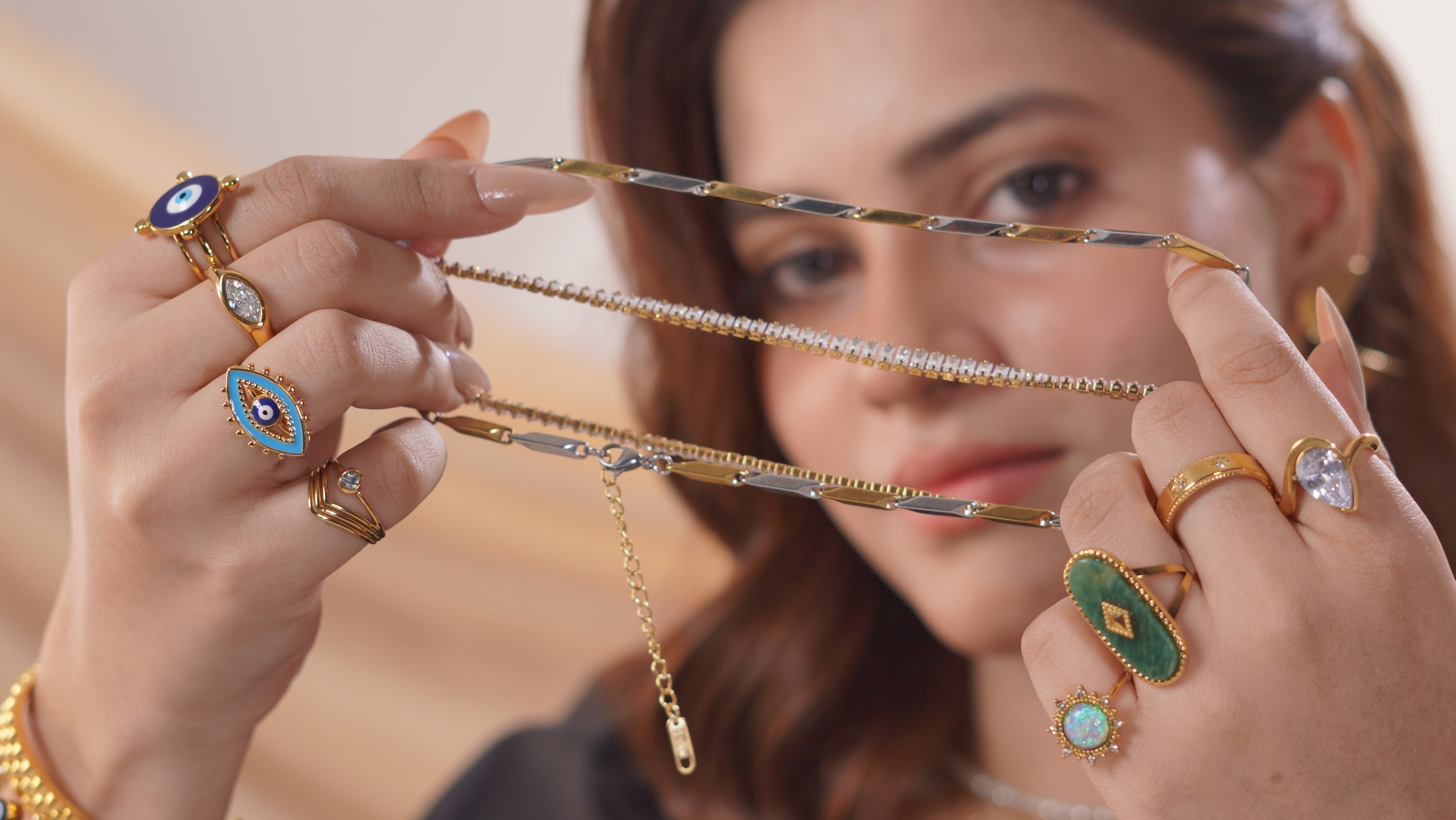
  • Rings — highest daily mechanical contact of any category. Standard electroplated brass rings show visible inner band wear and green finger marks within weeks of daily Pakistani use. PVD over stainless steel rings maintain their finish for one to three years under the same conditions. Browse rings in Pakistan.
  • Bracelets — dominant wrist contact with surfaces throughout the day. The highest-friction category after rings. Standard plated brass bracelets worn daily in Karachi's summer last two to six weeks. PVD stainless steel bracelets last two to four years under the same conditions. Browse bracelets in Pakistan.
  • Earrings — material matters most here for skin safety rather than surface durability. Stainless steel posts are hypoallergenic and do not cause the ear irritation and infection that brass posts produce in sensitive piercings under Pakistan's daily humidity. Browse earrings in Pakistan.
  • Necklaces — the lowest-friction category, where even standard plating holds reasonably well. But for a necklace worn daily in Pakistan — including through summer heat, neck sweat, and regular skincare product contact — PVD over stainless steel provides meaningful additional lifespan at the clasp and back-of-neck contact areas. Browse necklaces in Pakistan.

What stainless steel + 18K PVD cannot do — honest limitations

Every material has limits. Stainless steel with PVD coating is not indestructible — and understanding its limits is what makes the material decision genuinely informed rather than based on marketing language.

  • PVD is not permanent — it is a durability enhancement layer, not a lifetime coating. Under sustained daily mechanical wear, PVD surfaces do show gradual wear over time — beginning at the highest-friction contact points first. The coating does not fail suddenly — it thins gradually, which is a different failure pattern from standard electroplating which can peel and flake.
  • Direct perfume and alcohol contact accelerates wear — applying fragrance directly onto a PVD piece, or regular contact with hand sanitiser, shortens coating lifespan. Products should be applied before jewelry goes on and allowed to absorb fully. This applies to PVD as it does to all plated surfaces — the difference is that PVD handles accidental exposure better than standard plating.
  • It is not an investment asset — stainless steel jewelry has no precious metal resale value. It is daily wear jewelry, not wealth storage. Solid gold serves the investment function. PVD over stainless steel serves the daily wear function. Conflating the two leads to wrong purchase decisions in both directions.
  • Re-plating is not practical — PVD coating requires industrial vacuum chamber equipment to apply. Unlike standard electroplating which jewellers can re-do as a service, PVD re-plating is not widely available as a consumer service in Pakistan. For most PVD pieces, replacement rather than re-plating is the practical end-of-life path.

For the full durability analysis of PVD coating — including how it wears across different jewelry categories and what affects its lifespan in Pakistan specifically — the PVD coating durability guide covers every variable in detail.

How to care for stainless steel + 18K PVD jewelry in Pakistan

  • Apply all products before putting jewelry on — perfume, sunscreen, moisturiser, and hairspray should be fully absorbed into the skin before any piece goes on. This is the single most impactful daily habit for extending PVD lifespan under Pakistani daily wear conditions.
  • Wipe with a soft microfibre cloth after every wear — removes sweat residue, sodium chloride, and skin oils before they sit overnight against the coating surface. For rings and bracelets specifically, this habit consistently extends finish lifespan by months under Pakistani conditions.
  • Store in individual sealed pouches — not loose in a drawer or dish. Metal-on-metal contact causes surface micro-scratches. Cool and dry storage — away from the bathroom where Pakistan's ambient humidity works against even stainless steel surfaces over time.
  • Remove before workouts and swimming — sustained sweat combined with mechanical friction, or chlorine and saltwater contact, are the highest-wear scenarios for any coated piece. Removing jewelry before these activities costs nothing and adds months to the coating lifespan.

The complete care guide covering all jewelry types, gemstone pieces, and storage by category is at the jewelry care guide. And for the specific scenario of caring for pieces through Pakistan's summer shaadi season — where sunscreen, continuous sweat, and fabric friction run together for hours — the shaadi season jewelry guide covers the exact pre and post event protocol.

Stainless steel + 18K PVD jewelry in Pakistan — shop with COD

Every piece at Mithra & Co is built on stainless steel with 18K PVD coating — the combination this guide describes. Base metal and coating method are specified on every product listing. COD available across Pakistan — Karachi, Lahore, Islamabad, and nationwide. Free delivery on orders above Rs. 5,000.

Browse the full collection at mithraofficial.com.

Frequently asked questions

Q1. Why is stainless steel better than brass for gold plated jewelry in Pakistan?

A: Stainless steel does not react with sweat, humidity, or skin chemistry — meaning it does not cause green marks, skin irritation, or surface discolouration under Pakistan's daily wear conditions. Brass oxidises under sweat and moisture, producing copper salts that cause the green finger and wrist marks most associated with affordable fashion jewelry. In Pakistan's heat and humidity, this reaction accelerates significantly compared to cooler climates — making the base metal decision more consequential here than international jewelry guides typically reflect.

Q2. How long does 18K PVD gold plating last on stainless steel in Pakistan?

A: One to three years for daily wear under Pakistani conditions — significantly longer than standard electroplating which lasts two to eight weeks on brass under the same daily use. PVD's molecular-level bonding and 3 to 5 micron thickness resist the friction, humidity, and sweat exposure of Pakistani daily wear far better than the 0.5 to 2 micron surface deposit of standard electroplating. Care habits — products before jewelry, microfibre wipe after wearing, sealed pouch storage — extend the upper end of this range.

Q3. Is stainless steel jewelry hypoallergenic and safe for sensitive skin in Pakistan?

A: Yes. Stainless steel does not contain free nickel at levels that trigger reactions in most nickel-sensitive wearers, and the PVD coating adds a non-porous barrier that further reduces direct metal-to-skin contact. No copper or brass base means no green marks or oxidation reactions. For Pakistani buyers who have experienced itching, redness, or green marks from affordable fashion jewelry, switching to stainless steel base with PVD coating resolves these reactions in most cases because the root cause — reactive base metal contacting skin — is eliminated.

Q4. Can I wear stainless steel PVD jewelry in water and during wuzu in Pakistan?

A: For wuzu, yes — the stainless steel base does not corrode under water contact and brief exposure will not damage the PVD coating. Let water run over pieces naturally and pat dry with a soft cloth. For sustained water exposure — swimming in chlorinated pools, prolonged showers, saltwater — removal is recommended as repeated daily submersion gradually shortens the PVD coating lifespan over time. Stainless steel PVD handles Pakistan's daily reality — including wuzu multiple times daily — significantly better than any brass or copper-base alternative.

Q5. What is the price range for stainless steel 18K PVD jewelry in Pakistan?

A: At Mithra & Co, pieces range from approximately Rs. 2,000 for simple chains and studs through to Rs. 5,000 to 7,000 for sets and statement pieces — all in 18K PVD over stainless steel with COD available nationwide. The cost-per-wear value compared to standard electroplated alternatives is significantly better over a 12-month period: a piece that lasts one to three years at a moderate price point costs less annually than replacing cheap alternatives every four to eight weeks under Pakistani daily wear conditions.

Q6. Where can I buy stainless steel 18K gold plated jewelry in Pakistan with COD?

A: Mithra & Co ships all orders across Pakistan with cash on delivery — every piece specifies the stainless steel base and PVD coating on the product listing. Free delivery on orders above Rs. 5,000. Browse the full collection at mithraofficial.com — rings, bracelets, earrings, necklaces, and complete sets available with nationwide COD.

Reading next

PVD Gold Plated Jewelry Durability & Lifespan - Daily Wear Pakistan
A Simple Jewelry Guide — Types, Materials, and How to Buy in Pakistan

Leave a comment

This site is protected by hCaptcha and the hCaptcha Privacy Policy and Terms of Service apply.