

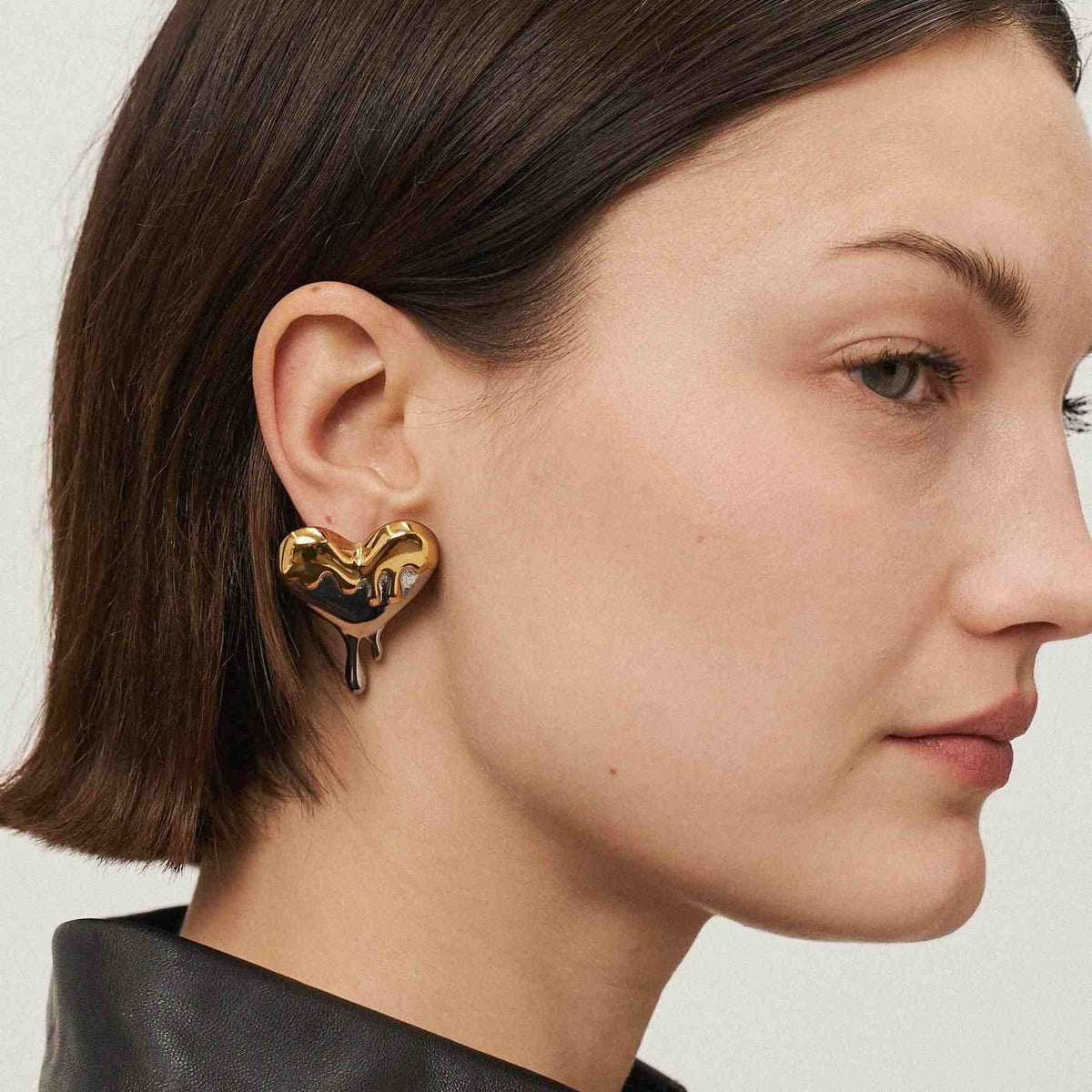
Why stud earrings fail — and it is almost never about the design
A stud earring sits in the earlobe through a post, with its face visible from the front and a backing holding it in place from behind. In theory this is the simplest earring design possible. In practice it is the category with the highest rate of daily disappointment — itching piercings, loose backings by afternoon, skin reactions after a few weeks, posts that bend or tarnish before the earring has been worn ten times.
None of these failures come from bad design. They come from the post material, the backing mechanism, and the base metal underneath the gold surface — three variables that are almost never mentioned in a product listing and almost always responsible for whether the earring works in daily Pakistani wear or ends up in the drawer within a month.
The post material — the most important variable in any stud earring
The post is the thin metal rod that passes through the piercing. It is in direct, sealed contact with the inside of the piercing for the entire duration of wear — which for many Pakistani women means twelve or more hours daily across multiple years of wear in the same piercing hole. No other jewelry piece maintains this kind of sustained, close-tissue contact.
A brass or copper alloy post in this environment causes a predictable sequence: warmth and moisture inside the piercing accelerate the release of copper ions from the alloy, the tissue reacts to the ions, the piercing becomes itchy, then red, then discharging. This is not a nickel allergy in most cases. It is a copper reaction — and it is almost universal in people who wear brass-post earrings for extended daily periods in Pakistan's heat.
A stainless steel post does not cause this reaction. The chromium oxide passive layer on the surface of 316L stainless steel prevents ion leaching under normal skin contact conditions — the same property that makes it the standard material for medical implants and surgical instruments. For daily earring wear in Pakistan, stainless steel posts are the correct default. Anything else is a compromise.
A post tarnishing inside the piercing while the visible face of the earring still looks fine is not a sign that the earring is wearing out — it is a sign that the post is made from the wrong material. The face catches the light and gets cleaned. The post sits sealed in tissue and never does. These are two different environments on the same piece of jewelry, and they age completely differently.
Stud earring sizes — what the numbers actually mean on a Pakistani ear
Stud earrings are sized by the diameter of the face — the visible part from the front. Sizes are usually stated in millimetres. The practical feel of each size on a Pakistani ear varies significantly from how it appears in product photography, because most product photos use models with larger ears or are shot close enough to distort scale.
| Size | Visual impression on ear | Best for |
|---|---|---|
| 4–5mm | Very small — barely visible at conversational distance | Second piercing, subtle daily wear, hijab-wearing contexts |
| 6–7mm | Small — clearly present without drawing attention | Office daily wear, minimalist aesthetic, all-day comfort |
| 8–10mm | Medium — noticeable, reads as a jewelry choice | Everyday wear with some presence, casual events |
| 11–14mm | Statement — designed to be seen | Semi-formal occasions, evenings, when earrings are the focal point |
| 15mm+ | Large — dominant visual element of any outfit | Events only — weight and size become uncomfortable in extended daily wear |
The most common sizing mistake is ordering 10mm or above for daily office or university wear, based on how the earring looks in a photo taken against a white background. At conversational distance, a 10mm stud is a statement piece. An 8mm stud is a considered choice. A 6mm stud is what most women actually mean when they say they want something minimal.
Backing types — why the back matters as much as the front
The earring backing is the component that holds the stud in the ear. It receives almost no attention in listings and is responsible for a significant proportion of stud earring failures in daily Pakistani wear.
| Backing type | How it works | Daily wear verdict |
|---|---|---|
| Butterfly / friction back | Metal wings grip the post under spring tension | Most common, comfortable, can loosen over time — check monthly |
| Screw back | Backing screws onto threaded post | Most secure — cannot fall off — slightly slower to put on and remove |
| Push back / la pousette | Clicks into a collar on the post | Very secure — requires deliberate pressure to remove — good for active daily wear |
| Clutch back | Metal clutch grips the post | Similar to butterfly but heavier grip — lasts longer before loosening |
For Pakistan's active daily routine — commuting, teaching, working, exercising, performing wuzu — a butterfly back that was firmly gripping the post at 9am can be loose enough to lose by 3pm if the post diameter isn't precisely matched to the backing's tension. Screw backs eliminate this risk entirely but require a threaded post, which not all studs have. When a listing specifies the backing type, that information is worth using.
Stud earring styles in Pakistan — which works for which context
Stud earrings are not a single category — they include multiple distinct shapes and constructions, each suited to different wear contexts.
- Ball studs — a simple sphere on a post. The most classic, most versatile, most appropriate for any context from hospital work to formal events. Catches light from all angles because of the spherical surface. The 6–8mm ball stud is the single most universally wearable earring available.
- Disc or flat face studs — a flat circular or shaped face rather than a dome. Sits closer to the earlobe than a dome stud. Slightly less visible from the side. Works particularly well under hearing aids, behind hair, and in contexts where profile matters.
- Geometric studs — squares, hexagons, rectangles. More contemporary aesthetic than round. The flat faces of geometric shapes make them slightly more prone to showing scratches from surface contact in daily wear than a dome surface which distributes contact.
- Stone-set studs — a CZ or crystal stone held in a setting on the post. The most popular category for occasion and semi-formal daily wear. Setting quality matters: a bezel or flush setting keeps the stone secure; a prong setting on a small stud risks snagging on hair, fabric, or pillow during sleep.
- Star, flower, or motif studs — shaped faces that create a specific visual impression. The shape itself is the statement, which means they work best as solo earrings without other jewelry competing for attention near the same area.
How to care for stud earrings to avoid the three most common failures
Stud earrings fail in three specific ways, each with a distinct cause and prevention:
Post tarnishing. The post darkens before the face does, because the post is sealed in the piercing environment where moisture, skin oils, and product residue accumulate. After removing studs, wiping the post with a soft cloth before storage prevents this buildup. A post that has already tarnished can often be restored with a gentle clean — a cotton bud moistened with water, wiped along the post, then dried completely.
Backing loosening. Butterfly backings lose tension gradually over months of daily use. The fix is simple: gently squeeze the wings of the butterfly back together before replacing after cleaning. This restores the grip tension without replacing the backing. If the backing is genuinely worn out and no longer holds after squeezing, replacing just the backing — not the whole earring — is the correct response.
Stone haziness. Stone-set studs lose their sparkle when product residue — moisturiser, sunscreen, hair product — builds up on the stone surface and inside the setting. A brief rinse under lukewarm water with a soft toothbrush worked gently around the stone, followed by immediate drying, restores clarity. This should never be done with an ultrasonic cleaner or any abrasive — both damage the PVD surface.
Stud earrings in the wider earring collection
Stud earrings are the daily-wear foundation of any earring collection — the pieces that go on first and come off last, that work with every outfit and every occasion, and that sit in the ear through the parts of the day when hoops, dangles, or statement earrings wouldn't. Once the right stud is in place, every other earring type becomes an addition to that foundation rather than a replacement for it. The full earring types guide covers how studs sit alongside hoops, huggies, drops, and ear cuffs in a complete earring collection — and which style does which job.
Stud earrings in 18K PVD over stainless steel are available with cash on delivery nationwide at mithraofficial.com/collections/stud-earrings — paid after you open the package, not before.
Browse Full Earrings Collection
Frequently asked questions
Q1. Why do stud earrings cause itching and irritation in Pakistan?
A: Almost always the post material — brass or copper alloy posts release ions inside the piercing under the warmth and moisture of Pakistani daily wear. This is a metal reaction, not typically a nickel allergy, and it is almost universal with brass-post earrings worn daily over extended periods. Switching to stainless steel posts resolves the irritation in the majority of cases because stainless steel does not release reactive ions under normal skin contact conditions.
Q2. What stud earring size works best for everyday wear in Pakistan?
A: 6 to 8mm covers most daily wear contexts — visible and present without being a statement piece. 6mm for genuinely minimal or office settings, 8mm for general daily wear with some presence. The most common mistake is ordering 10mm or above for everyday use, based on product photos where scale is distorted. At actual conversational distance, 10mm reads as a deliberate statement earring rather than a daily wear piece.
Q3. Which backing type stays on best for a full day in Pakistan?
A: Screw backs are the most secure for active daily wear — they cannot loosen or fall off during a commute, physical activity, or wuzu. The slight trade-off is that they take a few seconds longer to put on and remove. Butterfly backs are more convenient but require monthly checks and occasional re-tensioning to maintain their grip through a full Pakistani day.
Q4. Can I wear stud earrings during wuzu?
A: Yes. Stud earrings sit through the earlobe and do not block any area that needs to be washed during wuzu. They are the most wuzu-compatible earring style available — there is no washing surface they cover, and they are light enough that they do not interfere with the physical movement of washing the face and head.
Q5. What is the best stud earring for someone with sensitive ears in Pakistan?
A: A stainless steel post with 18K PVD coating — the post material is the determining factor for sensitive ear compatibility, not the design or price. Confirm the post material is stainless steel specifically, since "hypoallergenic" labelling on its own can apply to several base metals that still cause reactions in sensitive piercings under Pakistani daily wear conditions. The sensitive skin and jewelry guide covers the full chemistry of why certain metals cause reactions and how to read a listing accurately before buying.

Leave a comment
This site is protected by hCaptcha and the hCaptcha Privacy Policy and Terms of Service apply.