

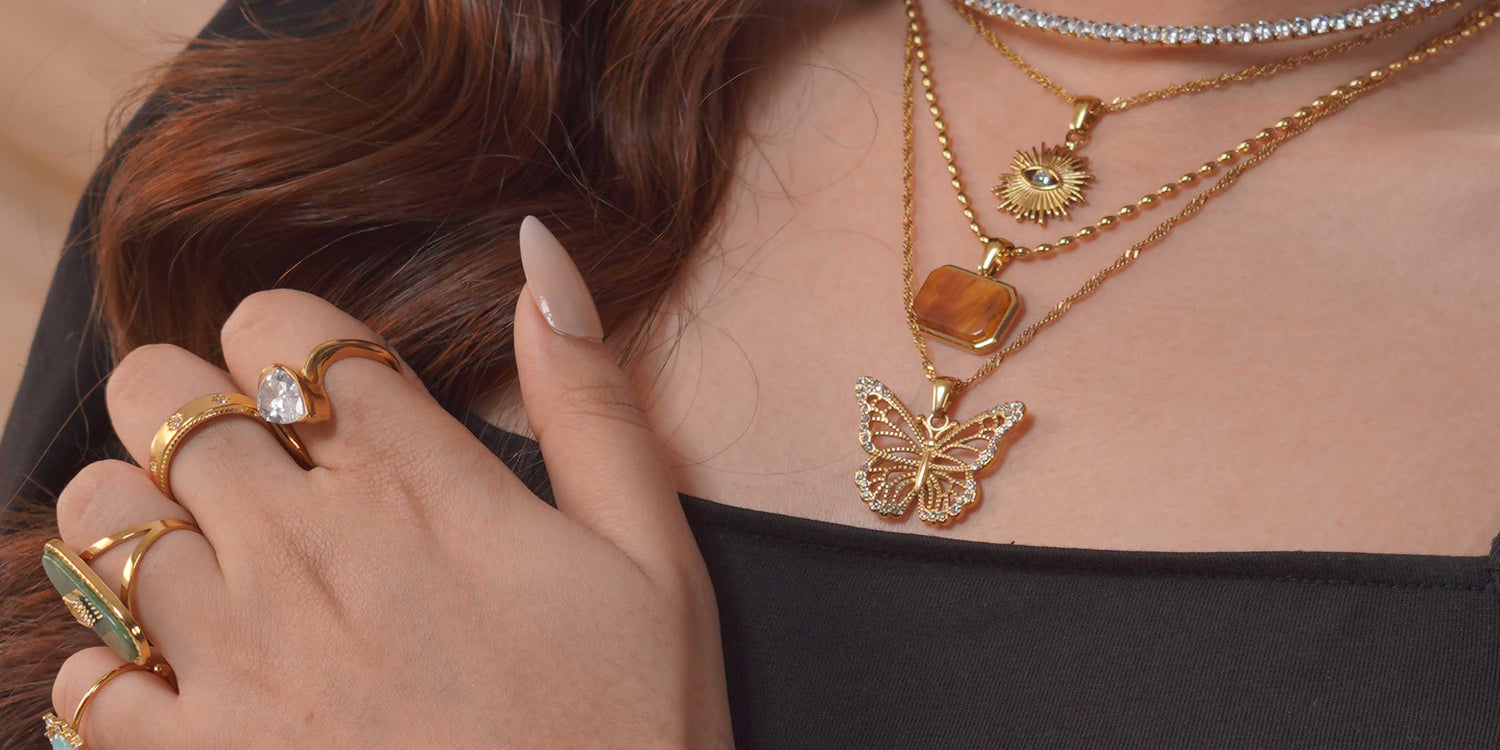
There are two people in every room when jewelry comes up. One of them wants the piece that people notice before they notice her — bold, deliberate, unapologetic. The other wants the piece that means something she does not necessarily need to explain. Neither is more right. But confusing which one you are is responsible for more wrong purchases than almost any other mistake in jewelry buying.
The assumption most people make — and why it costs them
Most people assume their jewelry personality is fixed — that they are either a statement person or a subtle person and that the line between the two never moves. In practice, it is more contextual than that. The same person who reaches for something bold on a Wednesday at the office might want something quieter and more considered for Eid at her grandmother's house. The same person who wears heritage-adjacent pieces to family events might want something completely different when she is out with her own friends on her own terms.
The problem is not that people do not know themselves. The problem is that most jewelry collections are built without acknowledging that both versions of a person exist — and need to be dressed for.
A collection that only contains statement pieces leaves you underdressed for intimacy. A collection that only contains quiet, understated pieces leaves you under-expressed for the moments that call for more. The right collection has room for both — but only once you understand clearly what each version of yourself actually needs. And underneath the personality question sits a practical one: whichever version you are buying for, the base metal and coating quality determine whether that piece is still performing in three months or sitting in the drawer after two wears. Understanding what makes a piece last applies equally to bold statement pieces and quiet everyday ones.
Knowing which kind of jewelry person you are — and when — is the difference between a collection that works for your whole life and one that works for half of it.
The person who wears jewelry that speaks first
You know this person. You might be this person. She walks into a room and the jewelry is part of the entrance — not because it is loud in an overwhelming way, but because it is deliberate in a way that is impossible to ignore. The piece was chosen to do something. To say something. To mark a position.
This is not about excess. The boldest jewelry people are often not the ones wearing the most pieces — they are the ones wearing the most intentional ones. A single swan-shaped pendant worn against a plain outfit carries more presence than four mismatched pieces worn together without purpose. The statement comes from the specificity of the choice, not from the volume of it.
What characterises this kind of jewelry personality:
-
Motif over metalThe shape, the symbol, the form of the piece matters as much as what it is made of. A swan. A geometric cut. An architectural detail. The piece carries meaning through its design rather than just through its material value. This is the person who buys a piece because of what it looks like, not just because of what it is made of — and who remembers exactly why she bought it when she looks at it six months later.
-
One piece, full commitmentThe bold jewelry person is comfortable letting one piece carry an entire look. She does not need backup. A statement necklace worn alone, a single sculptural ring, a pair of earrings that end the conversation before it starts — the confidence in the piece is part of the confidence in how it is worn. Layering for this person is a choice, not a default.
-
Jewelry as identity markerThe pieces this person chooses tend to reflect something about how she sees herself — not aspirationally, but accurately. The boldness in the jewelry is an extension of a boldness that already exists. The piece is not doing the work of creating an impression. It is confirming one that is already there.
The Sauvage collection at Mithra exists specifically for this version of a person — pieces built around the tension between something wild in concept and something precise in execution. The swan motif, which anchors the collection, is not an accidental choice: the swan is the symbol of grace that does not announce itself, elegance that is entirely unconcerned with whether it is being observed. Bold, but never trying. Built on stainless steel with 18K PVD coating — so the statement the piece makes on day one is still the statement it makes six months later.
The person whose jewelry carries something quieter
This person's jewelry does not announce itself. It reveals itself — slowly, to people paying attention, in the right light, at the right moment. A chain that catches sunlight when she moves. An earring whose detail only becomes visible in conversation. A ring that means something specific to her and nothing in particular to anyone who has not asked.
This is not quietness as a lack of confidence. It is quietness as a specific kind of confidence — the kind that does not need external confirmation to feel settled. The jewelry carries weight internally before it carries it visually.
In Pakistan specifically, this personality often surfaces most clearly in the relationship between contemporary dressing and cultural identity. The woman who wants to honour something inherited — a sensibility, a connection to craft, to occasion, to the specific texture of Pakistani celebration — without wearing it in a way that feels costume-like or performed. She wants the heritage to feel hers, not borrowed. Modern in proportion, considered in detail, rooted in something real.
-
Cultural without costumeThe pieces this person chooses feel connected to something — to a tradition, to an occasion, to a family aesthetic — but they do not wear the connection on the surface in a way that feels performative. The cultural reference is present in the detail, in the craft, in the sensibility of the design, not in an overt traditionalism that overwhelms a contemporary wardrobe.
-
Occasion as context, not costumeEid, a family walima, a daawat that matters — these are the occasions where this person's jewelry speaks most clearly. Not because the pieces are formal or heavy, but because they are chosen to mark the moment without performing it. A clean gold piece with genuine craft in its detail does this better than an elaborate set that announces "occasion" before the event has even begun.
-
The long relationship with a pieceThis person tends to wear pieces for a long time — not because she does not have other options, but because the pieces she chooses develop meaning through wear. The chain that was worn to three consecutive Eids. The earrings she wore the first time something important happened. The ring that has been on her hand long enough to feel like it belongs there. Jewelry as accumulation of meaning rather than accumulation of objects. For a piece to accumulate that kind of meaning, it has to hold up — which means the coating cannot be degrading, the surface cannot be tarnishing, the base metal cannot be reacting with skin. The material has to be as lasting as the intention.
The Inheritance collection was designed for exactly this — the space between fully traditional and fully contemporary, where Pakistani women increasingly choose to live. Pieces that feel like they belong to an occasion without being defined by it. Clean in proportion, considered in detail, rooted in a cultural sensibility without being weighted down by it.
The honest overlap — because most people are both
The cleaner truth is that almost nobody is entirely one or the other. The woman who wears the boldest statement piece to a creative work event is often the same woman who wants something with a quieter cultural weight for Eid at her parents' house. The woman who gravitates toward heritage-connected pieces for occasions often wants something with more edge and more personality when she is dressing for herself alone.
The two are not opposites. They are different modes — different registers of the same person, called for by different contexts. A jewelry collection that only accommodates one register is a collection that only dresses half the life.
What this means practically:
-
Start with foundationBefore either bold or quiet statement pieces, the everyday essentials that work across both registers — thin chains, small studs, adjustable rings — are what make the collection function as a whole. These pieces do not belong to either personality. They belong to both, which is why they get worn the most.
-
One bold pieceOne piece from the Sauvage register — something with a motif, with presence, with a deliberate design point of view — gives the collection range and gives the bold version of you somewhere to live. It does not need to be worn constantly to be worth owning. It needs to exist for the moments when that version of you is the one showing up.
-
One occasion pieceOne piece from the Inheritance register — something that feels right for the occasions that carry cultural or emotional weight — means you are never under-dressed for the moments that matter in the Pakistani context. It is not the piece you wear every day. It is the piece you reach for when the day itself is not ordinary.
Three categories. Three distinct purposes. A collection that covers the whole person rather than just the version of her that showed up the day she went shopping. If you are unsure how to sequence those purchases practically, the guide to choosing jewelry in Pakistan maps the build order from daily essentials through to occasion pieces step by step.
Why this distinction matters when you are buying online
Buying jewelry online in Pakistan without knowing which register you are buying for is the most common cause of pieces that arrive and immediately feel wrong — not because the quality is off, not because the photograph was misleading, but because the piece belongs to a different version of you than the one who placed the order.
A bold statement piece bought in a quiet mood looks like too much when it arrives. A subtle heritage piece bought in a moment of wanting something more forward looks like not enough. The piece is right. The moment of purchase was not.
The practical fix is simple: before placing any jewelry order, ask which version of yourself you are buying for — and whether that version of you has an upcoming occasion that will actually call for this piece. If the answer is yes to both, the purchase is a sound one. If the answer is uncertain, it is worth waiting for a moment when the answer is clearer — because a piece bought for the right version of you, at the right moment, almost always gets worn. The drawer problem is almost always a version mismatch problem — and now you have the framework to avoid it.
Frequently asked questions
Q1. How do I know which jewelry style suits my personality in Pakistan?
A: Start by identifying which version of yourself you dress for most often — the one that wants to be noticed or the one that wants to feel rooted. Most Pakistani women are both at different times: bold for creative or social occasions, quieter and more culturally connected for family events and occasions like Eid or walima. A collection that only serves one register leaves the other version of you underdressed. Build for both — starting with everyday foundation pieces in 18K PVD stainless steel that work across both registers, then one bold piece and one occasion piece on top.
Q2. What is the difference between statement jewelry and everyday jewelry in Pakistan?
A: Statement jewelry carries an outfit — it has a motif, presence, a deliberate design point of view. Everyday jewelry works alongside an outfit without competing for attention. Both serve a real purpose. The material underneath matters equally for both: 18K PVD coating over stainless steel means neither category fades, tarnishes, or causes skin reactions under Pakistan's daily wear conditions — which is what allows a piece to stay in rotation long enough to become part of either register.
Q3. What jewelry is appropriate for Pakistani cultural occasions like Eid and walima?
A: Pieces that feel connected to the occasion without being costumed by it. Clean gold pieces with genuine craft in the detail — not elaborate sets that announce "occasion" before the event begins. For a piece to carry meaning across multiple Eids and family occasions, it needs to hold its finish and surface quality through repeated wear — which is why coating quality and base metal matter as much for occasion pieces as for daily ones.
Q4. Is bold or subtle jewelry better for daily wear in Pakistan?
A: Subtle wins for daily wear — pieces that require zero active styling decision are the ones that actually get worn every morning. A plain gold chain, small studs, and an adjustable ring solve the matching problem before you finish asking it. For daily use in Pakistan specifically, 18K PVD coating over stainless steel means these pieces handle humidity, sweat, and continuous wear without the coating degradation and skin reactions that make brass-base pieces end up in the drawer.
Q5. How do I build a jewelry collection that works for both bold and subtle occasions in Pakistan?
A: Three categories in sequence. First — three everyday essentials on stainless steel with PVD coating (chain, studs, adjustable ring) that work across both registers and handle Pakistani daily wear conditions reliably. Second — one bold piece for the version of you that wants presence. Third — one culturally connected piece for occasions that carry weight. In that order, every piece has a clear role and the material foundation means none of them retire to the drawer from coating failure.
Which one are you — right now, today
Not in general. Not across every occasion. Right now, today, for the next thing on your calendar — which version of you is showing up, and does your current collection have something for her?
If the answer is the bold one — the Sauvage collection is the right place to start. Swan motif pieces, sculptural details, 18K PVD gold plating on stainless steel. Tarnish free, built for real daily wear, available with COD.
If the answer is the quieter one — the Inheritance collection carries that sensibility. Modern in proportion, genuine in its cultural reference, the same stainless steel and PVD material quality underneath. For the occasions that deserve a piece that understands what kind of occasion they are.
Both collections are on Mithra — 18K gold plated, stainless steel base, tarnish free, COD across Pakistan. The right version of you already knows which direction to look.

Leave a comment
This site is protected by hCaptcha and the hCaptcha Privacy Policy and Terms of Service apply.