

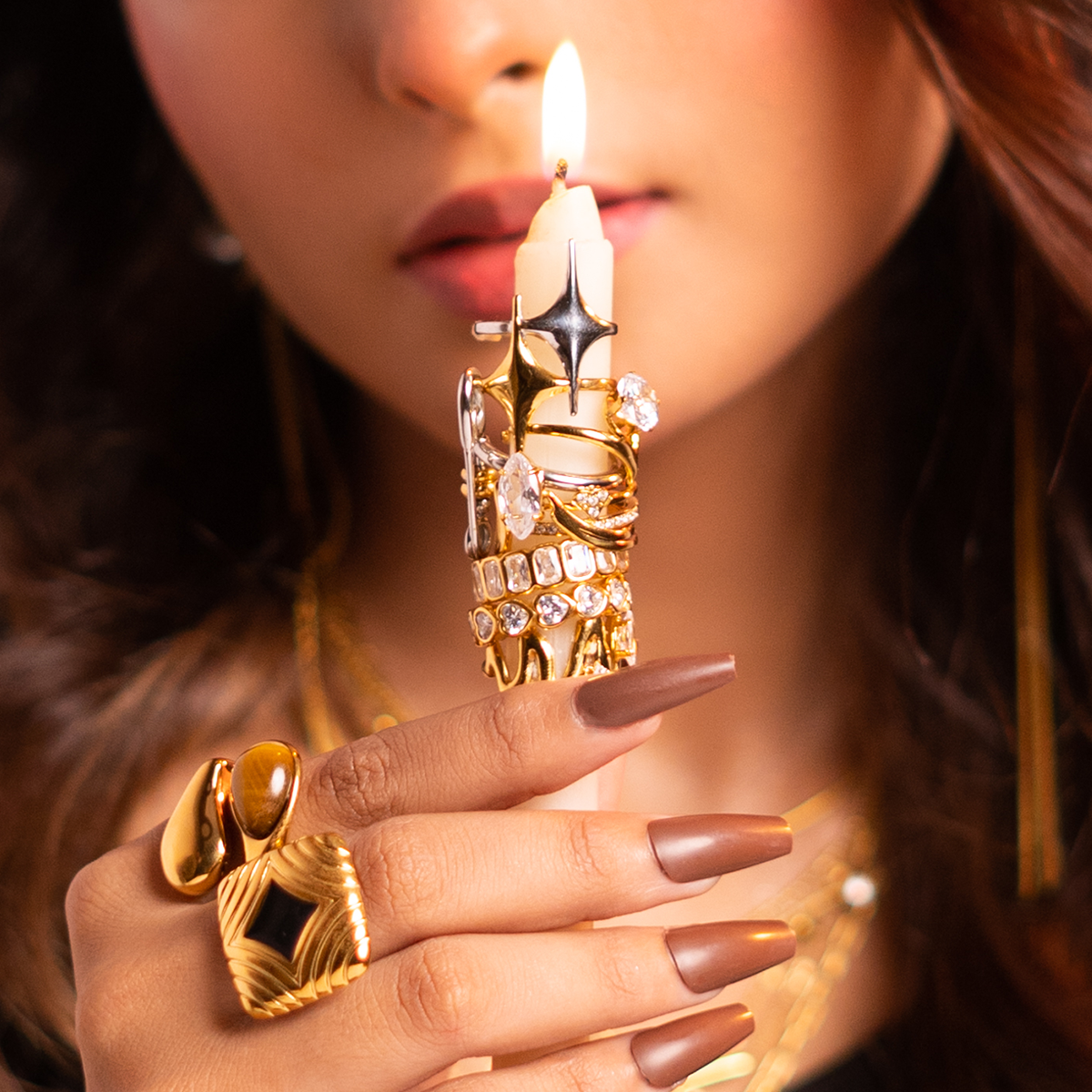
Something shifted in how Pakistani women wear rings in 2026 — and it happened quietly, without an announcement. The single ring on one finger, worn without much thought, started becoming a deliberate arrangement across multiple fingers. What used to be a jewelry choice became something closer to a design decision. Your hand became a canvas. And the interesting part is that getting it right has very little to do with spending more and almost everything to do with understanding five specific ideas that are shaping how rings are worn this year.
Why 2026 Is the Year the Single Ring Stopped Being Enough
It is worth understanding why this shift happened before understanding how to work with it — because the reason is not trend-following for its own sake. It reflects something genuine about how personal style has evolved.
The jewelry industry spent most of the last decade moving toward minimalism — one fine chain, one small stud, one delicate ring. Clean, quiet, barely-there. That aesthetic peaked and then something in it started feeling incomplete. Not wrong, but unfinished. Like a sentence that trails off.
What replaced it is not maximalism exactly — it is intentionality at higher volume. More rings, yes, but each one chosen for a reason. The stack is not about covering your hand. It is about curating it. And this distinction — between coverage and curation — is the entire difference between a ring arrangement that looks considered and one that looks like you put everything on at once and forgot to edit. Understanding how to choose rings that earn their place in a stack is where intentional ring dressing begins.
The five ring trends defining 2026 are not independent of each other. They are five expressions of the same idea: that your hand, worn deliberately, is one of the most visible things about you.
Trend One — The Ring Stack, Done With Actual Intention
Ring stacking has been building for three years and 2026 is where it stopped being a trend and became the default for anyone who wears rings at all. Hailey Bieber, Priyanka Chopra, and half of Pakistani Instagram have been wearing stacks long enough that the conversation has moved from "should I try this" to "how do I make mine look like that and not like this."
The answer to that question is more specific than most guides admit:
-
Width is the structureA stack built from rings of similar width looks like one thick ring from a distance — which defeats the purpose. The stacks that read as curated almost always use at least three different widths: one very slim band that almost disappears, one medium band that anchors, and one slightly wider or more detailed ring that gives the stack its focal point. Width variation is what creates rhythm. Everything else is secondary to this.
-
Odd numbers read betterThree rings on one finger reads as intentional. Two reads as accidental. Four reads as a lot. Five reads as someone who is making a specific point. The odd number rule is not absolute but it holds often enough to be worth starting with — especially for anyone building their first proper stack. Start with three, get comfortable, then decide whether four or five serves the look or clutters it.
-
One ring anchors, the rest supportEvery successful stack has one ring that is clearly the centrepiece and two or three others that exist to frame it. The centrepiece can be a statement stone, a sculptural shape, or simply a slightly wider band — but it needs to exist. A stack where all the rings are equally weighted competes with itself and reads as noise rather than composition.
-
Material consistency matters for stacking specificallyWhen rings are stacked, they are in constant contact with each other — rubbing, pressing, wearing against each other's surfaces all day. A soft base metal like zinc alloy will show wear at contact points within weeks when stacked. Stainless steel holds its surface integrity even under this kind of constant friction, which is why the material conversation is more important for stacked rings than for any other wearing style. The full detail on how PVD coating holds up under the friction of stacked rings explains why base metal matters most here.
Trend Two — Organic and Sculptural Shapes Taking Over From Geometric
The geometric ring trend — sharp angles, clean squares, perfect circles — has been dominant long enough that its replacement was inevitable. What replaced it in 2026 is something that looks almost like the opposite: organic, fluid, asymmetric shapes that look like they were formed rather than constructed. The "melted metal" aesthetic. Rings that appear to move even when they are still.
In the Pakistani context this trend has a specific relevance: organic shapes sit closer to the craft tradition of South Asian jewelry — the irregular, handmade quality of heritage pieces — than geometric minimalism ever did. A sculptural gold ring does not look foreign against a Pakistani aesthetic the way a sharp angular piece sometimes can. It belongs to a longer visual history even when it is entirely contemporary in its execution.
What to look for in this category:
-
Fluid bandsBands that are not perfectly round or uniformly wide — that taper, swell, or curve unevenly. The irregularity is the design point. These work as solo statement rings or as the centrepiece of a stack, and they carry personality that a plain band cannot.
-
Textured surfacesHammered finishes, brushed surfaces, irregular textures that catch light differently across the band. Texture is how a simple ring becomes interesting in three dimensions — and textured pieces photograph dramatically better than plain surfaces, which matters more now than it ever has.
-
Motif piecesRings where the design motif is the point — a swan shape, a leaf, an architectural element that makes the ring identifiable from across the room. These are the rings people ask about. The motif does not need to be elaborate to be effective — it needs to be specific and deliberate.
Trend Three — The Pinky Ring Has Its Own Moment
The pinky ring is having its 2026 moment and it is worth understanding why — because it is not just about adding another ring to the collection. It functions differently from every other ring position.
A ring on the index or middle finger is part of the hand. A ring on the pinky is a punctuation mark. It sits at the edge of the hand, visible in a different way — more visible when gesturing, more visible in motion, more visible from across a table. It reads as deliberate in a way that a ring on the middle finger simply does not, because the pinky ring has no default associations. Nobody wears a pinky ring accidentally.
The 2026 version of the pinky ring is not the heavy signet style of the past. It is a slim band, a small stacked pair, or occasionally a small stone — something that reads as chosen rather than inherited. The restraint is what makes it work. A pinky ring that is too heavy competes with the rest of the hand. A pinky ring that is proportioned correctly adds a final deliberate note that makes the whole arrangement feel finished.
Adjustable rings are particularly practical for the pinky position — pinky finger sizing varies significantly between hands and between individuals, and an adjustable band removes the need to know your pinky size before ordering.
Trend Four — Mixed Metals, Done Deliberately
The rule that gold and silver should not be worn together has been dissolving for several years and in 2026 it is effectively gone. Mixed metal styling is one of the strongest ring trends globally — and in Pakistan specifically, where gold-tone jewelry has historically dominated, the introduction of silver-tone pieces into a predominantly gold arrangement creates a visual contrast that feels genuinely fresh.
The important distinction is between mixed metals done deliberately and mixed metals that look like you could not decide. The difference is usually one thing: the ratio.
Three or four gold rings with one silver band woven in. The silver reads as an intentional interruption — a cool note in a warm arrangement. The gold stays dominant, the silver adds contrast without taking over. Most wearable starting point for anyone new to mixing.
Rarer in the Pakistani context but increasingly visible. A silver stack with one gold ring — often the statement centrepiece — creates a warmth that the all-silver arrangement lacks. The single gold piece becomes more prominent because of everything around it.
The easiest version of mixed metals: all gold on one hand, all silver on the other. Keeps each hand coherent while the overall look reads as intentionally mixed. Lower risk than mixing on the same hand, still achieves the multi-tone effect that makes the trend work.
Alternating gold-silver-gold-silver across a single hand. Equal distribution of two tones reads as indecision rather than intentionality. Mixed metals needs a dominant and a subordinate — not an even split.
Trend Five — The Counter-Trend: One Ring That Does Everything
Every strong trend produces a counter-trend, and the counter to ring stacking in 2026 is the single statement ring worn with intention and nothing else. Not because stacking is wrong — but because a truly exceptional single ring, given the full focus of a bare hand, carries more presence than five rings competing for attention.
This is the most confident version of ring wearing. It says: this piece is enough. It does not need backup. It does not need a stack to justify its presence. It is simply the right ring, worn correctly, and that is the complete statement.
The single statement ring works best when:
-
The ring has genuine detail or presence. A plain slim band worn alone reads as unfinished. A sculptural piece, a meaningful motif, a ring with a stone or significant texture worn alone reads as deliberate. The ring earns the solo position through what it actually is.
-
The rest of the outfit is relatively quiet. A statement ring against a plain outfit — a solid kameez, a clean formal suit, a simple dress — has nowhere to compete and everything to gain. The same ring against a heavily patterned outfit gets lost.
-
The finger position is considered. Index and middle finger placements carry the most visual prominence for a single ring — they are most visible in natural hand position and in motion. A statement ring on the ring finger reads as a relationship symbol regardless of intent. A statement ring on the index or middle finger reads as pure style.
-
The material is right for daily wear. A single statement ring worn every day faces more scrutiny than any ring in a stack — because there is nothing else on the hand drawing attention away from how it holds up over time. The material case for stainless steel and PVD plating is stronger here than anywhere else, because the ring that earns the solo position needs to keep earning it month after month.
How These Five Trends Connect to a Single Idea
The ring stack, the organic shape, the pinky ring, mixed metals, the single statement piece — these five trends look different from each other but they are all expressions of the same shift: from rings as accessories you happen to be wearing to rings as a considered part of how you present yourself.
The Pakistani woman who is most fluent in this shift in 2026 is not necessarily the one with the most rings. She is the one who knows why she is wearing what she is wearing, where each piece sits on her hand, and what the whole arrangement communicates when someone looks at it.
That fluency begins with understanding the trends — which you now have. It continues with building the foundation right — understanding material, sizing, and what makes a ring worth wearing every day before the stack gets built around it.
Frequently Asked Questions About Ring Trends Pakistan 2026
Q1. What ring trends are Pakistani women wearing in 2026?
A: Five trends are defining ring dressing in Pakistan in 2026 — deliberate stacking with width variation, organic and sculptural shapes replacing geometric minimalism, the pinky ring as a punctuation mark, mixed metal arrangements with a dominant tone, and the single statement ring worn with full intention on a bare hand. Each trend is an expression of the same shift: from rings worn by habit to rings worn by design.
Q2. How do I start a ring stack in Pakistan without it looking random?
A: Start with three rings in different widths — one slim, one medium, one slightly wider or more detailed. Put the most interesting ring in the centre position. Let the other two frame it rather than compete with it. Odd numbers read as intentional. Start with three before deciding whether four or five serves the arrangement or clutters it.
Q3. Can I wear mixed metal rings in Pakistan — gold and silver together?
A: Yes — and 2026 is the year the old rule against it effectively ended. The key is ratio, not balance. Three or four gold rings with one silver accent reads as deliberate. Equal gold and silver on the same hand reads as indecision. Choose a dominant metal and use the other as a single intentional interruption. The easiest version is all gold on one hand, all silver on the other.
Q4. What material is best for stacked rings worn daily in Pakistan?
A: Stainless steel with 18K PVD coating is the strongest choice for stacked rings specifically — because stacked rings are in constant surface contact with each other all day, creating friction that accelerates wear on softer base metals like zinc alloy or brass. Stainless steel holds its surface integrity under that friction in a way that alloy-based metals cannot, which means the stack looks the same in month six as it did in week one.
Q5. Where can I buy gold plated rings for stacking online in Pakistan with COD?
A: Mithra delivers gold plated rings across Pakistan — including Karachi, Lahore, Islamabad, and Rawalpindi — with cash on delivery available nationwide. The rings collection covers slim bands for stacking, adjustable styles for pinky ring placement, gemstone pieces for statement positions, and multilayer designs for anyone who wants the stacked effect in a single piece. Browse the full rings collection here.
Where to Start Building Your 2026 Ring Arrangement
If you are approaching this with intention — which is the entire point of all five trends above — the practical starting point is not buying five new rings at once. It is identifying which of the five trends speaks to the version of you that actually shows up every day, and beginning there.
For the stacker: start with two or three slim bands in different widths and add intentionally rather than all at once. The stack builds meaning through accumulation, not through immediate volume.
For the single statement piece wearer: one ring with genuine design presence, worn on the index or middle finger, is the complete brief.
For everyone: browse the full Mithra rings collection with one of the five trends in mind rather than browsing generally. Intentional browsing produces intentional purchases — which is exactly what 2026 ring dressing is about.

Leave a comment
This site is protected by hCaptcha and the hCaptcha Privacy Policy and Terms of Service apply.