

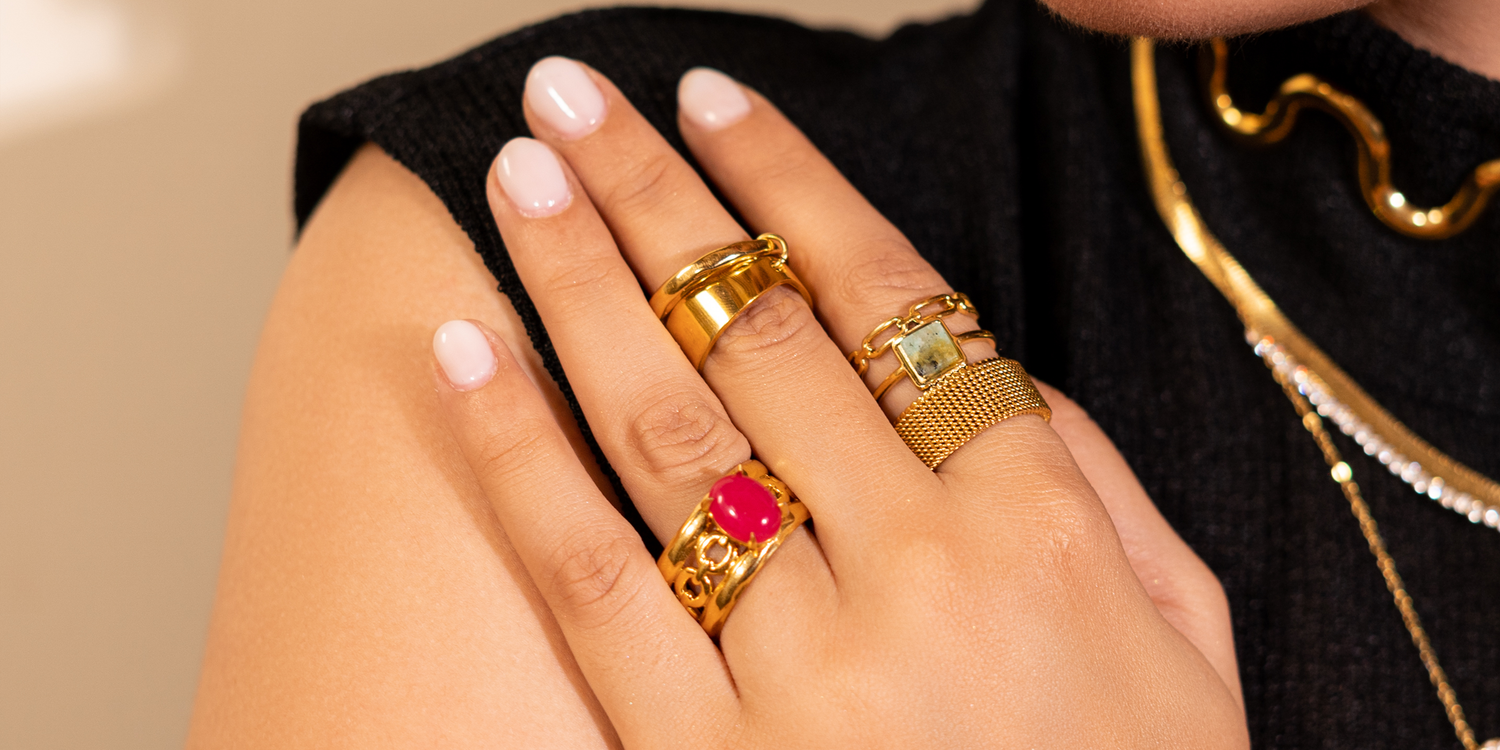
There is a version of jewelry that looks expensive without announcing itself. No logos. No stones catching every light source in the room. No clattering stack that arrives before you do. Just a plain chain sitting exactly where it should, a slim ring that has been there so long it looks like it grew there, and the quiet confidence of someone who stopped trying to prove something a while ago. That is the old money aesthetic in jewelry — and it is the hardest look to fake because it was never designed to be faked.
What "old money" actually means in a jewelry context
The phrase gets used loosely on social media — often as shorthand for "expensive looking" or "minimal." Neither is quite right. Old money aesthetic in jewelry is specifically about the absence of effort. It is the visual language of someone who did not choose their pieces to be noticed. The pieces just happen to be there, worn every day, for years.
What separates old money from regular minimalism is permanence. Minimalist jewelry can be new, deliberate, and curated. Old money jewelry looks inherited. It has the quality of something that has been on the same wrist for so long that removing it would feel wrong. The aesthetic is not about owning expensive things — it is about owning a few things so well-chosen that they stop being accessories and become part of how you look.
In Pakistan's jewelry culture — where the instinct has historically been to add, not subtract — this represents a genuine shift. The women building this look are not choosing between quantity and quality. They are choosing between performing wealth and inhabiting it.
The pieces that actually define the old money look
The old money aesthetic has a very short list of core pieces. Nothing in the list is unusual. Everything in it is chosen for one specific reason: it looks the same in year three as it did in week one.
-
Plain chain17 to 18 inches. Gold tone. No pendant. No charm. Just the chain itself — the kind that photographs as a single unbroken line from collarbone to collarbone. This is the spine of the entire aesthetic. Everything else is optional. This is not.
-
Slim band ringOne ring. One finger. No stones. No texture. A flat or slightly domed band in gold tone that looks like it has been there long enough to have found its place on the hand permanently. Worn alone — not stacked, not paired, not anchored with a statement piece on an adjacent finger.
-
Small stud earringsGold disc, small sphere, or tiny geometric shape. Nothing that moves. Nothing that catches peripheral light. The earring that is genuinely difficult to see across a room but visually correct up close. The opposite of statement earrings in every way.
-
Thin bracelet or nothingIf a bracelet at all — one slim chain on the non-dominant wrist. Or nothing. The old money wrist is frequently bare. The absence of a bracelet reads as deliberate restraint rather than absence, which is the point.
That is the complete list for the core look. Four pieces, or fewer. The discipline is in the subtraction — every piece added beyond these four moves the aesthetic away from old money and toward something more curated and calculated.
What makes the old money look fail — and why Pakistan's market makes this harder
The old money aesthetic fails in two very specific ways. The first is coating. A piece that starts gold and begins showing its base metal at the inner band or clasp area within a month does not read as inherited — it reads as recently purchased and already failing. The permanence the look depends on requires material that actually holds up. A chain that dulls at the back of the neck within weeks cannot carry the aesthetic that depends on it looking exactly the same in three years as it does today.
The second failure is overcrowding. The most common mistake Pakistani women make when attempting this look is adding — a tennis bracelet here, a second ring there, small hoops instead of studs — until the restraint that defines the aesthetic is gone. The old money look is not a collection of carefully chosen pieces. It is a deliberate removal of everything that doesn't belong. Each addition is actually a subtraction from the overall effect.
The discipline of old money jewelry is not in what you choose. It is in what you leave out.
Pakistan's wholesale jewelry market makes this particularly difficult because the available aesthetic vocabulary leans heavily toward presence — stones, layers, sets, and embellishment. Finding a plain 17-inch chain with a stainless steel base in Pakistan requires knowing exactly what to look for. The pieces exist, but they are not what most traditional markets default to.
Gold tone vs silver tone — which is correct for Pakistan
Gold. Not because silver cannot work — it can — but because gold tone reads more naturally against Pakistani and South Asian skin tones across the warm and neutral undertone range that most Pakistani women fall within. Silver sits correctly on cool undertones specifically, which is a smaller portion of the spectrum.
More practically: gold tone is the default of the inherited jewelry vocabulary in Pakistan. A silver-toned piece that is supposed to read as "been there forever" has to overcome the cultural context where inherited jewelry is almost universally gold. The path of least resistance for the old money aesthetic in Pakistan runs through gold tone throughout.
Mixed metals — gold and silver worn together — move the look decisively out of old money territory and into contemporary styling. The aesthetic depends on consistency. One metal family, worn everywhere.
How to build this look in Pakistan — the correct sequence
-
Start with the chain. One plain 17 to 18 inch chain in 18K gold on stainless steel. This is worn every day. It does not come off except for maintenance. The old money chain is not a piece you put on for going out — it is a piece you forget you are wearing.
-
Add the band ring. One slim band. Determine which finger and which hand before buying — the ring will live there. Adjustable slim bands are useful here for online purchases in Pakistan where sizing uncertainty makes a fixed ring a risk. Once the fit is confirmed, this ring becomes the second permanent piece.
-
Choose the studs. Small, gold tone, simple geometry. The decision between disc, sphere, bar, or minimal shape is a personal one — all are correct for the aesthetic. These come off for sleep and go back on every morning.
-
Leave the bracelet question open. The old money wrist is frequently bare. If adding a bracelet, wait until the chain, ring, and studs feel settled and correct before introducing a fourth piece. The bracelet slot is the most expendable element of the four.
-
Remove what doesn't serve. The old money look requires periodic subtraction. If a piece has been added and the overall effect feels heavier or more deliberate, the piece is wrong for this aesthetic even if it is objectively beautiful.
The material question — why it matters more for this look than any other
Most jewelry aesthetics tolerate some attrition — pieces that wear out are replaced, updated, rotated. The old money aesthetic does not have this flexibility. A piece that starts showing base metal wear within months breaks the foundational premise: that the piece has been there so long it has earned its permanence.
18K PVD coating over stainless steel is the correct material for this look in Pakistan specifically. The stainless steel base does not oxidise under sweat or humidity — no green marks, no skin reactions, no colour change at the inner band. The PVD coating maintains gold colour under daily wear significantly longer than standard electroplating. In Pakistan's heat and humidity, the difference between a piece that looks the same after two years and one that starts degrading after two months is almost entirely the base metal and coating method. Why stainless steel with 18K gold plating outperforms alternatives covers the material science in detail — the short version is that the permanence the old money look requires is only achievable with the right base.
The complete guide to gold plated jewelry in Pakistan maps every material option with realistic lifespan data — useful before committing to daily-wear pieces that are supposed to last.
Old money jewelry in Pakistani daily life — what it actually looks like worn
The old money aesthetic does not exist in photographs. It exists in the cumulative impression of seeing someone wear the same pieces every day, in every context, without variation. The plain chain worn to the office on Tuesday is the same chain worn to a family dinner on Saturday. The slim ring on the right hand is there at 9am for a meeting and there at 11pm at a wedding. The consistency is the aesthetic.
For Pakistani women specifically, this means resisting the contextual jewelry logic that governs most Pakistani dressing — different pieces for formal, casual, occasion, and everyday. The old money approach collapses those categories into one. The pieces work everywhere because they were chosen for everywhere.
This does not mean never wearing other jewelry. It means having a permanent base of two to three pieces that are always there, and building occasion-specific choices on top of that foundation when the occasion genuinely calls for it. The two kinds of jewelry people in Pakistan explores this distinction between a permanent understated base and occasional statement pieces — the old money collector almost always falls into the understated category with occasional expansion rather than the all-out statement category.
Where Mithra's collections sit in this aesthetic
The pieces that define the old money look — plain chains, slim bands, small studs, thin bracelets — map directly to Mithra's everyday essentials and 9-5 Vibes collections. The Old Money Collection specifically takes this further: every piece is chosen for the same criteria the aesthetic demands — no logos, no excessive stones, no embellishment that competes with restraint.
COD across Pakistan means the chain or ring arrives at your doorstep. With COD, you pay when the parcel reaches your doorstep. Open it, see the piece in your own light, on your own hand or neck — and if something is wrong, you have 3 days from the delivery date to request an exchange.
Browse everyday essentials at mithraofficial.com — plain chains, slim bands, and minimal studs in 18K PVD over stainless steel.
Frequently asked questions
Q1. What is the old money jewelry aesthetic?
A: The old money aesthetic in jewelry is the visual language of restraint — pieces that look permanent rather than deliberate. Plain chains, slim band rings, small studs, and occasionally one thin bracelet. Nothing that announces itself. The core principle is that each piece looks as though it has been worn every day for years, which is only achievable if the material actually holds up to that daily wear without degrading.
Q2. How is old money jewelry different from minimalist jewelry?
A: Minimalist jewelry can be new, curated, and visually deliberate — a single statement piece worn with intention. Old money jewelry looks inherited and forgotten, in the best possible way. The distinction is permanence: minimalist pieces can rotate; old money pieces stay. A plain chain worn every day without removal for two years reads differently from the same chain worn once a week. The look is built in wearing, not in choosing.
Q3. Does old money jewelry work with Pakistani traditional outfits?
A: Yes — with a specific framing. The plain chain and slim ring combination works with shalwar kameez, lawn suits, and formal Pakistani outfits precisely because the jewelry never competes with the embroidery, fabric, or silhouette. For formal occasions requiring more presence, the old money base stays on and occasion-specific pieces are added on top of it — not instead of it. The permanent base is always there; additional pieces are temporary additions for specific contexts.
Q4. What material holds up for daily wear in Pakistan's climate?
A: 18K PVD coating over stainless steel. The stainless steel base does not react with sweat or humidity — no green marks or skin reactions regardless of Pakistan's summer heat. The PVD coating maintains gold colour under daily wear significantly longer than standard electroplating — 2 to 4 years for a chain with basic care versus weeks or months for standard plated alternatives. The old money aesthetic specifically requires this material quality because the look depends on pieces that genuinely last.
Q5. Where can I buy old money aesthetic jewelry in Pakistan with COD?
A: Mithra & Co carries plain chains, slim band rings, small studs, and thin bracelets in 18K PVD over stainless steel — the material the old money look requires to hold up under Pakistani daily wear. COD available across Pakistan including Karachi, Lahore, Islamabad, and nationwide. Browse the everyday essentials collection at mithraofficial.com — free delivery on orders above Rs. 5,000.
The Look Is Not Built in a Day — It Is Built in Years of the Same Pieces
The old money aesthetic is the only jewelry look that gets better the longer you commit to it. The chain that looks new today looks settled in six months and permanent in two years. That permanence is not available for purchase — it is accumulated through daily wear of the right pieces.
The right pieces in Pakistan require the right material. 18K PVD over stainless steel holds up under Karachi heat and Lahore humidity without green marks, skin reactions, or surface degradation that ends a piece before it earns its permanence. Shop the everyday essentials at mithraofficial.com — plain chains, slim bands, and small studs built for daily wear across Pakistan, with cash on delivery nationwide.

Leave a comment
This site is protected by hCaptcha and the hCaptcha Privacy Policy and Terms of Service apply.