

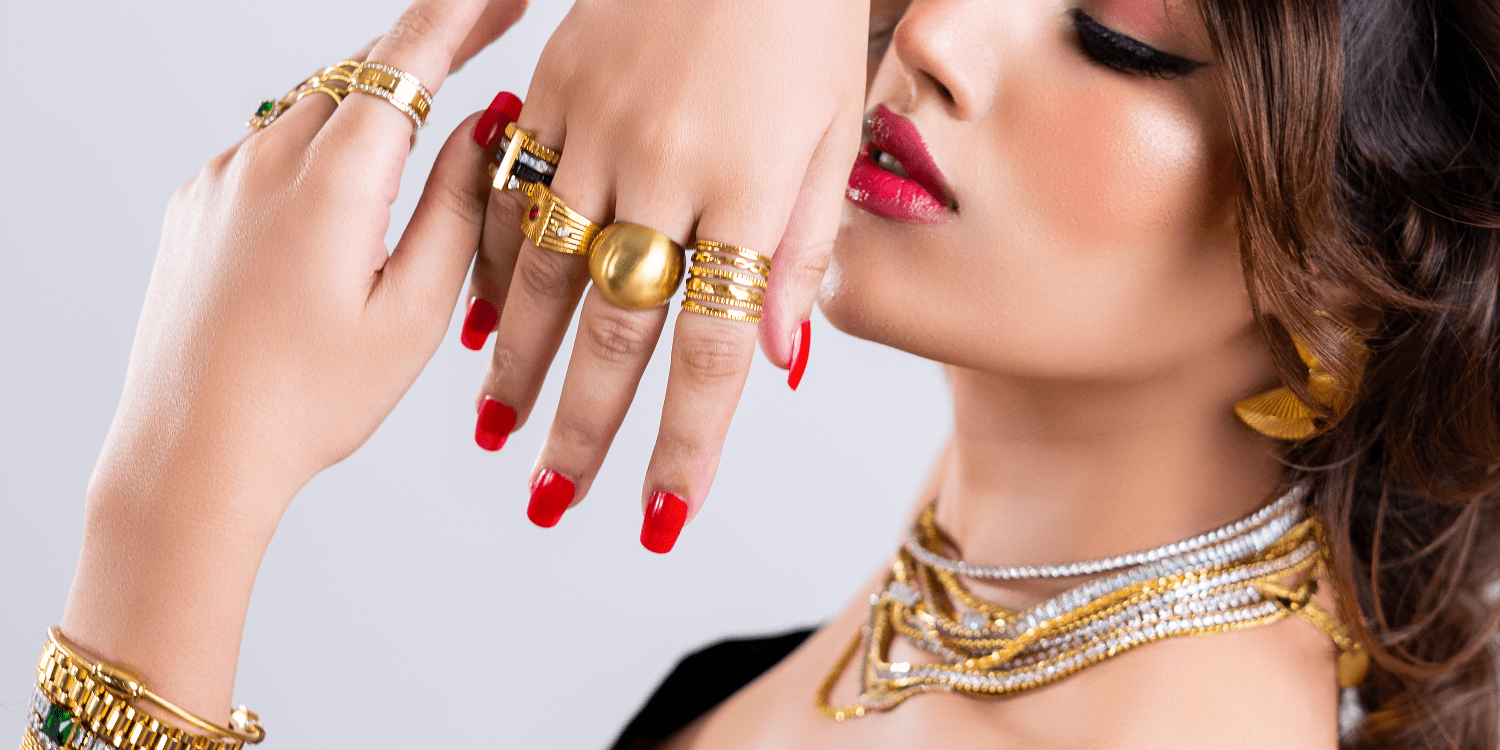
The Wedding Guest Style Blueprint — How to Style Mehndi, Baraat, and Walima Ensembles
Every invitation says the function starts at seven. The outfit has been hanging on the door since Tuesday. The problem is never the clothes. It is the twenty minutes before you leave — standing in front of the jewelry box, holding something up to your outfit, putting it down, picking up something else. The bride has a stylist, a custom set, and three months of planning behind her look. You have a dupatta, a mirror, and fifteen minutes. This guide is for you.
The Guest's Problem is Different From the Bride's Problem
Bridal jewelry content covers exactly one perspective — the bride. It assumes an outfit built around a multi-kilo heavily embellished lehenga, a dramatic makeup palette, and high-carat jewelry sets designed to be photographed at close range. None of that applies to you.
As a guest, you are managing jewelry across consecutive, fast-paced functions (Mehndi, Baraat, Walima) in variable lighting, shifting outfit weights, and often in intense seasonal heat during outdoor lawn segments. A heavy statement set that photographs beautifully on a static bridal stage looks completely out of place on a guest standing for three hours in a crowded dinner line. Your jewelry decisions require structural comfort and realistic proportions, not just aesthetic matching.
There is also a social boundary to respect: a wedding guest should never compete with the bride. Showing up to a Nikah or Baraat wearing a heavy layered choker, matching tikka, and massive chandelier earrings signals a visual overstep. A guest's jewelry has a singular, highly polished objective: look intentional, complete the clothing architecture, and remain a elegant baseline in the background of the photographs.
Mehndi — Intentional Freedom and Tactical Selection
The Mehndi is the most visually relaxed function of a Pakistani wedding. Bright silks, festive multi-colored prints, and singular statement pieces are entirely appropriate here. If you want to introduce an eclectic element — a bold tennis bracelet, a layered chain system, or a distinct signet ring — the Mehndi is the proper canvas.
However, your choices must account for the physical environment. Mehndi functions routinely involve sitting on low floor cushions, navigating packed dholki circles, and getting wet henna applied to your hands. Heavy bracelets or stacked rings will get in the way of the henna artist and risk getting ruined by wet paste. Focus your style footprint on your neckline and earrings, which stay completely clear of the chaos.
If the event is hosted outdoors on a lawn, remember that your neck and chest will be coated in a layer of heavy sunscreen and setting sprays. When reactive base metals like brass or zinc alloy sit against chemical skincare products in a hot, humid environment, they oxidize rapidly, leaving dark marks on your skin before the night ends. Shifting to an inert 316L stainless steel base entirely prevents this reaction.
-
The Neckline PlanOpt for a sleek layered chain or a singular high-polish pendant in a warm 18K gold tone. This configuration ensures that even when your dupatta is loosely draped over one shoulder during dances, the jewelry remains visible and anchored.
-
The Earring ChoiceSelect medium hoops or compact drop earrings. Look for pieces that offer subtle movement and catch the light without causing severe earlobe fatigue by hour four of an event that started late.
-
Rings & BraceletsKeep hand accessories minimal or easily removable. A single, high-end adjustable ring is highly practical here because it can be slipped off instantly when the mehndi artist calls you to the mat, skipping the struggle of a tight, fixed-size band.
Baraat — The Rules of Strategic Subtraction
The Baraat demands the absolute highest contrast between the guest and the bridal party. The bride will be in her most traditional, maximum-weight ensemble: intricate metalwork embroidery, a heavy dupatta settings, and multi-layered heritage jewelry.
The golden rule for guest styling at a Baraat is strategic subtraction. If you plan on wearing statement earrings, drop the necklace entirely. If you want to wear a clean, prominent necklace, pull back to minimalist studs. When a guest attempts to wear a full, heavily matched set to a Baraat, the look immediately tilts into bridal territory. Simplicity isn't underdressed; it is correctly dressed.
The Baraat is also the longest continuous wear function of the weekend. Between arrival photography, the long wait for the procession, the Nikah ceremony, dinner, and the late-night rukhsati, you will be wearing your jewelry for six to eight hours straight. Avoid any piece with a heavy physical weight or sharp structural edges that require constant adjustment.
-
The Two-Piece MaximumNever wear statement earrings and a prominent necklace simultaneously. Choose one focal point. A clean, high-shine profile reads with far greater elegance in wide group photographs than intricate, busy sets that dissolve into visual noise at a distance.
-
Trust the BaselineDo not wear unverified fashion jewelry to a long Baraat. If a low-grade alloy ring begins to irritate your finger or turn your skin green three hours in, you are stuck with that discomfort for the rest of the evening. Stick to hypoallergenic, field-tested materials.
Walima — Contemporary Forms and Defined Lighting
Walima dress codes in urban Pakistan have pivoted decisively toward modern, sophisticated formals. Heavily traditional lehengas give way to sleek formal pret, pastels, raw silks, or contemporary maxis. Your jewelry system should adjust to match this lighter textile weight.
Because Walimas are traditionally hosted in indoor, brightly lit banquet halls or hotels, fine jewelry details actually register cleanly. Visual elements that would be completely lost in the shadows of an outdoor night lawn will pop beautifully under indoor chandeliers.
Since the strict social boundaries of the Baraat are relaxed at the Walima, you have the room to experiment with polished, modern accessories. A structured tennis-style necklace or a brilliant crystal-set bracelet provides the exact level of high-end formality required without mimicking traditional bridal sets.
The Multi-Function Capsule System
If you are attending three consecutive wedding events over one weekend, you don't need three entirely separate heaps of jewelry. You can build a highly efficient, tarnish-proof capsule system using these core pillars:
A premium 18K gold-tone chain operates universally. A 16-to-18 inch length rests cleanly on the collarbone for high-neck festive kurtas, while a 20-to-22 inch length matches the deeper necklines common in contemporary Walima formals.
Compact, high-polish earrings eliminate wedding-weekend friction. They do not snag on heavy silk dupattas, will not cause earlobe fatigue during an eight-hour marathon event, and maintain a polished look across every outfit variation.
An adjustable ring eliminates the risk of seasonal finger swelling in warm halls and slides off seamlessly before you get your mehndi applied. It offers modular, pain-free wear across all three days.
A slim, brilliant crystal bracelet or subtle tennis necklace injects an instant shot of formal luxury for the indoor Walima dinner, elevating your look without adding physical bulk.
What to Avoid as a Wedding Guest — The Direct Truth
Most style advice is too polite to be practical. If you want to maintain an elite style standard, eliminate these four elements completely:
-
Bridal-Adjacent Hair AccessoriesTikkas, jhoolas, and heavy matha pattis belong exclusively to the bride. Wearing a prominent headpiece as a casual guest is a major style overstep. Keep your hair styling clean or accented with simple, non-bridal pins.
-
Overly Matched Factory SetsWearing a matching necklace, earring, and bracelet combo from a single box looks rigid and uninspired. High-end styling relies on mixing elements—pairing a standalone luxury chain with a distinct set of hoops looks significantly more intentional.
-
Low-Grade "Premium" AlloysA multi-day wedding weekend involves sweat, perfume sprays, and friction. Cheap brass or zinc pieces will begin to degrade and tarnish before the third function concludes, ruining your look and staining your skin.
Material Integrity for the Wedding Season
A wedding weekend is the ultimate stress test for fashion jewelry. The intense combination of heat, body heat, heavy perfumes, settings sprays, and constant fabric friction will strip traditional electroplated brass within 48 hours.
Investing in a medical-grade 316L stainless steel base with a molecular PVD gold finish ensures your capsule system stays pristine. The gold is bonded in a vacuum, making it completely impervious to sweat and water exposure. While you should always wipe down your pieces after an event to remove sunscreen film and perfume residue, a PVD steel system guarantees you won't face the nightmare of green skin or tarnished metal halfway through a family wedding.
Frequently Asked Questions
Q1. What is the standard shipping framework for ordering wedding guest jewelry online?
A: Mithra offers Cash on Delivery (COD) nationwide across Pakistan. In strict compliance with standard courier policies (TCS, Leopards, Trax), payment must be handed to the rider before the sealed flyer can be opened. Once unboxed, your purchase is fully protected under our official 3-day exchange policy for any sizing adjustments or verified manufacturing defects.
Q2. Can I wear my PVD stainless steel jewelry during pre-event wuzu?
A: Yes. The 316L stainless steel base and PVD gold finish are entirely water-safe and will not rust or turn green from water contact. However, because wedding makeup, heavy perfumes, and soaps can get trapped behind stones or beneath bands, we recommend giving the pieces a quick rinse with clean tap water and wiping them completely dry with a soft cloth after the function to preserve their maximum brilliance. For a detailed breakdown of the theological and material compliance rules regarding jewelry during ablution, read our complete guide on Wuzu and Jewelry: What You Need to Remove and What Can Stay On.
Q3. What jewelry pieces work best for a formal Baraat look?
A: Stick to the two-piece maximum. Pair a refined, high-polish 18K gold-tone chain with a set of clean daily studs or small hoops. This gives your look a highly intentional, polished finish in group photography without competing with the bride's traditional heritage sets.
Q4. Why should I choose adjustable rings for multi-day summer functions?
A: Extended hours of standing, crowded venues, and hot local summer climates cause immediate finger swelling. Rigid fashion rings quickly become painful or impossible to slide off. High-end adjustable rings adapt to your body dynamically, allowing you to loosen or tighten them seamlessly throughout a long night.
Q5. How do I build a dependable wedding guest jewelry capsule?
A: Start with your daily essentials: one flawless 18K PVD gold chain, a set of compact studs, and an adjustable ring. These pieces form your baseline. When a wedding arises, you simply add a singular formal accent—like a brilliant tennis piece—to elevate the system to match the weight of your formal formals. Learn more about choosing right jewelry for Pakistani occasions here.
Streamline Your Styling Logic
Managing three distinct outfits across a hectic wedding weekend shouldn't require carrying a massive box of fragile, high-maintenance fashion jewelry. By anchoring your look with a solid, tarnish-proof 18K PVD stainless steel capsule system, you solve the matching problem before it even begins.
Invest in accessories engineered to look pristine through every photograph, every function, and every season. Shop the complete tarnish-resistant collection at mithraofficial.com today — with secure Cash on Delivery nationwide.

Leave a comment
This site is protected by hCaptcha and the hCaptcha Privacy Policy and Terms of Service apply.