

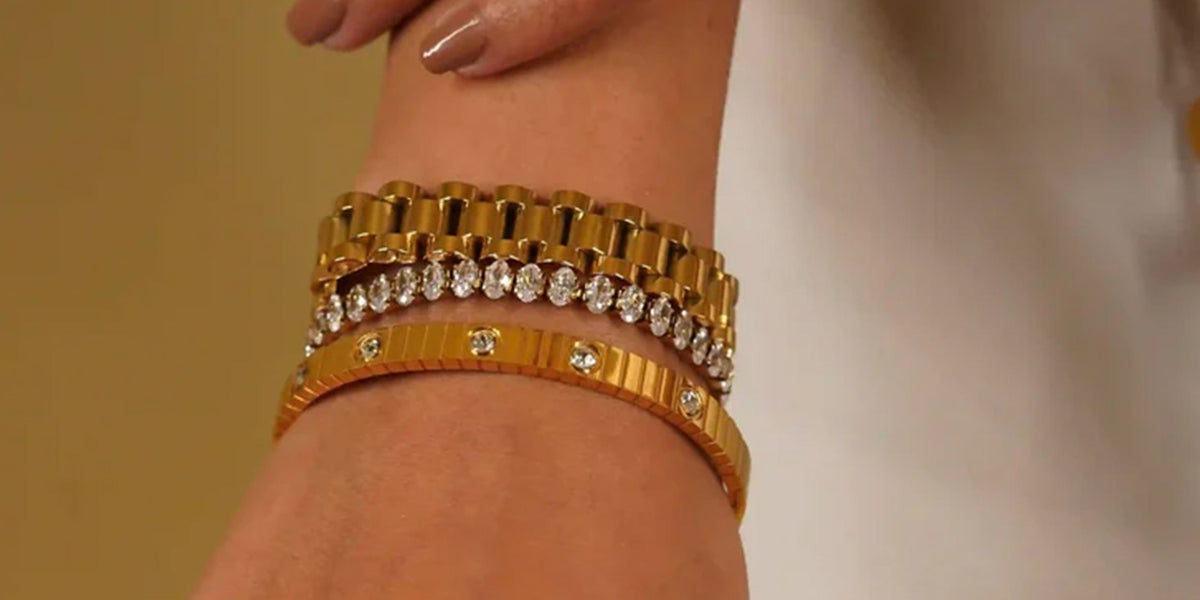
The watchband gets more daily contact than almost any other piece you own
A ring comes off for hand washing. A necklace sits loose against the collarbone. A watchband sits sealed against the wrist for eight to twelve hours a day, trapping sweat, skin oils, and heat underneath a metal surface that has nowhere to breathe. This is the highest sustained-contact jewelry category most people wear — and it is also the category with the least written about it specifically in the Pakistani market, where every guide talks about rings, earrings, and necklaces but treats the watchband as an afterthought.
The short answer on what holds up: a stainless steel link base with 18K PVD coating and a secure fold-over or deployant clasp. Everything else below explains why, link type by link type, so the decision is not a guess.
Link types — what each one actually does under daily wear
The link structure of a watchband is not a style choice made in isolation. It determines how the band flexes with wrist movement, how much surface area contacts skin continuously, and where wear concentrates first.
| Link type | Structure | Skin contact | Daily wear behaviour |
|---|---|---|---|
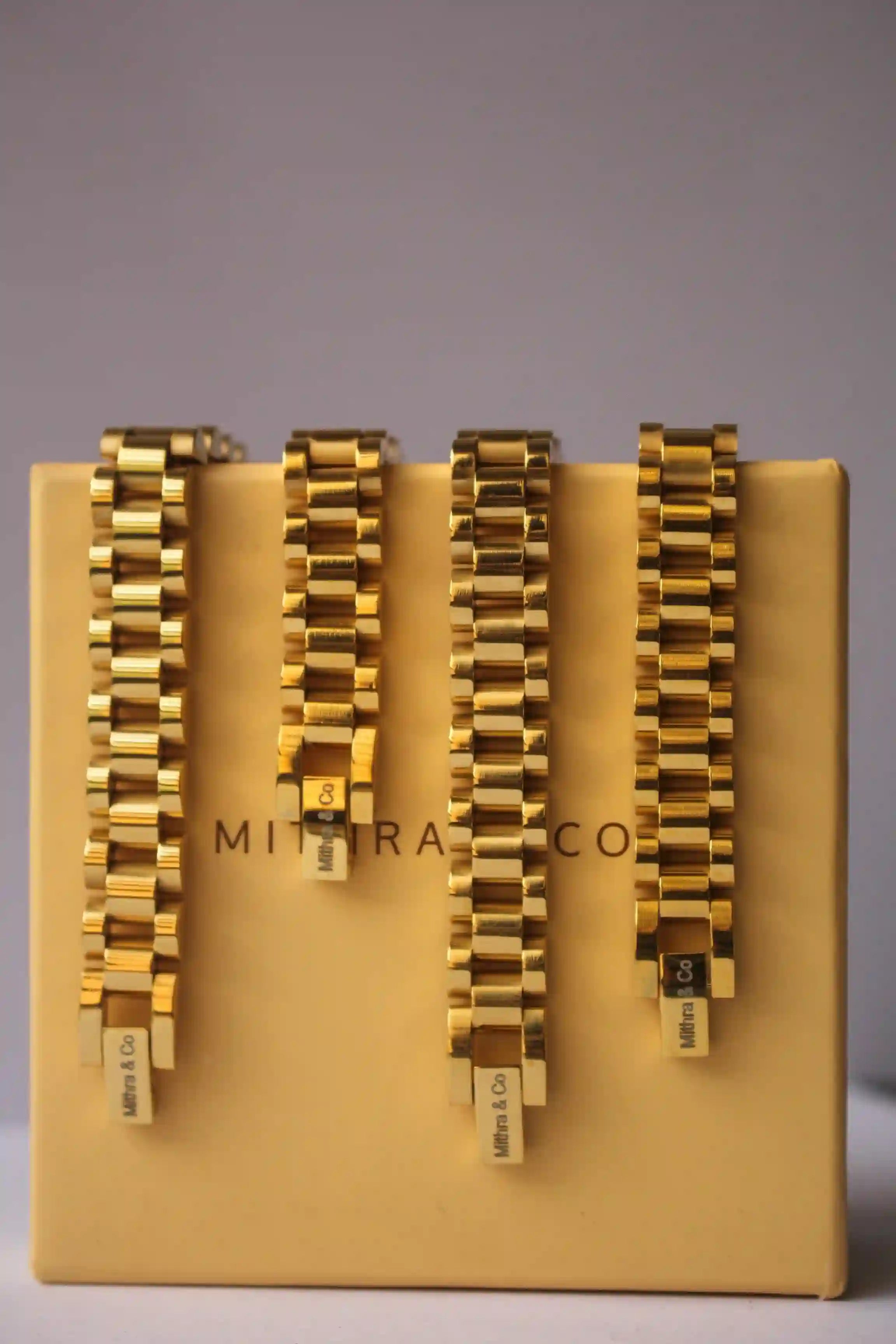
| Box link | Square, hollow interlocking links | Moderate — flat underside | Distributes flex across many joints; wear shows first at the joint pins |
| Mesh link | Fine woven metal strands | High — dense continuous contact | Traps sweat and moisture between strands; needs more frequent drying |
| Brick link | Offset rectangular links, brick-pattern stacking | Moderate | Rigid feel, less flex, wear concentrates at the widest contact points |
| Jubilee-style link | Alternating wide and narrow links | Lower — narrower links reduce total contact | More airflow underneath, dries faster after sweat exposure |
Mesh links look elegant and sit close to the wrist, but that closeness is exactly what makes them the hardest link type to keep dry in Pakistan's summer. A box or jubilee-style link with slightly more gap between the band and the skin gives sweat somewhere to evaporate instead of sitting trapped for hours.
Closure types — where a watchband actually fails first
The clasp is the single point on a watchband that opens and closes every single day, sometimes multiple times. It is under more mechanical cycling stress than any other component.
- Fold-over clasp with safety catch — the most secure option for daily wear. Two-stage closure means the band cannot fully open unless both the primary clasp and the safety catch release. The stress point is the hinge, which on a stainless steel base holds up significantly longer than on a plated brass equivalent.
- Deployant clasp — a folding mechanism that opens like a book rather than a simple hook. More secure than a basic fold-over, more complex mechanically, which means more individual moving parts that can wear over years of daily opening and closing.
- Pin buckle — the simplest mechanism, most common on leather-look or single-strap metal bands. Fewer moving parts means fewer failure points, but also less structural security if the band is under lateral pull.
The clasp fails before the coating does. On a watchband specifically, the mechanical stress of daily opening and closing wears out a weak clasp mechanism years before surface plating shows any breakdown — which is why base metal and closure quality matter more on a watchband than the gold layer itself.
Base metal — the same rule that applies everywhere else applies here, with higher stakes
A watchband sees more continuous skin contact per day than a bracelet, which means the base metal question that matters for every piece of gold plated jewelry in Pakistan matters more here. Brass or zinc alloy links under a thin gold coating will oxidise at the highest-friction points — the clasp hinge and the links closest to the wrist bone — within weeks of daily wear in Pakistani heat and humidity. The reaction is the same copper-salt oxidation that produces green marks on any brass-base piece; on a watchband it shows up as discolouration along the inner links first, since that is where sweat concentration is highest and airflow is lowest.
Stainless steel does not carry this risk. A stainless steel link base with 18K PVD coating handles the sustained sweat and heat exposure of a full Pakistani workday without the base metal reacting, because the steel itself is chemically inert against skin contact. The bracelet buying guide covers this same base-metal logic in more depth, since bracelets and watchbands share almost identical wear conditions.
How to size a watchband correctly
Most link-style watchbands are adjustable by removing or adding individual links, not by a sliding buckle mechanism. The correct fit allows one finger to pass between the band and the wrist with the clasp closed — tighter than a standard bracelet fit, because a watch needs to stay positioned on top of the wrist rather than rotating freely. A band that is too loose will spin so the watch face sits on the underside of the wrist, and a band that is too tight will leave visible pressure marks by the end of the day. For the general wrist-measurement method that applies to any wrist-worn piece, the bracelet size guide covers the measuring technique in full; the difference for a watchband is only the tighter target fit described above.
Realistic lifespan by link type and coating
| Watchband type | Base and coating | Daily wear lifespan Pakistan |
|---|---|---|
| Standard fashion watchband | Brass, electroplated | 1–3 months before clasp and inner-link discolouration |
| Better electroplated watchband | Brass, thicker plating | 3–6 months |
| Box or jubilee link 18K PVD | Stainless steel, PVD | 2–4 years |
| Mesh link 18K PVD | Stainless steel, PVD | 1–3 years — shorter than box/jubilee due to moisture retention |
The gap between mesh and box/jubilee lifespan on an otherwise identical stainless steel PVD build is not a manufacturing difference — it is purely a function of how much moisture each link geometry traps against the skin daily. Why gold plated pieces lose their finish under sustained moisture exposure is explained in full in the fading and durability guide, which covers the same underlying chemistry that applies here.
Gold plated watchbands in Pakistan — shop with COD
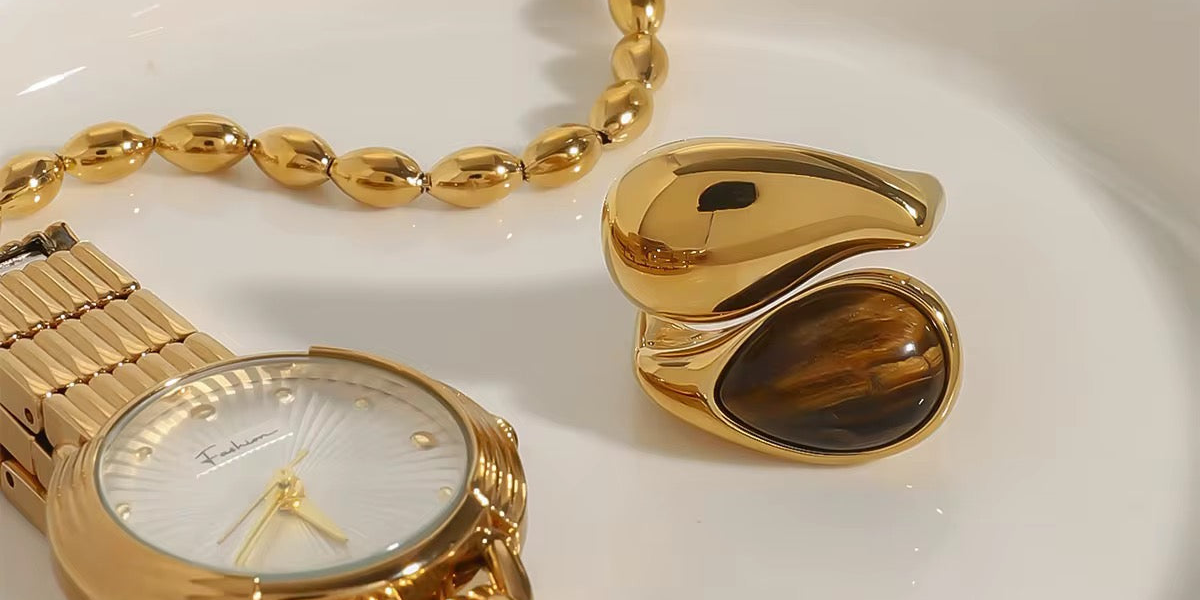
Every watchband at Mithra & Co is built on a stainless steel base with 18K PVD coating and a secure fold-over closure — designed to hold up under Pakistan's daily heat and sweat conditions without the discolouration or clasp failure that comes with brass-base alternatives. COD available across Pakistan.
Browse gold plated watchbands in Pakistan at mithraofficial.com.
Frequently asked questions
Q1. Which watchband link type lasts longest in Pakistan's heat?
A: Box link and jubilee-style links outlast mesh links under daily Pakistani wear, because both allow more airflow between the band and the wrist. Mesh sits closest to the skin and traps sweat for longer periods, which accelerates wear even when the base metal and coating are identical across all three link types. For daily summer wear specifically, a box or jubilee-style link on a stainless steel base is the more practical choice.
Q2. Why does my watchband turn dark near the clasp first?
A: The clasp and the links closest to it sit in the highest-sweat-concentration zone on the wrist and receive the most mechanical opening-and-closing stress every day. On a brass-base band, this combination of moisture and friction strips the coating fastest at exactly that point, exposing the reactive base metal underneath. A stainless steel base does not discolour this way because the metal itself does not oxidise under normal sweat exposure.
Q3. How tight should a watchband fit compared to a regular bracelet?
A: Tighter. A watchband needs one finger of clearance with the clasp closed, compared to slightly more room on a standard bracelet, because the watch face needs to stay positioned on top of the wrist rather than rotating. A watchband sized like a loose bracelet will spin during the day and leave the face sitting on the underside of the wrist.
Q4. Can I wear a gold plated watchband every day in Pakistan?
A: Yes, with a stainless steel base and 18K PVD coating specifically. This combination is built for sustained daily contact under Pakistan's heat and humidity. A brass-base electroplated watchband will show discolouration at the clasp and inner links within one to three months under the same daily conditions, regardless of price or design.
Q5. Where can I buy a gold plated watchband in Pakistan with COD?
A: Mithra & Co makes watchbands with a stainless steel base and 18K PVD coating, built for daily Pakistani wear conditions. COD is available nationwide. Browse the full watchbands collection at mithraofficial.com.

Leave a comment
This site is protected by hCaptcha and the hCaptcha Privacy Policy and Terms of Service apply.