

The short answer — and the one detail most people miss
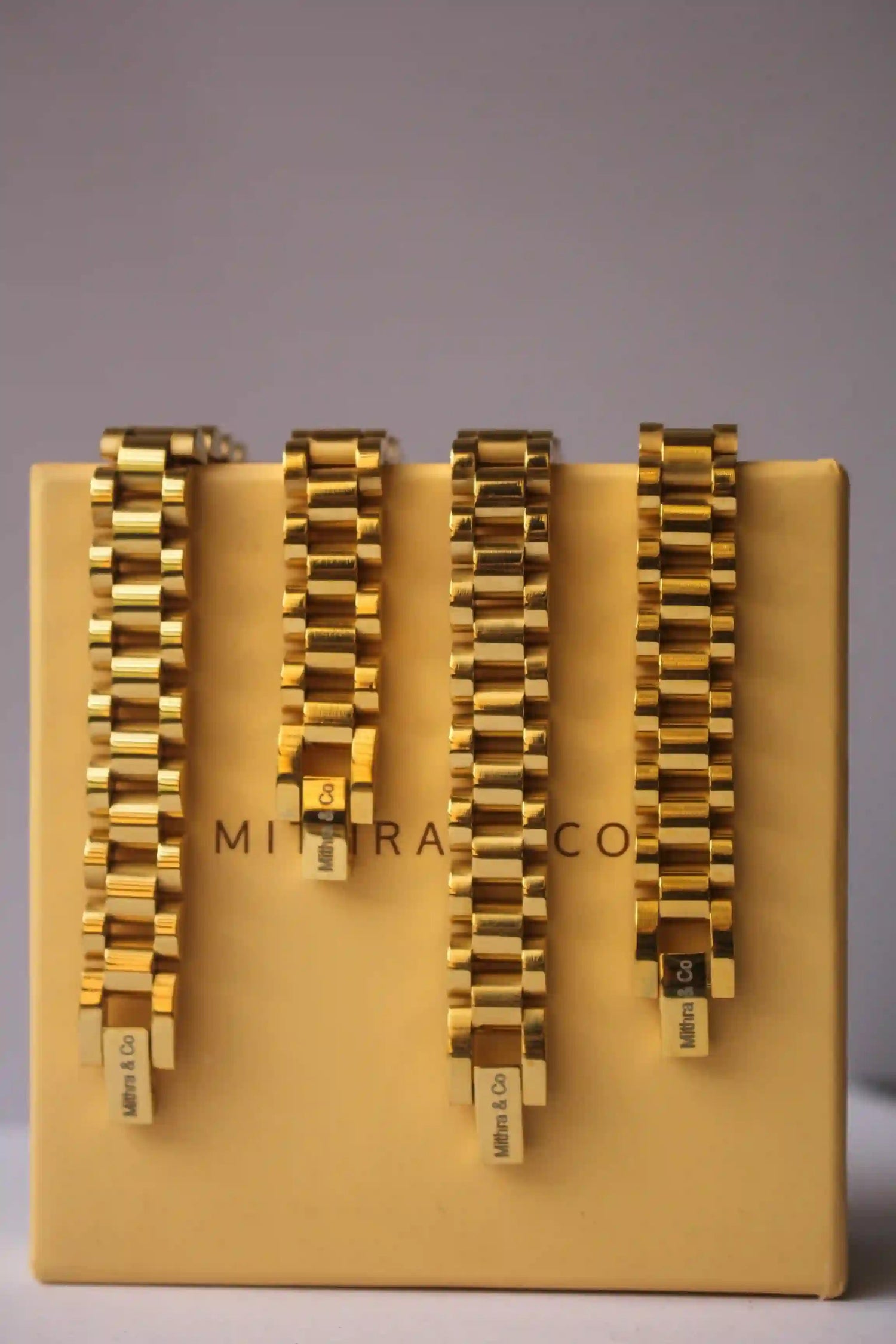
Yes, a gold plated watchband can tarnish in Pakistan's climate — but not evenly, and not randomly. On almost every case examined, discolouration begins at one of two exact locations first: the clasp hinge, or the two or three links immediately next to it. Understanding why it starts there specifically, rather than spreading evenly across the whole band, is the difference between catching the problem early and only noticing once it has already spread.
Why the clasp area tarnishes before anywhere else on the band
Two separate mechanisms stack on top of each other at exactly this spot, and neither one happens anywhere else on the band to the same degree.
| Mechanism | Why it concentrates at the clasp |
|---|---|
| Mechanical wear | The clasp opens and closes every time the watch is put on or removed — sometimes multiple times a day. This repeated flexing stresses the coating at the hinge more than anywhere else on the band, since the rest of the links stay in a fixed position through normal wear. |
| Moisture concentration | The underside of the wrist where the clasp typically sits is also where sweat pools most, particularly on the inner wrist during a full Pakistani workday. Combined with reduced airflow at the closed clasp, this spot stays damp longer than the rest of the band. |
A coating under mechanical stress and sustained moisture at the same location wears through faster than an identical coating anywhere else on the same band — which is why the clasp is the diagnostic starting point, not an inconsistent or random early warning sign.
What is actually happening once discolouration appears
On a brass or zinc alloy base watchband, once the plating thins enough at the clasp for the base metal to make direct skin contact, sweat's sodium chloride and the mild acids in skin oil react with the exposed base metal to form copper salts — the same reaction responsible for green marks on any brass-base jewelry. On a stainless steel base, this reaction does not occur, because stainless steel does not oxidise under normal sweat exposure regardless of how much the surface coating has worn. The watchband material guide covers this base-metal distinction in full detail across every link type, since it is the same underlying chemistry that determines lifespan for the entire watchband category, not just the clasp specifically.
A watchband that tarnishes only at the clasp while the rest of the band still looks new is not a defective piece — it is the expected wear pattern for any coated metal under repeated mechanical stress and concentrated moisture at one fixed point. Even points shows more wear evenly; a watchband almost never wears evenly.
Can tarnish at the clasp be stopped once it starts
If the coating is still intact but the area shows early dulling rather than visible discolouration, reducing moisture exposure at that specific spot — wiping the clasp area dry after a sweaty day, removing the watch before intense physical activity — slows further wear meaningfully. Once the base metal is actually exposed and reacting, no amount of care reverses it; the coating at that point is gone and the reaction is a property of the exposed metal itself, not the surface condition. At that stage the realistic options are living with a worn clasp on an otherwise intact band, or replacing the piece with one built on a base metal that does not carry the same risk from the start.
Frequently asked questions
Q1. Why does my watchband only tarnish near the clasp?
A: The clasp area combines two stress factors that do not occur elsewhere on the band — repeated mechanical flexing every time the watch is opened and closed, and concentrated sweat moisture from sitting against the inner wrist. Both factors together wear through the surface coating at that exact spot faster than anywhere else on the band, which is why tarnish typically starts there rather than spreading evenly.
Q2. Is a tarnished clasp a sign of a fake or low-quality watchband?
A: Not necessarily. Even a genuinely well-made plated watchband will eventually show wear at the clasp first, since that location experiences more combined mechanical and chemical stress than the rest of the band under normal daily use. What determines how long that takes is the base metal underneath — stainless steel resists the reaction that causes visible discolouration; brass or zinc alloy does not.
Q3. How long before a gold plated watchband starts tarnishing at the clasp in Pakistan?
A: On a brass-base electroplated band, discolouration at the clasp typically becomes visible within one to three months of regular daily wear in Pakistani heat and humidity. On a stainless steel base with 18K PVD coating, the same wear pattern takes considerably longer to appear, and the underlying base metal does not react even once the coating eventually thins.
Q4. Does removing the watch at night slow down clasp tarnish?
A: It helps marginally by reducing total daily wear cycles on the clasp mechanism, but the bigger factor is moisture exposure during active wear hours, not overnight rest. Wiping the clasp area dry after sweat exposure during the day has more impact than removing the watch overnight.
Q5. What watchband material avoids clasp tarnish entirely in Pakistan?
A: A stainless steel base with 18K PVD coating does not undergo the base-metal oxidation reaction that causes visible tarnish, even at the high-stress clasp point, because the steel itself is chemically inert under normal skin contact and sweat exposure. The watchband material guide covers link type and closure options built on this base metal.

Leave a comment
This site is protected by hCaptcha and the hCaptcha Privacy Policy and Terms of Service apply.