


There is a version of layered jewelry that looks intentional — a quiet series of decisions that happened to work together. And there is a version that looks like everything went on at once and nothing came off. The difference is not the number of pieces. It is one or two principles applied consistently, and most people have never been told what they are.
Why layering goes wrong — the actual reason
Most layering mistakes come from treating each piece as an independent decision. A necklace because you like the necklace. Earrings because you like the earrings. A ring, then a bracelet, because the occasion seemed to want them. Each choice was reasonable. The combination was not.
Layering works when pieces are chosen in relation to each other. They do not need to match — matching usually works against the look. Each piece needs to know its role: which one is the focal point, which ones support it, and which ones are competing when they should not be.
Every layered look has a hierarchy: one piece doing the most work, others doing supporting work, and empty space doing structural work. Once that is clear, most mistakes become obvious before they happen.
The difference between layered and cluttered is almost always one piece too many — and you usually know which piece it is before you leave the house.
The neck — where most people start
Necklace layering is the most referenced jewelry trend in Pakistan and the one with the most visible failures, because its rules are specific and rarely explained. The short version: at least 2 inches between plain chains, 4 when a pendant is involved; finest chain on top, pendant or heaviest piece lowest; one pendant per stack; every chain on the same base metal.
What never works at the neck: two statement necklaces together, two pendants at similar lengths, or any pairing where both pieces are trying to be the focal point. One piece leads; the other anchors. The lengths, combinations, and tangling fixes are in layered necklace sets.
The ears — the decision most people get backwards
The most common earring mistake in a layered look is treating earrings as an addition to the necklaces rather than something calibrated against them.
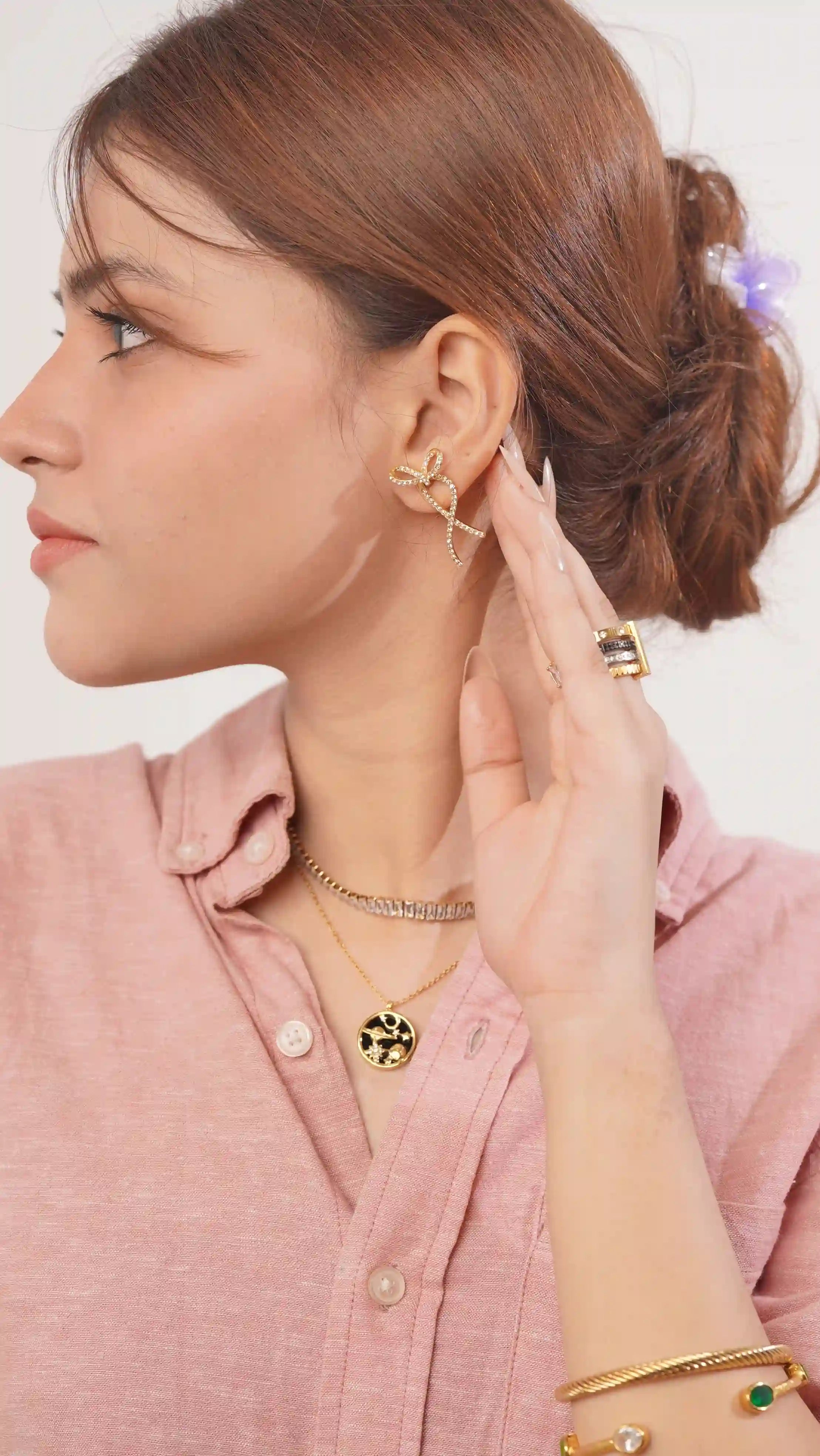
The rule: the more happening at the neck, the less at the ear. A three-chain stack needs small, quiet earrings — a stud, a small hoop, a minimal drop. Statement earrings with a layered neck fight for the same zone of the face, and neither wins. The reverse holds too: a bold earring needs a plain chain or no necklace at all.
Studs and huggies solve this permanently. They work beside any necklace arrangement without competing, which is why they are the most-worn earrings in any collection where necklace layering is a habit. The earring-versus-necklace table is in how to wear statement earrings.
The wrist and hand — one unit, not two
When jewelry is layered across both, the wrist and fingers read as a single visual unit. What happens at the wrist changes how a ring stack reads, and the reverse — yet most people decide them separately.
The principle: balance weight across the unit rather than concentrating it. A heavy bracelet reads better against one or two slim rings. A full ring stack reads better against a slim chain bracelet or nothing. Load both and the hand reads busy, however good each piece is.
-
Heavy wrist, light handA statement cuff or a bracelet stack, with one or two slim rings. The wrist carries the weight; the fingers complement it quietly.
-
Light wrist, stacked handA ring stack across two or three fingers, with one slim chain bracelet or nothing. The hand carries the detail; the wrist stays quiet.
-
Matched medium weightTwo slim bracelets and two slim rings. Neither side dominates. The hardest to calibrate, because both sides have to stay genuinely medium.
-
What breaks itA statement cuff and a full ring stack on the same hand. Several bangles and a heavy ring. The hand cannot hold two centres of attention.
The detail for each side is in how to stack rings and how to stack bracelets.
Metal tone — does everything need to match?
No. But consistency within a zone matters more than consistency across the whole look.
Gold necklace, silver ring, gold bracelet, silver earrings at equal weight reads as accidental — the eye cannot find a pattern and stops trying. Pick a dominant tone and let the other appear as a deliberate accent: three gold pieces and one silver ring reads as intentional mixed metals; two and two reads as undecided.
The simplest version is one tone throughout. Within that, the layering can be as complex or minimal as the occasion asks, and the tone becomes the invisible structure holding it together. Mixing tones well is covered in gold and silver together.
Layering by occasion — the rules scale
Two pieces maximum per zone — two chains or one chain and a pendant, small earrings, one or two rings. Layered, but nothing demanding attention in a professional room.
Where the ring stack, the three-chain combination, and bracelets-plus-rings all become appropriate. The context carries more volume, and casual necklines give each piece visibility.
Counter-intuitively, less layering, not more. One statement piece — a bold earring, a sculptural ring, a chain with presence — worn with nothing competing reads more dressed than a full arrangement.
The one context where full volume is expected. Multiple necklaces, stacked rings, layered bracelets, statement earrings. The rules that still apply: one tone, and one clear centrepiece.
The one edit that fixes most layering problems
Before leaving the house, remove one piece. Not the best piece — the one doing the least specific work, there because you added it rather than because the look needed it.
It works because layering nearly always overshoots before it lands. The instinct is to add until it feels complete, and "complete" is usually one piece past where the arrangement was working best. The piece whose absence you are least sure anyone would notice is the one to take off.
The pieces that survive this edit are the ones worth building a collection around. The ones that keep coming off are filling space, not doing work.
If most of what you own sits unworn, layering is often the answer. A slim chain too plain on its own becomes the base under a pendant that needed context; a ring that felt like not enough becomes part of a stack that is exactly enough. More in why you buy jewelry and never wear it.
Frequently asked questions
Q1. How do I layer necklaces without them tangling?
A: Length gaps first — at least 2 inches between plain chains, 4 with a pendant — then different chain types, so they move independently. A layering clasp holds them apart if you wear a stack daily. The full method is in the layered necklace guide linked above.
Q2. How many rings can I stack without it looking overdone?
A: Three across one or two fingers for daily wear — enough to read intentional, not enough to restrict movement or draw comment at work. Five or more reads as a deliberate style statement. Odd numbers tend to read as curated; even numbers as unfinished.
Q3. Can I mix gold and silver when layering?
A: Yes, with a dominant tone rather than an equal split. Three gold and one silver accent reads intentional; equal amounts read undecided. The easy version is all gold on one hand and all silver on the other.
Q4. What should I layer for a Pakistani office?
A: Two pieces per zone at most — one or two chains, small studs or hoops, one or two slim rings. Visible but not audible: nothing that catches on fabric, nothing that clinks in a meeting.
Q5. What material is best for layered daily wear?
A: Stainless steel with 18K PVD — and every piece on it. Layered pieces rub against each other constantly, so coating durability matters more than for a single piece, and mixing stainless steel with brass under sweat corrodes the brass faster. How PVD handles daily friction is in PVD jewelry explained.
Build with pieces that layer well
The quality that matters most in a layering piece is that it holds up to what layering does to it — rings touching rings, chains moving against chains, bracelets against the wrist all day. Stainless steel with PVD handles that without the surface wear that makes most affordable layered jewelry look tired within weeks.
The piece that looks the same in month three as in week one is the one that stays in the arrangement. Browse the collection — cash on delivery nationwide, materials stated on every product page.

Leave a comment
This site is protected by hCaptcha and the hCaptcha Privacy Policy and Terms of Service apply.