

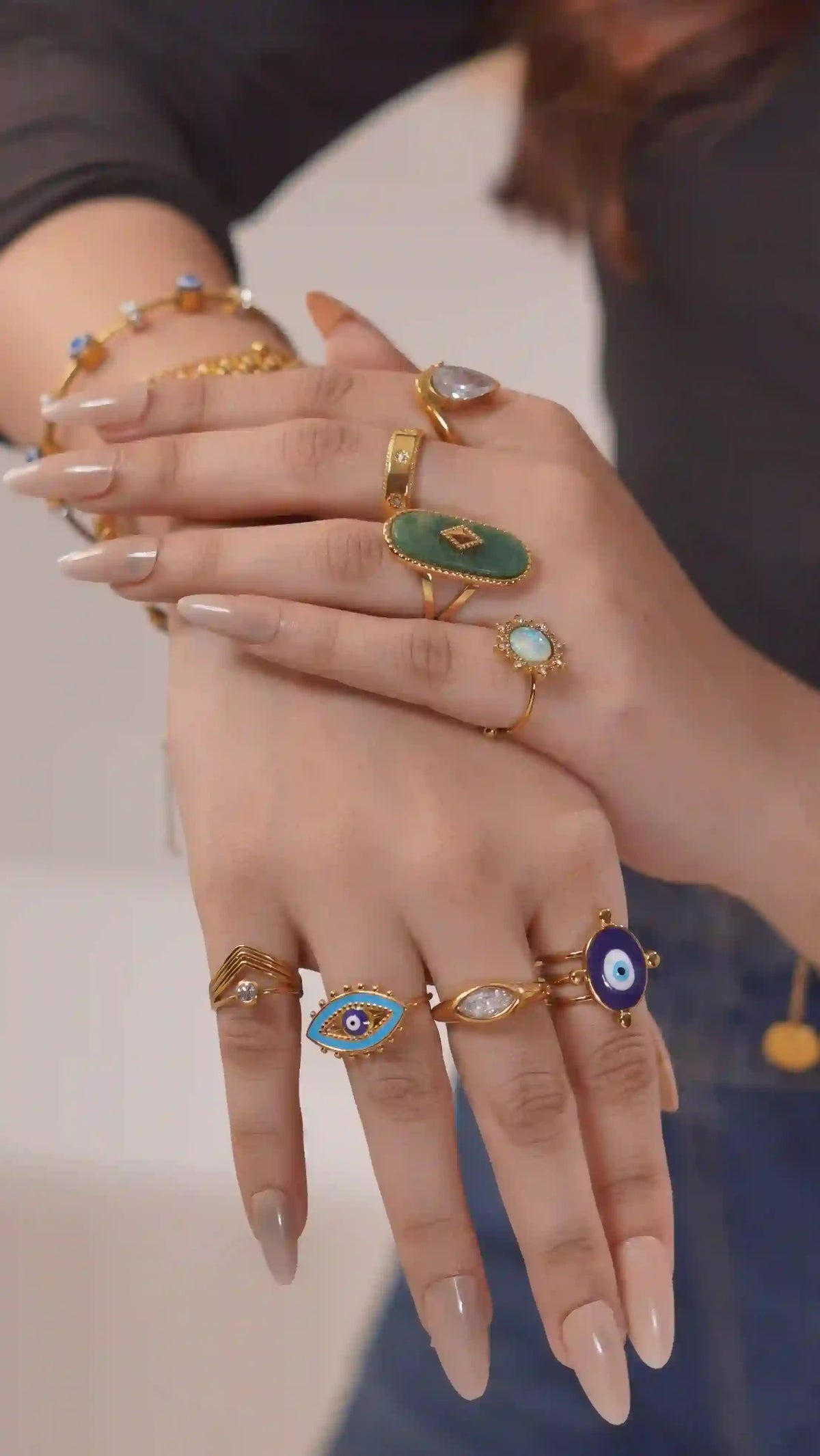
Every seller of waterproof jewelry in Pakistan uses the same word — but the word itself is not regulated, tested, or certified by anyone. This is what it actually depends on, and how to tell a genuine claim from a marketing one before you buy.
The short answer — the word tells you nothing about the metal underneath it
"Waterproof" on a Pakistani jewelry listing is not a regulated term. There is no certification body, no legal threshold, and no standard test a seller has to pass before using the word. A piece that survives a twenty-minute shower and a piece that lifts at the edges after one splash can both call themselves waterproof, and neither is lying in any enforceable sense — because the word was never defined to begin with.
What the claim actually depends on is the base metal underneath the coating and how porous that coating is. Two products using the identical word on the listing page can behave in completely different ways once water reaches the surface, and the listing gives you no way to tell which one you're looking at.
Why "waterproof" isn't regulated — the mechanism behind the gap
Every plated surface — standard electroplating or PVD — has microscopic porosity. No coating is a perfect seal at the molecular level; there are always gaps where a liquid can eventually reach the base metal given enough time, concentration, or surface tension. Standard electroplating, deposited at roughly 0.5 microns, is comparatively porous — water reaches the base metal faster. PVD, bonded at a molecular level and typically 1 to 3 microns thick, is significantly denser and slower to let water through.
That difference in porosity is what "waterproof" is actually describing when the claim happens to be true — but the word itself never specifies coating thickness, porosity, or base metal, so a buyer reading the word alone has no way to distinguish a genuinely water-stable piece from one that only survives being called that on a product page.
The three claims — what each one usually means, and what it does not
| Claim | What it usually means | What it does not mean | Pakistani daily wear verdict |
|---|---|---|---|
| Waterproof | Survives consistent, non-submerged contact — wudu, sweat, hand washing — without degrading | Survives chlorinated pool water, hot showers indefinitely, or saltwater | Reliable only when paired with a stainless steel base — the word alone confirms nothing |
| Water-resistant | Handles damp environments, atmospheric humidity, and brief splashes | Continuous daily rinsing or prolonged immersion | Fine on stainless steel; requires caution on a brass base regardless of the label |
| Splash-proof | Handles incidental, brief contact — sudden rain, an accidental droplet | Any sustained or daily water contact | The honest baseline claim for the reactive base metals common in local bazaar jewelry |
A piece honestly labelled "splash-proof" on a stainless steel base with PVD coating will outlast a piece labelled "waterproof" on a brass base with standard electroplating. The stronger-sounding word is not the stronger product. The base metal is the only variable that actually decides the outcome.
What to check on a listing instead of trusting the word
Since the claim itself is unverifiable from the outside, the questions worth asking a seller — or looking for explicitly in a product description — are structural, not semantic:
- What is the base metal, named explicitly? Stainless steel or 316L stainless steel is the answer that supports a waterproof claim. Brass, alloy, or an unnamed "premium metal" does not, regardless of what the listing calls the finish.
- What is the coating method? "PVD" or "physical vapour deposition" stated explicitly signals the denser, lower-porosity coating. A listing that only says "gold plated" or "18KGP" with no coating method named is very likely standard electroplating.
- Does the seller distinguish between water types? A listing that separately addresses sweat, wudu, showering, and swimming is describing an actual material property. A listing that uses "waterproof" as one blanket word for all of it is describing a marketing decision, not a tested one.
- Is there a return or exchange path if the claim doesn't hold? A seller confident in the material backs the claim with a real exchange policy rather than only the word on the page.
Where this claim actually gets tested in Pakistani daily life
The word "waterproof" is being asked to cover a wide range of very different situations — wudu five times a day, an indoor shower, monsoon rain, a gym session, an actual swimming pool — and each of those puts a different kind of stress on a coating. Rather than restate all of that here, the situation-by-situation breakdown — including why wudu specifically is the water exposure most international guides never account for — is covered in full in what actually happens across a normal Pakistani day. That guide is the one to read for "can I do X with this on" — this one is for understanding what makes a genuine waterproof jewelry claim in Pakistan before you buy.
What "waterproof" means for Mithra's pieces specifically
Every piece at Mithra & Co's waterproof jewelry in Pakistan is built on a 316L stainless steel base with 18K PVD coating, stated explicitly rather than left as an unqualified marketing word. The stainless steel base is genuinely stable under the water exposure Pakistani daily life produces, and the PVD coating's lower porosity slows water penetration meaningfully compared to standard electroplating. What this does not mean is that the coating is permanent — daily showering still shortens PVD lifespan over time, and pool or saltwater exposure is not recommended on any base metal, stainless steel included. The PVD coating durability guide covers realistic lifespan expectations under different exposure levels.
Frequently asked questions
Q1. Is "waterproof jewelry" a real, regulated claim in Pakistan?
A: No. There is no certification body or legal standard governing the word "waterproof" on a jewelry listing anywhere, including Pakistan. Two products using the identical word can have completely different real-world water performance. The word tells you what the seller decided to call the product, not a tested material fact.
Q2. How do I know if a "waterproof" listing is actually accurate?
A: Check for the base metal named explicitly — stainless steel or 316L stainless steel supports the claim, brass or an unnamed alloy does not. Check for the coating method stated as PVD specifically, not just "gold plated." A listing that names both is describing a real material combination; a listing that only uses the word "waterproof" with no supporting detail is making an unverifiable claim.
Q3. Is "water-resistant" a weaker claim than "waterproof"?
A: The words suggest a hierarchy that doesn't actually exist in practice, since neither is regulated. What matters is the base metal behind either word — a water-resistant claim on a genuine stainless steel PVD piece is more reliable in daily wear than a waterproof claim on an unnamed base metal, regardless of which word sounds stronger.
Q4. Does an 18K stamp mean the jewelry is also waterproof?
A: No — 18K refers to the gold purity used in the plating colour, not to the base metal or coating method underneath it. A piece can be 18K gold plated on a reactive brass base with thin standard electroplating, which will not perform as a waterproof claim would suggest. The karat number and the water performance are two separate specifications.
Q5. Where can I buy jewelry in Pakistan where the material claims are actually verifiable?
A: Mithra & Co is a waterproof jewelry brand in Pakistan that states the base metal and coating method explicitly on every product — 316L stainless steel with 18K PVD coating — rather than relying on an unqualified "waterproof" label. Browse the full collection, with cash on delivery available across Pakistan — the parcel arrives and is inspected before payment is made.
The Claim Is Marketing. The Base Metal Is the Fact.
"Waterproof," "water-resistant," and "splash-proof" are three words with no enforced meaning between them. What actually determines whether a piece survives Pakistani daily water contact is the base metal and the coating method — two things a seller can state precisely and a buyer can actually verify, unlike the adjective sitting above them on the listing. See Mithra & Co's waterproof jewelry in Pakistan to check the base metal and coating for yourself before you buy.

Leave a comment
This site is protected by hCaptcha and the hCaptcha Privacy Policy and Terms of Service apply.