

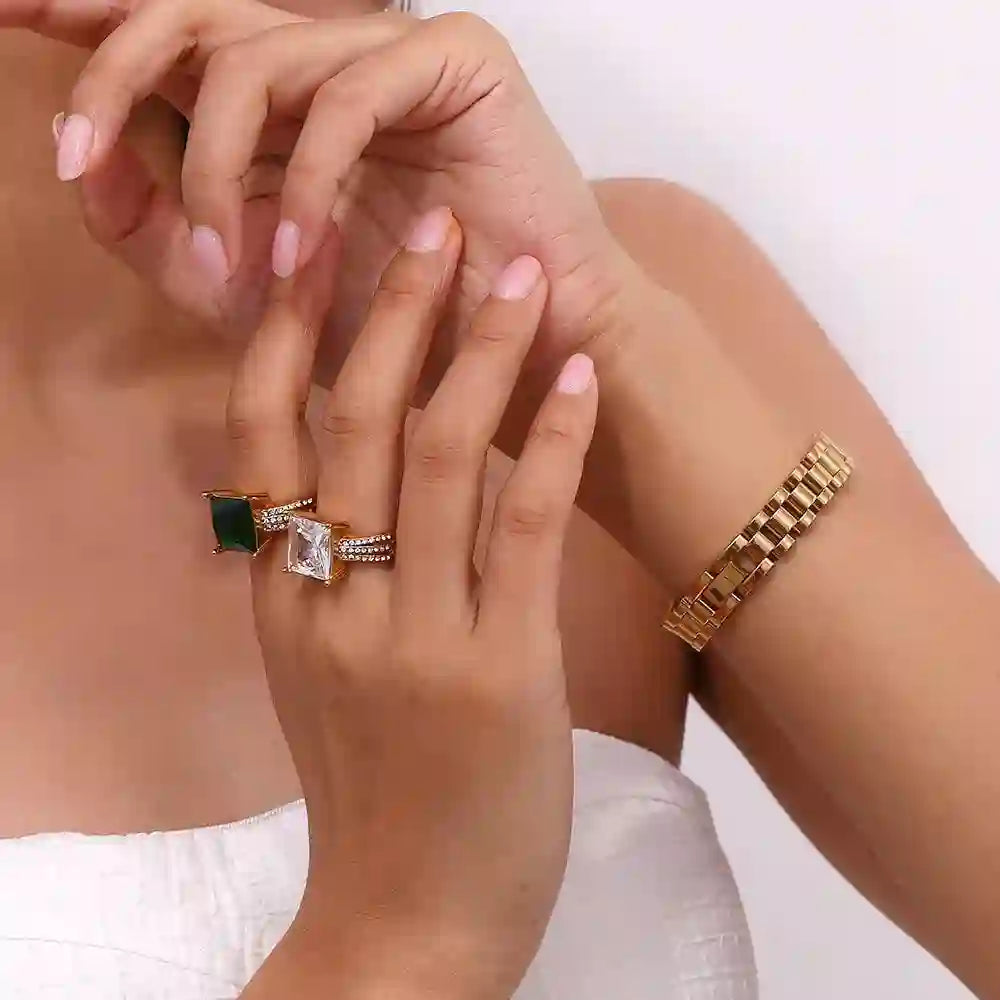
You put the watch on first, out of habit. Then a bracelet goes on the same wrist without much thought — and by afternoon the two have tangled, clinked against a desk for six hours straight, or just looked like too much happening in one place.
A watch is not a bracelet — pair it like a different category
Most stacking advice treats every wrist piece as interchangeable — add a chain, add a bangle, add a cuff, repeat. A watch breaks that logic. It has a face, a fixed size, and a job to do beyond decoration, which means it needs room around it rather than competition against it. The question is not how many pieces to stack — that is a separate topic already covered in full detail. The question here is specifically what happens when one of those pieces is a watch, because a watch changes the rules of the pairing in ways a second bracelet does not.
What pairs well with a watch on the same wrist
-
A single thin chain braceletSits close to the wrist and moves independently of the watch face. The thinness matters — anything with visual weight competes with the watch instead of accompanying it.
-
One slim bangle, worn slightly looseA bangle that sits a little further down the wrist toward the hand creates separation from the watch rather than crowding it against the watch face.
-
A tennis bracelet, but only if the watch face is small to mediumA tennis bracelet's continuous sparkle needs its own visual space. Against a large statement watch face, the two fight for attention. Against a smaller, cleaner watch face, they read as a considered pairing.
What to avoid pairing with a watch
The mistake is rarely the choice of a second piece — it is putting the second piece on the same wrist as the watch by default, without considering the other wrist at all. Most watch-and-bracelet combinations look more deliberate split across both wrists than stacked on one.
A cuff or bangle wide enough to sit directly against the edge of the watch case will catch on it through the day — literally, at desks, in bags, against door frames. A heavy chain bracelet with visual weight similar to the watch itself creates competition rather than pairing, since the eye cannot tell which piece is meant to be the focal point. And more than one additional bracelet on the same wrist as a watch reliably reads as cluttered rather than layered, in a way the same three pieces would not if two of them moved to the opposite wrist.
The two-wrist approach — the version that works most consistently
Keep it to the watch alone, or the watch plus one thin chain bracelet at most. This wrist's job is the watch — everything else is secondary.
This is where a fuller stack — multiple thin bracelets, a bangle, a tennis piece — has room to actually be seen without competing against a watch face for attention.
Splitting the two is not a rule so much as a practical outcome of how much visual space a watch takes up on its own. For the full logic of building a multi-piece stack — how many pieces, which metals, which widths work together — the bracelet stacking guide covers that separately; this pairing logic is specifically about what changes once a watch enters the equation.
Office and daily wear in Pakistan — what holds up through a full day
A watch and a thin bracelet on the same wrist means two pieces in continuous contact with a desk, a steering wheel, and each other for most of the day. In Pakistan's heat, this concentrated contact accelerates sweat buildup between the two pieces specifically, more than either would experience alone. Material choice matters more here than in most pairing decisions — a stainless steel watchband and a stainless steel bracelet worn together avoid the metal-on-metal reaction that happens when dissimilar base metals sit against each other under sweat exposure through a full Pakistani workday.
Frequently asked questions
-
Q1. Can I wear a watch and a bracelet on the same wrist in Pakistan?A: Yes, but keep the second piece thin and low-profile — a slim chain bracelet or a loosely worn bangle sitting away from the watch case. A heavy chain, a wide cuff, or more than one extra piece on the watch wrist tends to look crowded and can catch on the watch case through the day.
-
Q2. Should a watch and bracelet be the same metal colour?A: Matching gold tones is the safer default and avoids the mixed-metal question entirely. If mixing gold and silver tones, keep it to the watch and one other piece rather than a full mixed stack — a single contrast reads intentional, several competing tones do not.
-
Q3. Is it better to wear the watch and bracelet on separate wrists?A: For anyone who wants a fuller bracelet stack, yes — moving the stack to the opposite wrist gives both the watch and the bracelet arrangement room to be seen properly, rather than competing for space on one wrist.
-
Q4. Does wearing a bracelet against a watch scratch the watch case?A: It can, over time, particularly with a bracelet that has raised detail or a rough clasp sitting directly against the watch case edge. A slim, smooth-surfaced bracelet worn with slight distance from the case reduces this contact significantly.
-
Q5. What is the most versatile watch-and-bracelet combination for daily wear in Pakistan?A: A stainless steel 18K PVD watchband with a single thin stainless steel chain bracelet on the same wrist — same base metal avoids reaction under sweat, and the thin profile means neither piece dominates the other through a full day of desk work, movement, and Pakistani heat.
The Watch Sets the Rule — Everything Else Adjusts Around It
A watch is the one wrist piece that cannot be treated as interchangeable with the rest of a stack. Once that is the starting point, the pairing decision gets simpler: keep the watch wrist minimal, let the opposite wrist carry more, and match base metals where the two pieces sit close enough to actually touch.
Browse watchbands and bracelets at mithraofficial.com

Leave a comment
This site is protected by hCaptcha and the hCaptcha Privacy Policy and Terms of Service apply.