

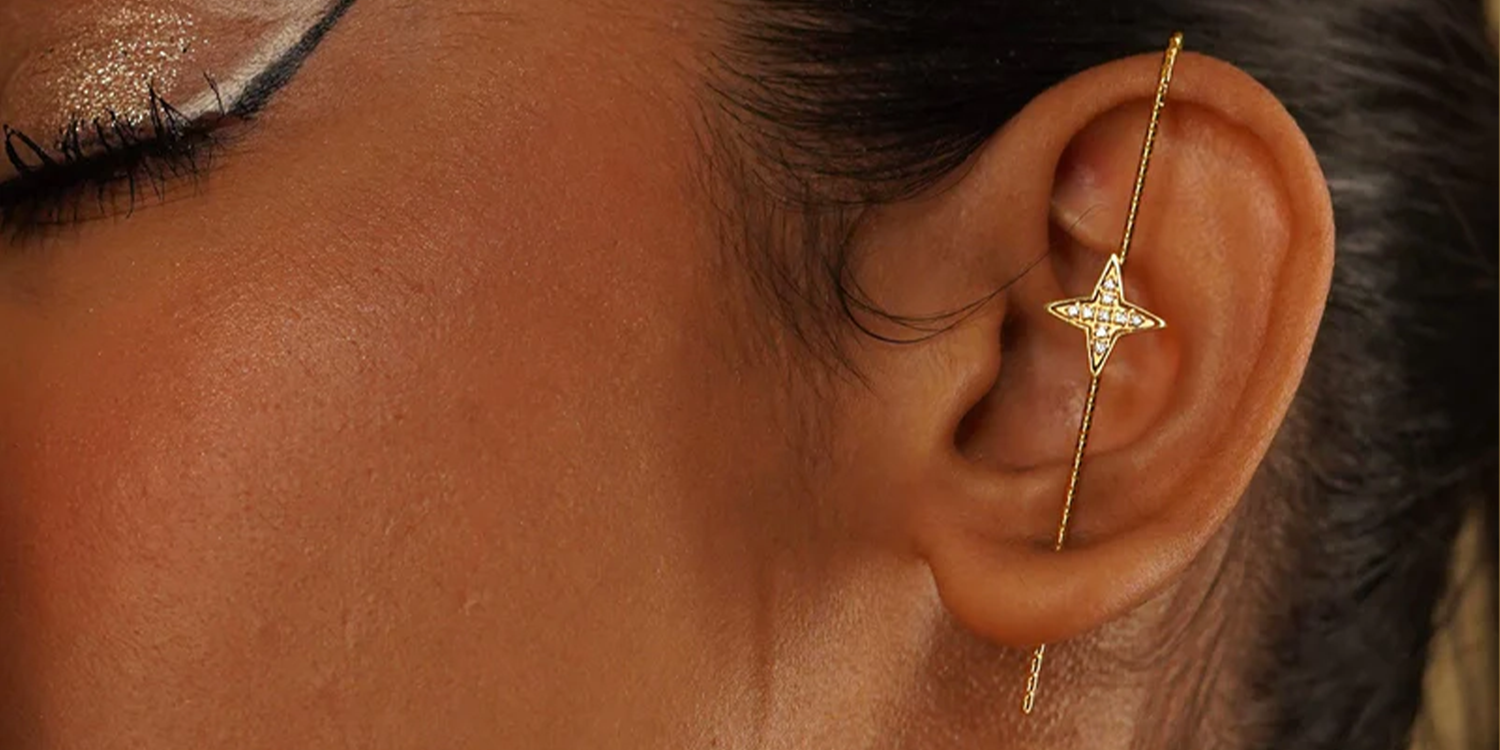
Everyone assumes you have a second or third piercing. You do not. The ear cuff is sitting there on the shelf, looking effortless on everyone in every photo — and nobody explains that the whole point is you do not need one.
What an ear cuff actually is — and why it stays on without a piercing
An ear cuff is a piece of jewelry that grips the outer cartilage of the ear rather than passing through a piercing hole. It works by tension — the cuff is slightly smaller than the ear cartilage width it sits on, which creates enough pressure to hold it in place without any piercing required. The grip comes from the metal's spring tension, not from a backing or post.
This is also why fit matters more with ear cuffs than with any other earring type. A cuff that is too wide for the cartilage it sits on falls off constantly. A cuff that is too narrow creates pressure and discomfort within an hour. The correct fit sits with light, even tension — noticeable enough to hold, not so tight that it pinches.
The ear cuff does not need a piercing because it is not going through the ear — it is going around it. This is the entire mechanism. The styling looks like a second or third piercing in photographs, which is why ear cuffs became the first jewelry trend in Pakistan driven entirely by the gap between how something looks in a photo and what it actually requires to wear.
The three types of ear cuffs — and which one stays on in Pakistani daily conditions
How to put on an ear cuff so it actually stays
Most ear cuff failures — the cuff that falls off within an hour — come from incorrect placement rather than a poorly made piece. The cuff needs to grip the narrowest point of the outer helix cartilage where the ear curves inward. This is not the very top of the ear and not the thicker cartilage lower down — it is the midpoint of the outer curve where the cartilage is thinnest and the cuff's tension engages correctly.
Run a finger along the outer curve of the ear from the lobe upward. The cartilage narrows and then widens again toward the top. The narrow midpoint is where the cuff grips best — usually about halfway up the outer helix.
Most ear cuffs arrive set tighter than needed. Before the first wear, gently press the two ends slightly apart to create enough gap to slide over the cartilage without forcing. Small increments — overbending a cuff weakens the metal at the bend point.
Position the cuff at the placement point and slide it onto the cartilage from the front. Do not try to clip it on from the side — the cartilage is thicker from the side angle and the cuff will not sit correctly. Front-to-back placement engages the tension correctly.
Once on, gently press the cuff's ends slightly closer together if it rotates or slips. Test by tilting the head — if it stays in position without touching, the tension is correct. If it falls forward, tighten slightly. If it pinches, open slightly.
Sizing — why Pakistani ear cuffs fall off and how to fix it
Ear cartilage varies significantly in thickness between individuals, and Pakistani buyers purchasing ear cuffs via COD cannot test the fit before the piece arrives. The most common result: a cuff that slides off because it arrived with an opening wider than the individual's cartilage thickness.
The fix is the same as for a cuff bracelet — gentle adjustment before first wear. A cuff that arrives slightly too wide needs the ends pressed slightly closer. A cuff that arrives tight enough to pinch needs the ends pressed slightly apart. Both adjustments take under a minute and, done gradually, do not weaken the metal. For how the same adjustment principle applies to cuff bracelets — where the fit mechanics are identical — the cuff bracelet wearing guide covers the adjustment method in detail.
Which ear to wear a cuff on — and does it matter
In Pakistani daily wear, there is no cultural rule governing which ear an ear cuff goes on. The practical considerations are: hair parting, photograph direction, and whether you wear a standard earring in the lobe on the same ear.
| Situation | Which ear | Why |
|---|---|---|
| Hair parted to one side | The side with more hair tucked behind the ear | The ear cuff is visible when the hair is tucked — hidden when hair falls forward over it. The parted side keeps the cuff in view. |
| Wearing a statement stud in one lobe | The same ear as the statement stud | Creates the connected-piercings look on one ear. The other ear can be plain or have a small stud for balance. |
| Single cuff as the only earring | Either — personal preference | No functional difference. Wear on the side that faces the camera at events or meetings if visibility matters. |
| Pair of cuffs (both ears) | Both | Symmetrical. Works for occasions where both ears are visible — hair up, dupatta pinned back. |
Ear cuffs with Pakistani outfits — what works and what fights
The ear cuff's visual language is contemporary and minimalist — which gives it a specific relationship with Pakistani outfit types. It works best where the outfit has space for a modern edge. It reads incorrectly against outfits with heavy traditional embellishment because the contrast between a sleek metal cuff and dense gota or zardozi work creates a register mismatch rather than contrast.
Ear cuffs for Pakistani occasions specifically
The ear cuff has a specific place in the Pakistani occasion calendar — not as a formal event piece but as the elevated casual and semi-formal earring that replaces the standard stud without requiring a second piercing.
For university farewell dinners, birthday lunches in Karachi's Defence cafes, or Lahore brunch outings — an ear cuff with plain semi-formal Pakistani wear reads as the most contemporary earring choice available without the formality commitment of a drop earring or the casualness of a small stud. For the full guide on jewelry calibration for these in-between Pakistani occasions, the casual events jewelry guide covers the complete combination logic.
For Eid morning visits and daytime Eid gatherings, a pair of matching ear cuffs — one on each ear — reads as festively modern without the weight or formality of traditional Eid earring sets. Against a plain Eid morning lawn outfit with minimal other jewelry, two matching cuffs create a complete look that reads as considered without reading as overdressed for a daytime family visit.
Caring for an ear cuff in Pakistani conditions
An 18K PVD over stainless steel ear cuff requires no special care beyond the same routine that applies to all PVD jewelry: apply perfume and hair products before wearing, not after. In Pakistan's summer heat where hair products and sweat are unavoidable, the sequence matters — the cuff goes on last. For the full guide on what products damage gold plated jewelry and in what order to apply them, the perfume and gold plated jewelry guide covers the complete application order.
Storage: ear cuffs should be stored open — not closed tighter than their resting position — to prevent the metal developing a set shape that no longer matches the cartilage it was adjusted for.
Frequently asked questions
Q1. Do ear cuffs hurt to wear?
A: A correctly sized and placed ear cuff should not hurt. If it pinches or creates pressure, the cuff is too tight — gently press the ends slightly apart. Pain after extended wear (more than four to five hours) usually means the cuff is positioned on a thicker part of the cartilage rather than the narrow midpoint of the outer helix where it grips most comfortably. Repositioning slightly upward or downward along the cartilage usually resolves sustained discomfort.
Q2. Will an ear cuff fall off during daily wear in Pakistan?
A: A correctly fitted ear cuff — adjusted to grip the cartilage with light, even tension — stays in place through normal daily movement including commuting, walking, and light activity. It will fall off if it is too wide for the cartilage, if it is placed on the wrong part of the ear, or if hair is constantly being tucked behind the ear and catching the cuff as it passes. The single most common fall-off cause is a cuff that was never adjusted from its as-arrived width before wearing.
Q3. Can I wear an ear cuff with a regular earring in the same ear?
A: Yes — and this is one of the most common ear cuff styling approaches. A small stud in the lobe with a single-band or climber cuff on the outer cartilage above it creates the connected-piercings look from a single standard lobe piercing. The cuff and the stud should be in the same metal tone — both gold or both silver — for the look to read as intentional rather than mismatched.
Q4. Are ear cuffs appropriate for Pakistani office wear?
A: A small, plain single-band ear cuff is appropriate for most Pakistani office environments — it reads as a subtle styling choice rather than a statement piece. A climber or chain cuff is more visible and may read as too casual or fashion-forward in conservative professional environments in Karachi and Lahore. The same rule that applies to all office jewelry applies to ear cuffs: the piece should be noticeable as a personal style choice without being the most visually prominent thing in the room. For the complete office jewelry guide, the office jewelry Pakistan guide covers which pieces cross the professional threshold.
Q5. How is an ear cuff different from a helix piercing earring?
A: A helix piercing earring passes through a hole pierced in the cartilage — it requires a piercing and stays in place because of the backing on the other side. An ear cuff grips the outside of the cartilage with tension and requires no piercing. The visual result can look similar in photographs, which is why ear cuffs are popular as a no-commitment way to achieve the stacked-piercings look. The practical difference: a helix piercing requires healing time, care during healing, and a permanent commitment. An ear cuff can be put on and taken off without any of those considerations.
The piercing look without the piercing — that is the entire brief
An ear cuff requires one adjustment before the first wear, one correct placement point on the cartilage, and nothing else. No healing. No appointment. No commitment to a permanent second piercing. The look that appears in every reference photo of stacked earrings and cartilage jewelry is achievable with a single piece and a standard lobe piercing — or without any piercing at all.
Browse ear cuffs at Mithra & Co

Leave a comment
This site is protected by hCaptcha and the hCaptcha Privacy Policy and Terms of Service apply.