

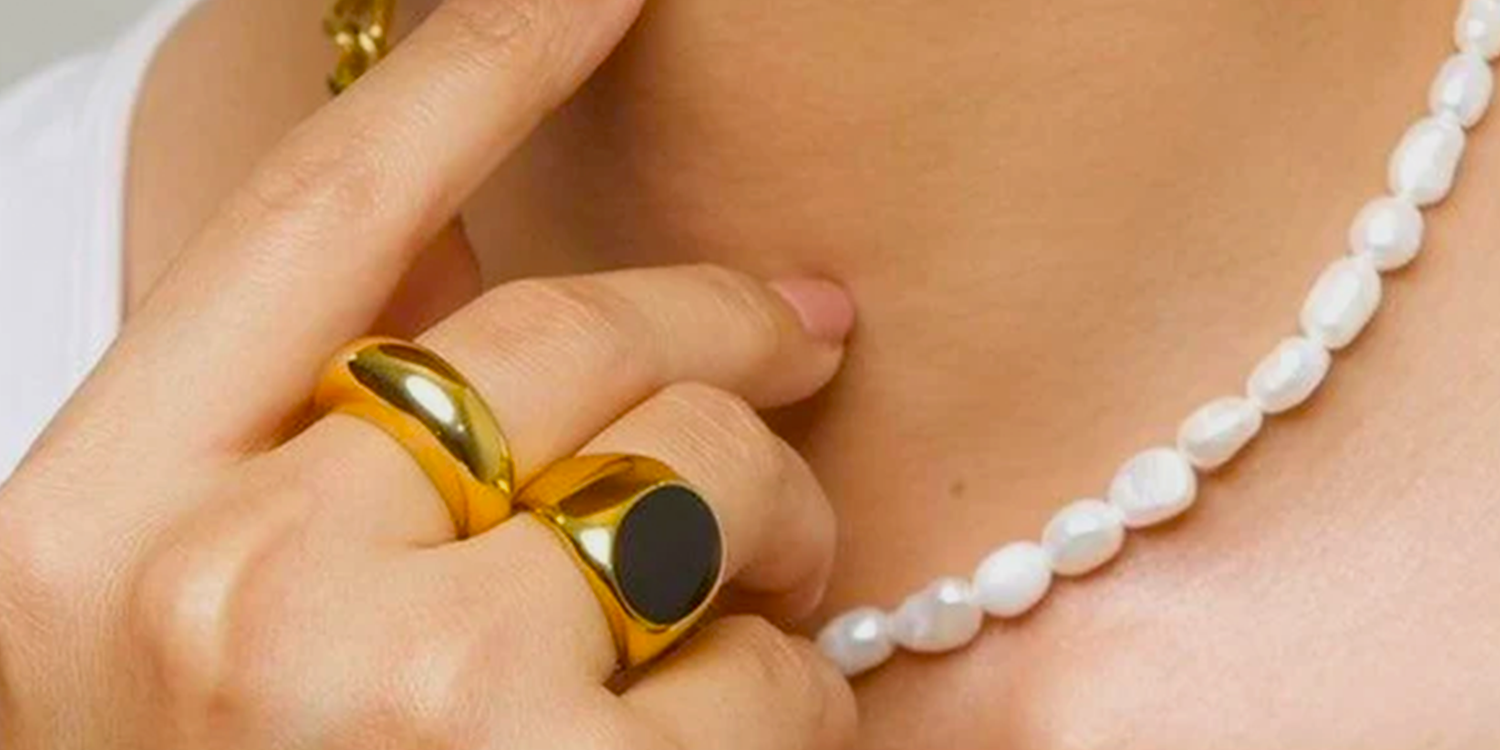
Why cleaning gold plated jewelry requires a different approach than solid gold
Gold plated jewelry — including 18K PVD over stainless steel — has a surface coating that responds differently to cleaning than solid gold does. Solid gold can tolerate mild abrasives, ultrasonic cleaners, and chemical cleaning solutions because the metal is consistent throughout. Gold plated pieces have a surface layer bonded over a base metal, and that layer responds to the wrong cleaning methods by accelerating the wear it was meant to resist.
The cleaning objective for gold plated jewelry is not to strip and resurface — it is to remove surface accumulation without disturbing the coating. Sweat residue, skin oils, sunscreen compounds, and dust all accumulate on the surface during wear. Left overnight and repeated across weeks, they accelerate surface dullness and micro-abrasion. Removed consistently with the correct method, they do not affect the coating at all.
The correct cleaning method — step by step
This method works for all 18K PVD over stainless steel pieces including rings, bracelets, necklaces, and earrings. It requires nothing that is not already in the house.
- Step 1 — dry wipe first: Before any moisture contact, wipe the piece with a soft microfibre cloth. This removes loose dust and surface particles that would otherwise act as abrasives during wet cleaning. A cotton cloth or tissue works but leaves lint — microfibre is cleaner.
- Step 2 — mild soap and lukewarm water: Mix one drop of mild liquid soap — dishwashing liquid or hand soap, not antibacterial or exfoliating formulas — into a small bowl of lukewarm water. Not hot. Hot water accelerates coating wear on any plated surface.
- Step 3 — soft brush application: Dip a soft-bristle brush — a clean baby toothbrush or a dedicated jewelry brush — into the solution and gently clean the piece. For rings and bracelets, pay attention to the inner band where sweat and skin oil accumulate most. For necklaces, work along the chain links where product residue collects. For stone settings, brush around the setting base rather than directly on the stone face.
- Step 4 — rinse briefly: Hold the piece under cool running water for five to ten seconds. Do not soak. Do not leave the piece submerged — prolonged water contact is not what removes dirt, and it shortens the lifespan of any coating unnecessarily.
- Step 5 — pat dry immediately: Pat dry with a clean microfibre cloth. Do not rub. Do not leave to air dry — water spots form as minerals in tap water evaporate, and in Karachi and Lahore's hard water conditions, these deposits are more visible than in soft water areas. Dry completely before storing.
What to avoid — Pakistani household products that damage gold plating
| Product | Why it damages gold plating | Verdict |
|---|---|---|
| Toothpaste | Contains micro-abrasives designed to remove enamel staining — strips gold plating surface under the same mechanism | Never use |
| Baking soda | Abrasive powder — removes surface coating rather than surface dirt | Never use |
| Vinegar or lemon juice | Acidic — reacts with gold plating and accelerates coating breakdown on any base metal | Never use |
| Bleach or household cleaners | Chlorine compounds are chemically aggressive to all metal surfaces including stainless steel's passive oxide layer | Never use |
| Antibacterial soap | Contains triclosan and other chemical compounds that react with metal surfaces under repeated contact | Avoid — use plain mild soap only |
| Polishing cloth (jeweler's rouge) | Designed for solid metal — abrasive compound removes PVD coating layer rather than polishing it | Never use on PVD pieces |
| Ultrasonic cleaner | Vibration loosens stone settings and can separate PVD coating from the base metal at adhesion points | Never use on plated pieces |
| Hand sanitiser | High alcohol content — alcohol compounds accelerate surface breakdown on any plated finish | Remove jewelry before applying, always |
Cleaning by jewelry type — what is different for each
Rings: The inner band accumulates the most product — soap, hand cream, sanitiser, and sweat all collect in the gap between the ring and the finger. Clean the inner band specifically with the soft brush on every cleaning cycle. Rings with stone settings need particular care around the prong base — dirt trapped under a prong setting causes the stone to appear cloudy from underneath rather than the surface being dirty.
Bracelets and bangles: Clasp mechanisms collect residue faster than the chain itself. Open the clasp fully during cleaning and work the brush into the clasp joint. Chain bracelets collect product between the links — run the brush along the chain lengthwise rather than scrubbing across it.
Necklaces: Fine chains tangle when wet — keep the chain extended across a flat surface during cleaning rather than bunching it. Pendant settings accumulate residue at the bail where the pendant meets the chain — clean this junction specifically.
Earrings: Post earrings accumulate skin cells and product at the post and butterfly back. Remove the butterfly back and clean both separately. Dangle earrings with chain drops should have the chain drops cleaned individually — residue in chain links on earrings is the most commonly missed area in at-home cleaning.
Hand chains: The finger ring portion of hand chains accumulates sweat most intensely — clean this section first. The connecting chain across the hand collects sunscreen and product residue from the back of the hand. Work the brush gently along the connecting chain rather than pulling it taut during cleaning.
How often to clean in Pakistani conditions
Pakistan's heat and humidity mean sweat accumulation on jewelry happens faster and more consistently than in temperate climates. The correct cleaning frequency for Pakistani daily wear conditions is not a fixed schedule — it is response-based.
- After any outdoor function in summer — shaadi, Eid, outdoor dinner — clean the same evening before storing. Sunscreen and sweat combined with overnight storage is the fastest way to accelerate surface dullness on any plated piece.
- Weekly for daily wear pieces — rings, bracelets, and stud earrings worn every day benefit from a weekly light clean even when they look clean. Surface accumulation that is not yet visible is still present and still reacting with the coating.
- Before storing for more than two weeks — any piece going into storage should be cleaned before storing. Sweat and product residue left on a surface in an enclosed pouch in Pakistani humidity creates the conditions for accelerated tarnishing even on stainless steel base pieces.
For the full storage protocol and what happens to jewelry in Pakistani storage conditions specifically, the jewelry tarnish in storage guide covers the humidity chemistry and the correct prevention method in detail.
Frequently asked questions
Q1. Can I use toothpaste to clean gold plated jewelry at home in Pakistan?
A: No — toothpaste contains micro-abrasives designed to remove enamel staining from teeth. These same abrasives strip the gold plating surface from jewelry under the same mechanism. It is one of the most common at-home cleaning mistakes for gold plated pieces and one of the fastest ways to dull a PVD finish permanently. Use mild liquid soap and a soft brush instead — it removes surface accumulation without touching the coating.
Q2. Can I clean gold plated jewelry with vinegar or lemon juice?
A: No. Both are acidic — vinegar contains acetic acid, lemon juice contains citric acid. Acids react with gold plating and accelerate coating breakdown regardless of the base metal underneath. These are folk cleaning remedies for solid metal that cause direct damage to plated pieces. Mild soap and lukewarm water is the correct and only necessary cleaning solution for 18K PVD pieces.
Q3. How do I clean a gold plated ring that has gone dull in Pakistan?
A: First determine whether the dullness is surface accumulation or coating wear. Surface accumulation — product residue, sweat, skin oil — responds to the mild soap and soft brush method described above. If the piece cleans up and returns to its original finish, it was surface dirt. If the dullness remains after cleaning, it is coating wear — the gold layer has thinned at that point and cleaning will not restore it. On 18K PVD over stainless steel, coating wear takes significantly longer to appear than on standard electroplated brass pieces.
Q4. Is it safe to use a toothbrush to clean jewelry at home?
A: A soft-bristle baby toothbrush is one of the best at-home cleaning tools for gold plated jewelry — the bristle size reaches into chain links, stone settings, and clasp joints that a cloth cannot. The critical word is soft. An adult toothbrush with medium or hard bristles has enough abrasive force to scratch PVD coating over repeated use. Use a baby toothbrush or a dedicated soft jewelry brush only.
Q5. How do I clean gold plated jewelry with stones at home?
A: Clean around the stone setting rather than on the stone face. Dip the soft brush in mild soapy water and work it around the prong base and the setting perimeter — this is where product accumulates and causes the stone to appear cloudy. Avoid soaking stone-set pieces — prolonged water contact can loosen adhesive in some setting types. Rinse briefly, pat dry immediately, and store separately. For cubic zirconia specifically — which is what Mithra's stone pieces use — the stone itself is chemically stable and does not require special treatment beyond keeping the setting clean. The complete jewelry care guide covers gemstone and CZ care in full.

Leave a comment
This site is protected by hCaptcha and the hCaptcha Privacy Policy and Terms of Service apply.