


There is a version of layered jewelry that looks intentional and considered — like someone made a quiet series of decisions that happened to work together. And there is a version that looks like everything went on at once and nothing was removed. The difference between the two is not the number of pieces. It is one or two principles applied consistently, and most people have never been told what they are.
Why Layering Goes Wrong — The Actual Reason
Most layering mistakes come from the same place: treating each piece as an independent decision. You put on a necklace because you like the necklace. Then earrings because you like the earrings. Then a ring because it seemed right. Then a bracelet because the occasion felt like it needed one. Each individual choice was reasonable. The combination was not.
Layering works when pieces are chosen in relation to each other, not independent of each other. This does not mean they need to match — matching is not the goal and in most cases works against the look. It means each piece needs to understand its role in the arrangement: which piece is the focal point, which pieces are supporting, and which pieces are competing when they should not be.
Once you understand that every layered look has a hierarchy — a piece doing the most work, pieces doing supporting work, and negative space doing structural work — most of the common mistakes become obvious before they happen.
The difference between layered and cluttered is almost always one piece too many — and usually you know which piece it is before you leave the house.
The Necklace Layer — Where Most People Start and Where Most Mistakes Happen
Layering necklaces is the most referenced jewelry trend in Pakistan right now and also the one with the most visible failures, because the rules for making it work are specific and rarely explained.
The single principle that determines whether a necklace layer works or does not: length separation is not optional. Two chains at the same length do not layer — they sit at the same point on the chest and compete for exactly the same visual space. The minimum length difference for a layered look to read as layered rather than doubled is three inches. Four to five is more reliable.
-
Two chainsOne at 16 to 18 inches, one at 20 to 22 inches. The shorter sits at or just below the collarbone; the longer sits at mid-chest. This is the most wearable combination for everyday use and works against almost every neckline. Plain chain plus pendant chain is the most reliable two-piece combination — plain chain and pendant chain together let the pendant carry the detail while the plain chain provides the base.
-
Three chainsAdds a third at 24 to 26 inches. This length reaches below the chest and works specifically with open or wide necklines — off-shoulder, deep V, wide scoop. With a high neckline, a 26-inch chain disappears under fabric and the third layer is wasted. Three chains require all three lengths to be meaningfully different or the arrangement reads as crowded rather than layered.
-
What does not workTwo statement necklaces layered together. Two pendants at similar lengths. A heavy chain layered with a delicate one at the same length. Any combination where both pieces are trying to be the focal point simultaneously. One piece layers; the other one anchors. The roles cannot both be focal.
Earrings in a Layered Look — The Decision Most People Get Backwards
The most common layering mistake with earrings is treating them as an addition to a layered necklace look rather than as something that needs to be calibrated against it.
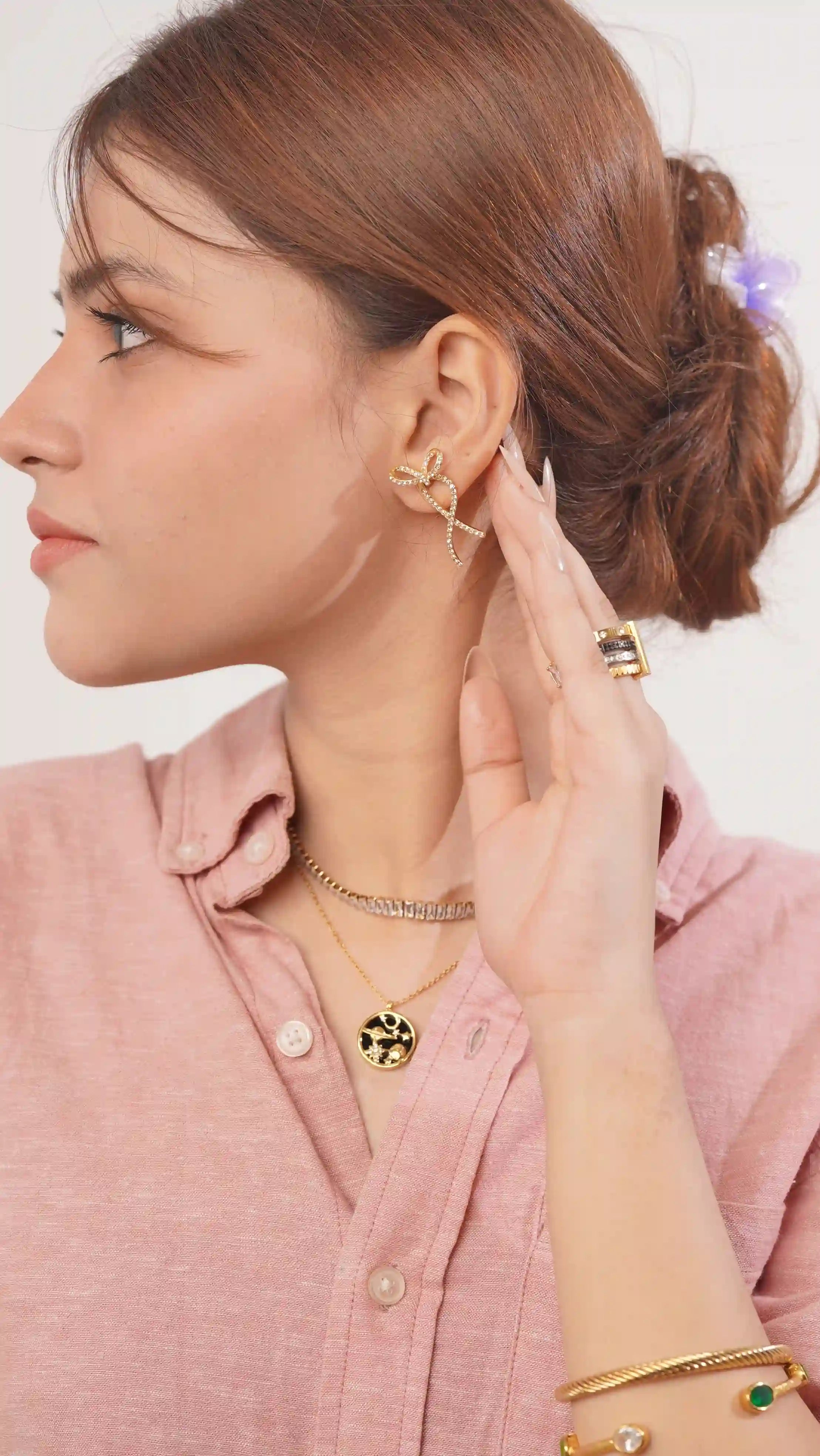
The principle is straightforward: the more is happening at the neck, the less should be happening at the ear. A layered three-chain necklace arrangement needs small, quiet earrings — a stud, a small hoop, a minimal drop. Statement earrings worn with a layered necklace fight each other for attention at the same vertical zone of the face and neck, and neither wins.
The reverse also holds: if the earring is the statement, the neck should be quiet. One bold earring or a dramatic drop pair works best against either a plain chain or no necklace at all. The earring needs negative space around it to read as intentional.
Small studs and minimal hoops are the earring category that solves this problem permanently — they work alongside any necklace arrangement without competing, which is why they are the most-worn earrings in any collection where necklace layering is a regular habit.
Rings and Bracelets Together — The Wrist-to-Hand Connection
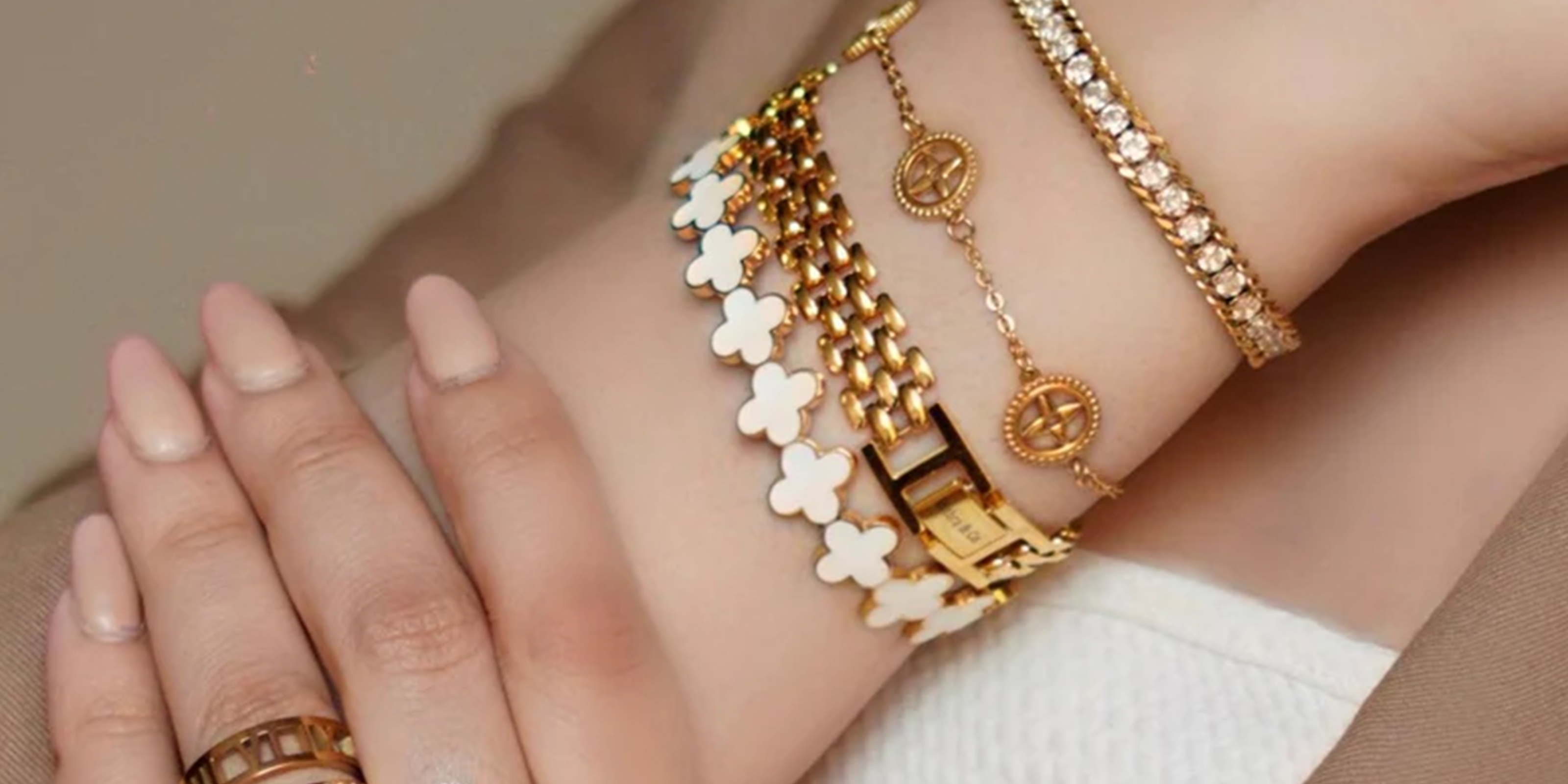
The hand and wrist function as a single visual unit when jewelry is layered across both. What happens on the wrist affects what the ring stack reads as, and vice versa — and most people treat them as independent decisions.
The working principle: weight should be balanced across the unit, not concentrated at one point. A heavy statement bracelet on the wrist reads better against a minimal ring or two slim bands on the fingers. A full ring stack reads better against a slim chain bracelet or no bracelet at all on the same hand. When both the wrist and the fingers are heavily loaded, the hand reads as too busy regardless of how good each individual piece is.
-
Heavy wrist, light handA statement cuff or a stacked bracelet arrangement on the wrist pairs with one or two slim rings on the fingers. The wrist carries the visual weight; the fingers provide a quiet complement. This is the combination that reads as considered without looking like the jewelry department.
-
Light wrist, stacked handA ring stack across two or three fingers paired with a single slim chain bracelet or nothing at the wrist. The hand carries the detail; the wrist stays quiet. This is the combination most visible in Pakistani celebrity off-duty content right now.
-
Matched weight, both sidesMedium weight on both — two slim bracelets at the wrist and two slim rings on the fingers. Neither the wrist nor the hand dominates; the overall look reads as quietly considered. This is the hardest combination to calibrate because it requires both sides to stay genuinely medium rather than one drifting toward heavy.
-
What breaks the balanceA statement cuff and a full ring stack on the same hand. Multiple bangles and a heavy ring. Two competing focal points at the wrist and at the fingers simultaneously. The hand cannot hold two centres of attention — one always undermines the other.
The Metal Tone Question — Does Everything Need to Match?
No. But consistency within a zone matters more than consistency across the whole look.
Mixing gold and silver across the neck and hand simultaneously — gold necklace, silver ring, gold bracelet, silver earrings — creates a visual inconsistency that reads as accidental rather than styled. The eye cannot find a pattern and stops trying. The result is that individual pieces, however good they are, stop reading as intentional.
The approach that works: pick a dominant tone and let the other appear as a deliberate accent, not an equal. Three gold pieces and one silver ring reads as intentional mixed metals. Two gold and two silver at equal distribution reads as undecided.
The simplest version — and the one that requires no additional thought once the decision is made — is single-tone consistency throughout. All gold or all silver across necklaces, earrings, rings, and bracelets. Within that consistency, the layering can be as complex or as minimal as the occasion requires. The metal tone becomes the invisible structure that holds everything together.
Layering for Specific Occasions — Because the Rules Scale
The same principles apply differently depending on the context. Calibrating the volume of a layered look to the occasion is the final element that separates jewelry that reads as appropriate from jewelry that reads as either trying too hard or not trying enough.
Two pieces maximum at each zone — two chains or one chain and one pendant, small earrings, one or two rings. Everyday essentials layered simply give the layered look without any piece demanding attention in a professional context.
This is where the ring stack, the three-chain combination, and the bracelet-plus-rings arrangement all become appropriate. The context is relaxed enough to carry more volume and the footwear and necklines typical of casual dressing give each piece proper visibility.
Counter-intuitively, formal occasions call for less layering, not more. One statement piece — a single bold earring, one sculptural ring, one chain with presence — worn with intention and nothing competing reads as more dressed for an occasion than a full layered arrangement.
The one context where maximum layering is both appropriate and expected. Multiple necklaces, stacked rings, layered bracelets, statement earrings — the traditional occasion context in Pakistan has always accommodated full jewelry volume. The only rule that still applies: keep metal tones consistent and let one piece be clearly the centrepiece of the arrangement.
The One Edit That Fixes Most Layering Problems
Before leaving the house in a layered look, remove one piece. Not the best piece — the piece that is doing the least specific work. The one that is there because you added it rather than because the look needed it.
This edit works because layering almost always overshoots before it lands correctly. The natural instinct when building a layered look is to add until it feels complete, and "complete" tends to be one piece past the point where the arrangement was actually working best. Removing one piece after the look is assembled — specifically the piece whose absence you are least certain would be noticed — almost always improves the result.
The pieces that survive this edit consistently are the ones worth building a collection around. The ones that keep getting removed are the ones filling space rather than doing work.
If you have been through the drawer problem and recognised that most of what you own sits unworn — layering is often the solution. Pieces that did not work individually become part of an arrangement that works as a whole. The slim chain that was too plain on its own becomes the base layer under the pendant that needed context. The ring that felt like not enough alone becomes part of a stack that feels like exactly enough.
Questions About Layering Jewelry in Pakistan
Q1. How do I layer necklaces without them tangling in Pakistan's daily wear?
A: Length separation is the primary fix — chains at the same length tangle because they occupy the same point on the chest and move together. A minimum three-inch difference between each chain length keeps them in separate visual zones and reduces contact friction. Thinner chains with different textures — a snake chain layered with a paperclip chain — also move more independently than two chains of the same style.
Q2. How many rings can I stack without it looking overdone?
A: Three rings across one or two fingers is the most wearable number for daily wear — enough to read as intentional, not enough to restrict movement or attract commentary in a professional setting. Five or more rings reads as a deliberate style statement rather than everyday layering. The odd number rule helps: three and five read as curated, two and four read as accidental or incomplete.
Q3. Can I mix gold and silver jewelry when layering in Pakistan?
A: Yes, but with a dominant tone rather than equal distribution. Three gold pieces and one silver accent reads as intentional mixed metals. Equal gold and silver across the same look reads as undecided. The easiest version is all gold on one hand, all silver on the other — each zone stays coherent while the overall look reads as intentionally mixed.
Q4. What jewelry should I wear for layering at a Pakistani office?
A: Maximum two pieces per zone — one or two chains at different lengths, small stud or hoop earrings, one or two slim rings. The layered look should be visible but not audible. Nothing that catches on fabric, nothing that moves loudly, nothing that draws attention in a meeting. Gold plated stainless steel pieces on quiet chain styles achieve the layered look within professional limits.
Q5. What material is best for layered jewelry worn daily in Pakistan?
A: Stainless steel with 18K PVD coating holds up best for layered daily wear — because layered pieces experience more friction and contact than single pieces. Rings in a stack touch each other constantly. Necklaces move against each other. The full detail on how PVD coating holds up under daily friction explains why base metal matters more for layered pieces than for anything worn alone.
Building the Pieces That Layer Well
The most important quality in a piece chosen for layering is that it holds up under the daily wear that layering involves — because layered pieces experience more friction and contact than single pieces do. Rings in a stack touch each other constantly. Necklaces move against each other. Bracelets layer against wrist skin through full days of activity.
Stainless steel with PVD plating is the construction that handles this without the surface wear that makes most affordable layered jewelry look tired within weeks. The piece that looks the same in month three as in week one is the piece that stays in the layered rotation rather than being quietly retired after a season. Browse the full collection at Mithra — COD nationwide, material specifications on every product page. Find the pieces that will actually hold their place in the arrangement you are building.

Leave a comment
This site is protected by hCaptcha and the hCaptcha Privacy Policy and Terms of Service apply.