

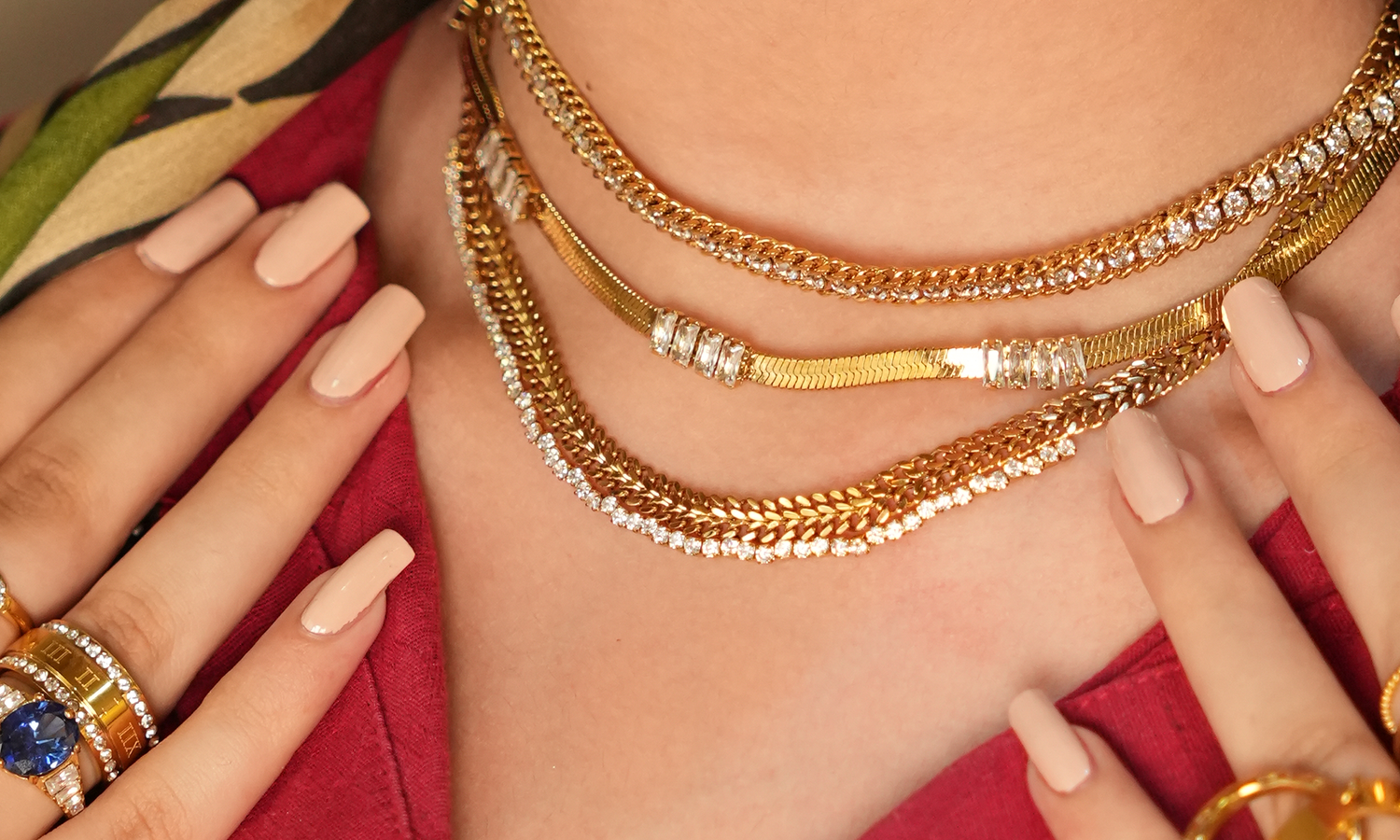
Yes — but only for two of the three things "18K gold jewelry" can actually mean. 18K refers to gold purity, 75 percent pure gold. It says nothing about what that gold is sitting on, and in Pakistan that distinction is what decides whether a piece survives daily wear or fails within weeks. For how any base metal reacts to sweat, perfume, sanitiser, and water — the mechanism behind every failure described below — see what actually damages gold plated jewelry in Pakistan.
The three types of 18K gold jewelry available in Pakistan
75% pure gold throughout the entire piece. Does not fade, tarnish, or cause skin reactions. The correct choice for lifetime investment pieces — engagement rings, heirloom jewelry, anything bought once and kept forever. Price point is significantly higher than any plated alternative.
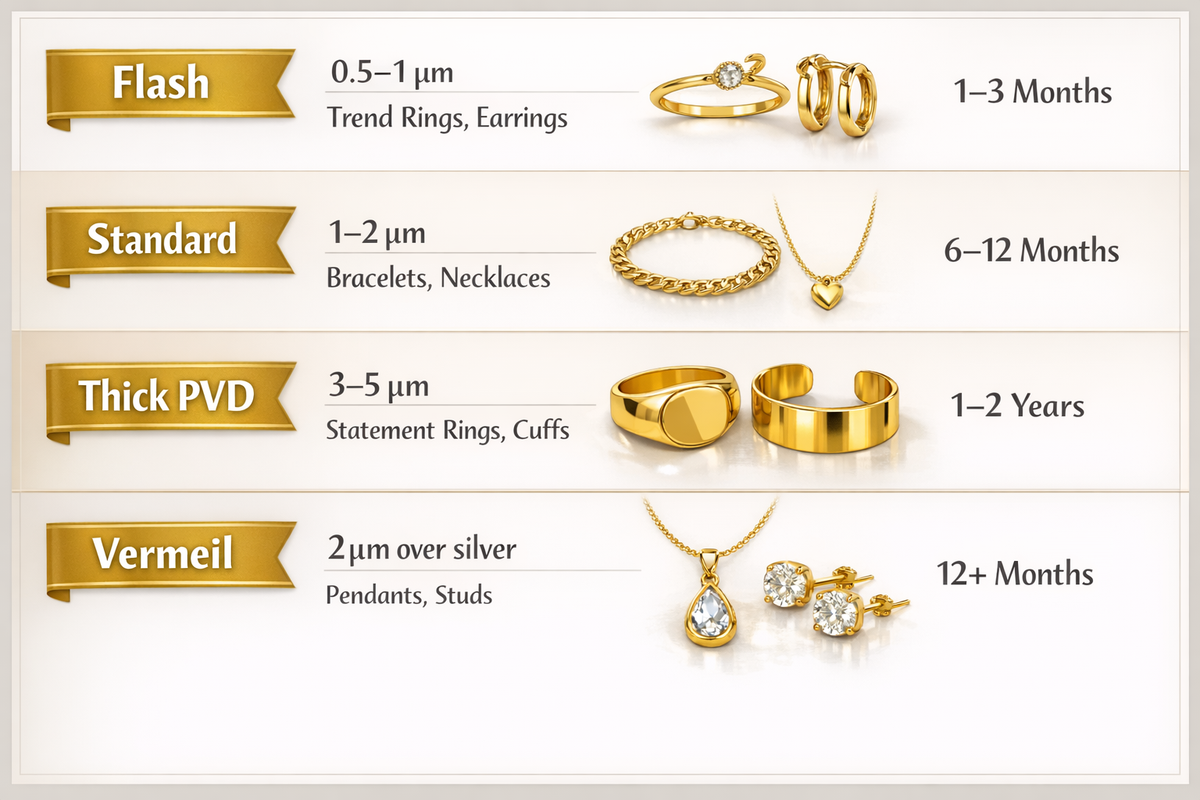
An 18K gold coating over a reactive base metal, applied by standard electroplating at 0.5 to 2 microns thick. The gold layer is real but thin, sitting on top of a base metal that oxidises under Pakistan's heat and humidity — producing the green marks and dark lines associated with cheap fashion jewelry. Suitable for occasional wear only.
An 18K coating applied over stainless steel via physical vapour deposition, bonding at a molecular level rather than sitting on top. The stainless steel base does not react with sweat or skin, and the PVD layer at 3 to 5 microns is three to five times thicker than standard electroplating. For daily wear — office, university, errands, shaadi season — this is the combination that holds up without skin reactions or visible fading. The mechanism behind why PVD specifically outperforms standard plating is covered in full in gold plating types compared for Pakistan.
The value calculation for daily use
-
Standard plated brassLower upfront cost, but replaces every 4 to 8 weeks under daily Pakistani wear. The annual cost of repeated replacement adds up quickly, and the skin reactions and green marks are an ongoing quality-of-life cost that price does not offset.
-
18K PVD stainless steelModerate upfront cost, lasts one to three-plus years under daily wear with basic care (realistic figures by piece type are in the PVD durability guide). No skin reactions, no green marks, no replacement cycle. Cost per wear over twelve months is a fraction of the standard plated alternative.
-
Solid 18K goldHigh upfront cost, permanent. Worth it for investment and heirloom pieces. For the chain you wear every day or the ring you never take off, solid gold is not necessary when PVD stainless steel delivers comparable daily performance at a fraction of the price.
Which type is worth buying for which use case
-
1Daily wear — office, university, errands. 18K PVD over stainless steel. Handles daily conditions without replacement cycles, skin reactions, or maintenance beyond a microfibre wipe after wearing.
-
2Event and occasion wear — shaadi season, Eid, functions. 18K PVD over stainless steel, for the same reasons plus its ability to handle the compounding stress of a full shaadi evening — sunscreen, sweat, fabric friction, six-plus hours — without the surface failure standard electroplated brass produces reliably under those exact conditions.
-
3Investment and heirloom pieces. Solid 18K gold. No coating to wear, no replacement cycle, permanent colour. For pieces bought once and kept for years — engagement rings, sentimental gifts, pieces meant to be passed on — solid gold justifies the premium that PVD stainless steel does not require for daily wear.
-
4Occasional and fashion wear. Standard 18K electroplated brass is acceptable here — for pieces worn a few times a month rather than daily, the coating lasts long enough that the lower price makes sense. The mistake is using occasional-wear pieces for daily use and expecting daily-wear performance from them.
Care basics that apply regardless of which type you choose
-
Products before jewelryPerfume, sunscreen, moisturiser, hairspray fully absorbed before any piece goes on.
-
Microfibre wipe after wearingTo remove sweat residue before it sits overnight.
-
Separate pouch storageRather than loose in a drawer or dish.
The complete care guide covering storage by jewelry type and the full cleaning method is at the M&Co jewelry care guide.
Frequently asked questions
Q1. Is 18K gold jewelry good for daily use in Pakistan?
A: Yes — specifically 18K PVD gold plated stainless steel for daily wear, and solid 18K gold for investment and heirloom pieces. Standard 18K electroplated brass is not recommended for daily use in Pakistan's climate. The karat number alone does not determine daily wear suitability — the base metal and coating method do.
Q2. What is the actual difference between 18K solid gold and 18K gold plated jewelry?
A: Solid 18K gold is 75% pure gold throughout the entire piece — permanent colour, no coating to wear. 18K gold plated jewelry has an 18K gold surface coating over a base metal, and the quality depends entirely on what that base metal is and how the coating was applied. PVD over stainless steel is the highest-performing plated option for daily Pakistani wear; standard electroplating over brass is the lowest.
Q3. Is it worth paying more for 18K PVD instead of standard 18K electroplated?
A: Yes, for anything worn regularly. The annual replacement cost of standard electroplated brass — replaced every 4 to 8 weeks under daily Pakistani wear — exceeds the higher upfront cost of PVD stainless steel within the first year, before even accounting for the skin reactions and visible degradation standard plating causes.
Q4. When is solid 18K gold actually worth buying over PVD stainless steel?
A: For pieces with genuine investment or sentimental permanence — engagement rings, heirloom jewelry, gifts meant to be kept for decades. For everyday rotation pieces — the chain worn daily, the stud earrings worn constantly — PVD stainless steel delivers equivalent daily-wear performance without the premium solid gold commands.
Q5. Where can I buy 18K gold plated jewelry in Pakistan with COD?
A: Mithra & Co makes every piece with 18K PVD coating on a stainless steel base and ships across Pakistan with cash on delivery — every listing specifies the base metal and coating method. Browse the full collection at mithraofficial.com.

Leave a comment
This site is protected by hCaptcha and the hCaptcha Privacy Policy and Terms of Service apply.